

Blog
How AI Is rewriting the rules of discovery in pet health

Half of consumers now intentionally seek out AI-powered search engines when researching what to buy, ahead of traditional search. For the pet industry, that’s not a distant shift – it’s already reshaping how brands get found, and the pace of change is only accelerating.
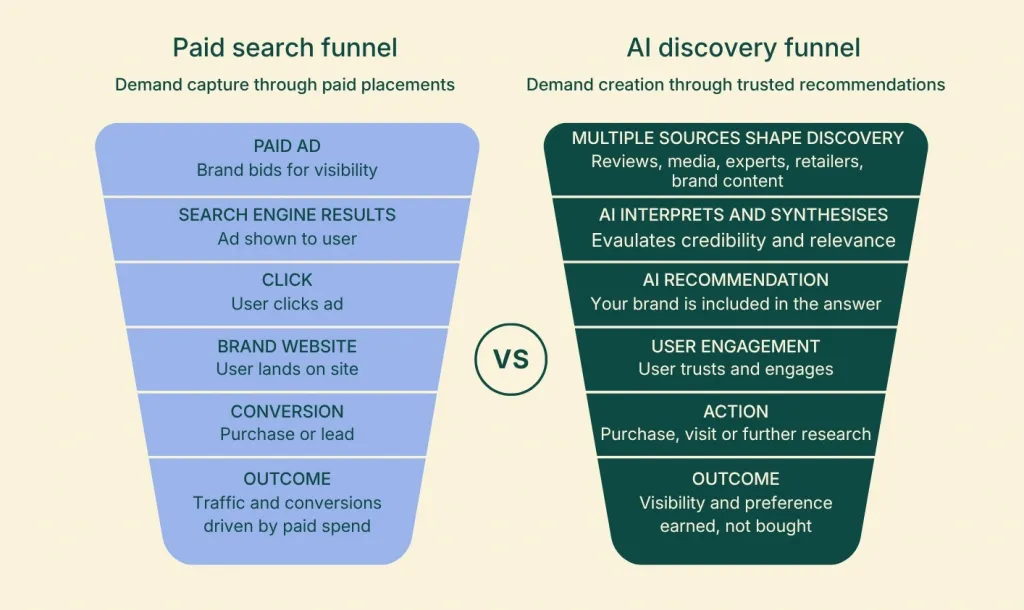
Since the advent of digital marketing communications, discovery has mostly run through search and paid media. You bid for visibility, someone clicks, they land on your site, and hopefully they convert. That funnel is now sitting alongside a very different one – and by some measures, it’s among the fastest technology adoption curves we’ve seen. Six in ten Australians already use AI tools regularly, and that number is increasing rapidly.
When someone asks an AI tool to recommend a joint supplement, a puppy food, or a flea treatment, the AI isn’t weighing up who spent the most on ads. It’s synthesising from reviews, expert content, ingredient disclosures, and third-party coverage – the things people have actually said about a brand, not what the brand has said about itself. Research suggests that in many cases, up to 90 per cent of what AI cites when making a recommendation comes from this kind of earned and owned media, while a brand’s own website can account for as little as 5-10 per cent of what actually gets referenced – though the exact mix shifts depending on the category and how established a brand already is.
That’s a real inversion of how visibility has worked for the past decade. A brand with modest ad spend but a strong body of published expertise, credible reviews, and genuine third-party mentions may now be more visible in AI-generated answers than a brand outspending it on paid media but with a thin footprint everywhere else.
It’s also worth watching where this is heading. Agentic AI – tools that don’t just recommend but actively research, compare, and complete a purchase on someone’s behalf – is estimated to influence around 30 per cent of digital commerce transactions globally by 2030. Locally, 44 per cent of Australian businesses already describe themselves as advocates of agentic commerce, and 85 per cent say they’re taking steps to prepare – even as 61 per cent of Australian consumers remain sceptical of the shift. That gap between business preparation and consumer trust is worth sitting with: it suggests the winners won’t just be the businesses that adopt fastest, but the ones that earn confidence in the process.
None of this means paid media stops mattering. But it does mean the businesses that treat their earned presence – reviews, expert content, ingredient transparency, third-party credibility – as core marketing infrastructure rather than a nice-to-have are going to be the ones AI actually finds. For an industry built on trust and evidence, that’s arguably a shift in our favour, provided we take it seriously now rather than after it’s already reshaped where the customers are.
This article was written by Melissa Smith, Director of Strategy & Growth at PBC Partners, Australia’s strategic marketing consultancy for the animal health and wellbeing industry.
The article draws on findings from PBC Partners’ Animal Health & Wellbeing Market Report 2026, available at pbc.partners.
To stay up-to-date on the latest industry headlines, sign up to the Pet Industry News e-newsletter.