

Blog
A Guide to dog grooming shears professional: Essentials for Pros


Ever tried to give a dog a quick trim with a pair of kitchen scissors? If you have, you already know it’s a recipe for a choppy, uneven coat and a very unhappy pup. That’s where professional dog grooming shears come in—they’re not just scissors, they’re specialized instruments designed for the unique art of grooming.
These tools are built to glide through thick, wiry, or matted fur without pulling or snagging. This protects the dog’s delicate skin and gives groomers the control they need to sculpt a perfect, show-ready finish.
Why Professional Shears Are a Groomer’s Best Friend
So, what’s the real difference between a decent haircut and a truly fantastic one? More often than not, it’s the quality of the shears in the groomer’s hand. Investing in the same dog grooming shears professional groomers rely on isn’t just an upgrade; it’s a must-have for anyone serious about the craft.
Trying to groom a dog with standard household scissors is a bit like trying to carve a sculpture with a butter knife. You might make a dent, but the result will be frustrating, clumsy, and potentially unsafe. Professional shears are engineered from the ground up to handle the specific textures and challenges of animal fur.
This isn’t just an observation from the grooming table; it’s a global trend. The pet grooming products market is booming, expected to grow from around USD 14.7 billion to nearly USD 21.1 billion by 2030. This surge is fueled by pet owners who want the absolute best for their furry family members.
To really see the difference, let’s compare them side-by-side.
Professional Shears vs Household Scissors at a Glance
| Feature | Professional Shears | Household Scissors |
|---|---|---|
| Blade Material | High-carbon steel (e.g., Japanese 440C) for a razor-sharp, durable edge. | Basic stainless steel that dulls quickly and can rust. |
| Blade Design | Convex or beveled edges designed specifically for cutting hair cleanly. | Flat, thick blades designed for paper or craft materials. |
| Ergonomics | Offset or crane handles to reduce hand and wrist strain for all-day use. | Simple, symmetrical handles that cause fatigue and cramping. |
| Tension System | Adjustable screw to fine-tune blade tension for different coat types. | A fixed rivet that cannot be adjusted, leading to poor performance. |
| Safety Features | Rounded or blunted tips on certain models to protect sensitive areas. | Sharp, pointed tips that pose a high risk of injury to the dog. |
| Intended Use | Cutting and sculpting animal fur of all textures and densities. | General-purpose cutting of paper, tape, and string. |
As you can see, every element of a professional shear is designed with the groomer and the dog in mind, making them the only real choice for quality grooming.
The Core Benefits of Pro-Grade Shears
So what does all that specialized design actually mean for you? The value of a professional shear really boils down to three game-changing benefits that affect your work, your health, and the dog’s experience.
- Unmatched Precision: The blades are incredibly sharp and perfectly balanced. This lets you create clean, crisp lines and smooth blends that are simply out of reach with regular scissors. Say goodbye to those frustrating choppy marks.
- Enhanced Safety: A dull blade from a cheap pair of scissors will grab and pull hair, which is painful for the dog and can easily lead to skin irritation or injury. Professional shears slice through fur effortlessly, making the entire process safer and more comfortable.
- Improved Efficiency: When your tool does most of the work for you, grooming becomes faster and less strenuous. A sharp, well-made shear cuts perfectly the first time, reducing the number of passes you need to make and saving precious time on each groom.
The right pair of shears reduces groomer fatigue significantly. Their ergonomic design minimizes strain on your hands, wrists, and shoulders, which is crucial for preventing repetitive stress injuries over a long career.
For those looking to turn a passion into a profession, mastering these tools is a critical first step. A formal diploma in dog grooming can give you the hands-on training to use them like a pro. With this foundation set, we’re ready to dive deeper into the world of shears.
Breaking Down a Professional Grooming Shear
To really get why a pair of professional dog grooming shears is a game-changer, you have to look at what’s under the hood. It’s a lot like a high-performance engine; every single part is engineered to work together perfectly. Getting to know this anatomy is your first step to picking the right tool and really honing your skills.
Don’t think of your shears as just a simple tool. They’re a precision instrument. Every component, from the blade tips all the way down to the finger rest, has a job to do. When they’re all working in sync, you get that clean, sharp cut you’re after, all while saving your hand from unnecessary strain. You can feel the difference immediately when you pick up a well-made pair.
The Key Parts and What They Do
Let’s pull back the curtain and look at the essential components. Each one is designed to give you better control, more comfort, and maximum cutting performance.
- Blades: This is where the magic happens. A professional shear has razor-sharp, often convex, edges that slice through hair without bending or pushing it. The quality of the steel here is everything—it determines how sharp your blades get and how long they stay that way.
- Shanks (or Handles): These are the long arms that connect the blades to the finger rings. Their shape and length are what give the shear its balance and overall feel in your hand.
- Finger Rings: Pretty straightforward—this is where your thumb and finger go. But on pro-level shears, you’ll often find them offset or angled. This isn’t just for looks; it keeps your hand in a much more natural position, which is a lifesaver during a long day of grooming.
- Finger Rest (or Tang): That little metal bit sticking out? It’s a resting spot for your pinky. It might seem small, but it gives you a massive boost in stability and control, especially when you’re doing detailed scissoring. Most are removable, so you can set them up just how you like.
This diagram really connects the dots, showing how superior design directly leads to better precision, safety, and efficiency on the grooming table.
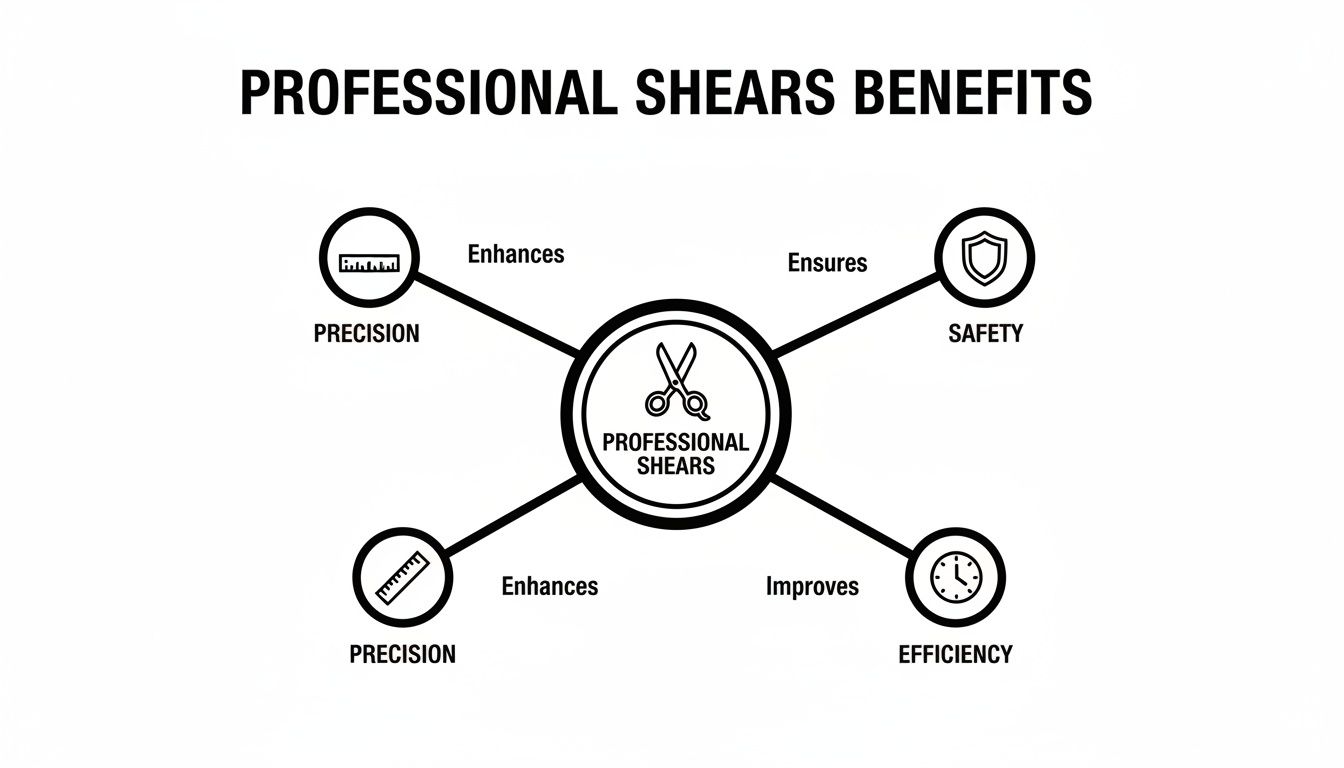
As you can see, every single element is there for a reason—to help you get a better result and, just as importantly, to protect your body so you can have a long, healthy career.
The Heart of the Shear: The Tension System
Now, let’s talk about the most important—and most overlooked—part of any professional shear: the tension system, also known as the pivot screw. This is what dictates how the two blades work together.
The tension setting is critical. If it’s too loose, the shears will just fold the hair instead of cutting it. Too tight, and you’ll prematurely wear down the blade edges and put a ton of strain on your hand.
Most professional shears have an adjustable screw for a reason. It lets you dial in the perfect tension for the coat you’re working on. A silky Yorkie coat needs a different touch than a thick, wiry Doodle coat. Having that level of control is one of the biggest things that separates pro tools from the rest.
Getting the feel for the right tension is a skill you’ll develop over time. A properly tuned shear should feel smooth as butter when you open and close it—no grinding, no catching, and no forcing it. That seamless action is what allows you to cut effortlessly all day long. Once you understand how all these pieces fit together, you’ll be able to choose, use, and maintain your shears like a true professional.
Choosing the Right Shears for the Job
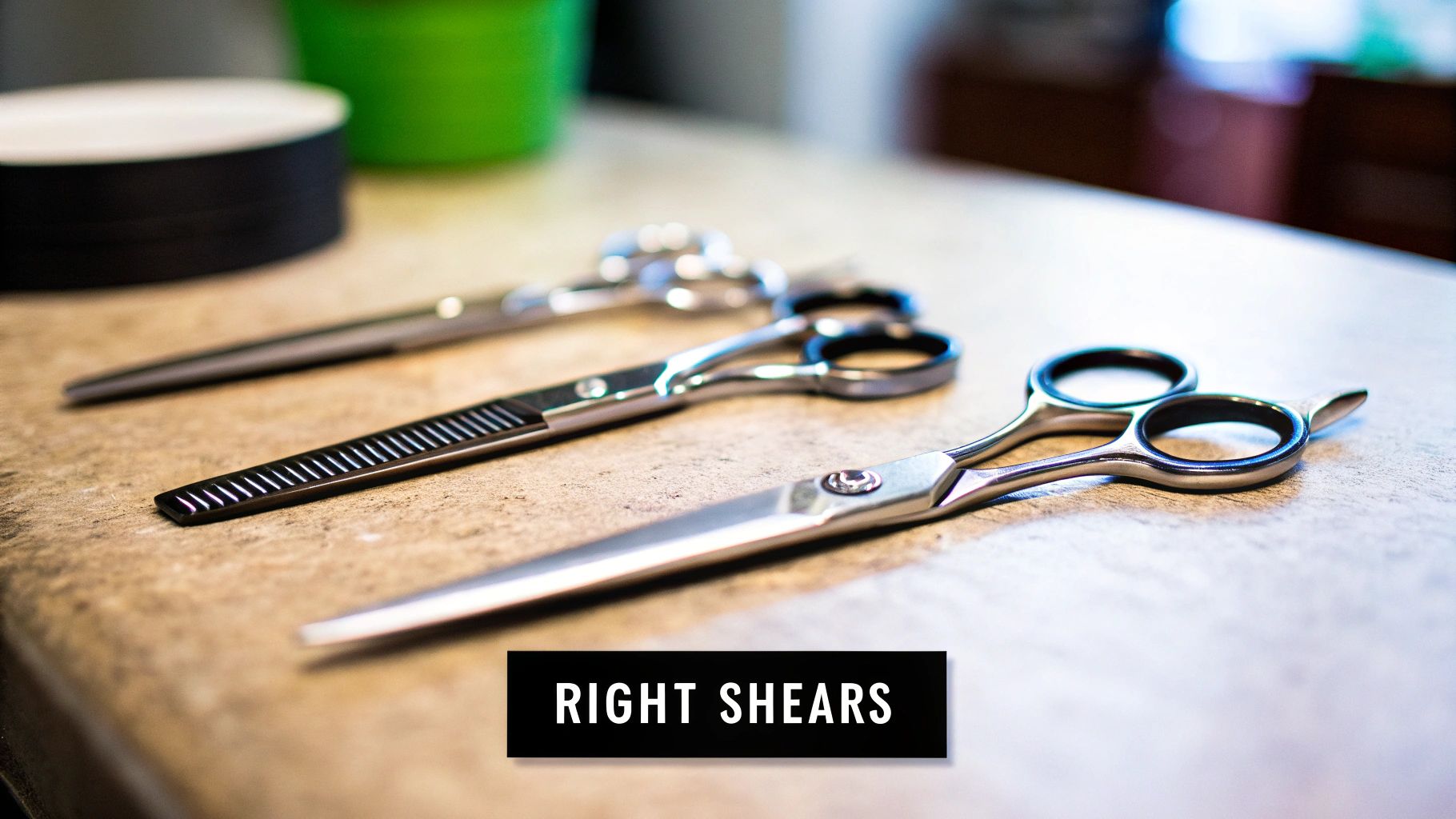
If you’ve ever seen a master chef at work, you know they have a specific knife for every single task. It’s the same in the grooming world. To get those beautiful, consistent results, you need a collection of shears. One pair just won’t cut it.
Each type of dog grooming shears professional groomers use is built for a specific purpose—different coats, different parts of the body, and different styling goals. Knowing which shear to grab and when is what truly separates a basic trim from a show-stopping groom. The wrong tool can mean choppy lines, an unnatural finish, or even an unsafe experience for the dog.
Let’s break down the three essential types that should be in every groomer’s toolkit.
Straight Shears: The Indispensable Workhorse
Think of straight shears as the foundation of your entire grooming arsenal. They are the most versatile and most-used tool in the box, designed for setting the primary lines and overall structure of a haircut.
These are your go-to shears for removing bulk hair quickly and defining those clean, crisp edges on flat-coated breeds. A groomer will use a long pair of straights to get those sharp lines on a Schnauzer’s back or to shape the legs and body of a Standard Poodle. They are all about cutting power and precision, doing the heavy lifting before you get to the fine-tuning.
Curved Shears: The Sculptor’s Tool
Once you’ve established the basic shape, it’s time to add the artistry. This is where curved shears shine. Their blades have a distinct arc, making them absolutely perfect for shaping rounded areas and creating soft, natural-looking contours.
Trying to create a smooth curve with a straight shear is a recipe for a choppy, angular mess. Curved shears, on the other hand, let you effortlessly follow the natural lines of the dog’s body.
They are essential for sculpting a Poodle’s topknot, rounding a Bichon Frise’s head, or perfecting the shape of a dog’s paws and chest. These are the tools that give your work that polished, professional look by eliminating harsh edges and creating a seamless, sculpted finish.
Thinning and Blending Shears: The Finishing Touch
Last but not least, we have the thinning and blending shears—the secret weapon for a flawless, natural-looking coat. One blade is solid, while the other has teeth, a design that removes just a small amount of hair with each snip.
This allows you to soften harsh scissor lines, blend different coat lengths together, and take out bulk without sacrificing length. It’s all about creating texture and a seamless transition between clipped and scissored areas. Imagine softening the skirt on a Cocker Spaniel or blending the harsh lines on a Golden Retriever’s freshly trimmed coat. Thinning shears make the final result look soft and lived-in, not like it was just cut.
To make it even clearer, here’s a quick guide to help you decide which tool you need for the job.
Which Grooming Shear Do You Need?
| Shear Type | Primary Use | Best For Breeds Like |
|---|---|---|
| Straight Shears | Setting lines, bulk removal, straight edges | Schnauzer, Standard Poodle, Westie |
| Curved Shears | Sculpting round areas, contouring | Bichon Frise, Poodle (topknots, tails), Pomeranian |
| Thinning Shears | Blending, softening lines, texturizing | Golden Retriever, Cocker Spaniel, Shih Tzu |
Building out your toolkit with these three core types of shears will prepare you for almost any grooming challenge that walks through your door. Whether you’re just starting or looking to upgrade, you can find the perfect tools in our collection of high-quality grooming and cleaning supplies.
What Really Makes a Great Pair of Shears?
Ever pick up a pair of professional grooming shears and just feel the difference? It’s not magic. That immediate sense of quality comes down to two things that separate the pro-level tools from the ones that just don’t cut it: the steel they’re made from and the way they fit in your hand.
One is all about performance—how well the shears cut and how long they last. The other is about you—your comfort, your health, and your career longevity. Getting both right is the secret to finding a tool that feels less like a piece of equipment and more like an extension of your own hand.
It All Starts with the Steel
Let’s be honest, the heart and soul of any shear is the blade. And a blade is only as good as the steel it’s forged from. If you’ve ever used a cheap pair of shears, you know the frustration. They go dull in a heartbeat, and soon enough they’re folding and pulling hair instead of making clean, crisp cuts.
This is exactly why the type of steel is so critical. For professional groomers, Japanese 440C stainless steel is the undisputed champion. It’s a high-carbon steel known for being incredibly hard, which means it can be sharpened to an unbelievably fine, convex edge that lasts.
Think of it this way: a harder steel holds its edge longer. A shear made from 440C steel will stay razor-sharp through groom after groom, shrugging off the wear and tear that would quickly dull a lesser blade.
But hardness isn’t the whole story. This premium steel is also great at resisting corrosion. Grooming salons are wet, humid places, and your tools are constantly being washed. High-quality stainless steel prevents rust from becoming a problem, protecting your investment and ensuring your shears perform beautifully for years to come.
Ergonomics: Your Hand’s Best Friend
While the steel does the cutting, the handle’s ergonomics determine how the shears feel in your hand. Grooming is tough on the body, involving thousands of repetitive cuts every single day. The wrong handle forces your hand into an unnatural position, leading to fatigue, wrist pain, and even serious issues like carpal tunnel syndrome that can cut a career short.
Finding the right handle is like getting a glove that’s custom-fit. It should work with your hand’s natural position, not against it.
It’s no wonder the demand for better tools is booming. The U.S. pet grooming market is set to grow from around USD 4.5 billion to nearly USD 7.8 billion by 2034. That growth is driven by over 300,000 professional groomers who depend on tools that are both durable and ergonomically sound. You can learn about the expanding pet grooming market on market.us to see the full picture.
Finding Your Perfect Fit: Common Handle Designs
The right handle is a personal choice, so let’s break down the most popular styles you’ll find on professional dog grooming shears.
- Offset Handles: Here, one handle is shorter than the other. This simple change allows your thumb to sit in a more natural, open position, which dramatically cuts down on hand fatigue. It’s a favorite for good reason.
- Crane Handles: Take the offset design and crank it up a notch. The top handle is angled down sharply, letting you drop your elbow and relax your shoulder. This reduces strain not just on your hand, but all the way up your arm.
- Swivel Handles: For the ultimate in flexibility, nothing beats a swivel thumb. The thumb ring rotates, giving you total freedom to change your cutting angle without ever having to twist your wrist. It’s the best defense against repetitive stress injuries.
At the end of the day, the perfect shear is a marriage of two things: razor-sharp, long-lasting steel and a handle that feels like it was designed just for you. Get that combination right, and you’ll not only do better work, but you’ll be able to do it comfortably and safely for a long, long time.
Mastering Your Craft with Essential Grooming Techniques
Having the best dog grooming shears professional groomers swear by is one thing, but knowing how to use them is where the real magic happens. The way you handle your shears transforms a simple haircut into a work of art. Nailing these core skills not only boosts your confidence and delivers stunning results but, most importantly, keeps the dog safe and comfortable on your table.
It all starts with your grip. To get the best control and avoid cramping up, only your thumb and ring finger should go through the finger rings. Let your index finger rest on the shank to guide your movements, and place your pinky on the tang (that little metal hook) for extra stability. This grip makes the shears feel like a natural part of your hand, giving you incredible precision.
The Comb and Scissor Method
If you want to achieve that perfectly smooth, blended finish, the comb and scissor method is your best friend. This is a classic for a reason—it lets you lift the hair and cut it evenly, getting rid of any choppy lines that can mess up a great groom.
Here’s the breakdown:
- Prep the Coat: You need a clean slate. Make sure the dog’s coat is clean, totally dry, and brushed free of tangles. For tricky mats or a dense undercoat, a great prep tool like our double-sided pet grooming brush will make your life a whole lot easier.
- Lift the Hair: Take a good grooming comb and slide it into the coat, keeping it parallel to the skin. Now, gently lift it away from the dog’s body, raising a section of hair.
- Cut Above the Comb: With your shears, snip the hair that’s sticking up past the teeth of the comb. The comb acts as your safety net and your guide, guaranteeing a straight, even cut while protecting the skin.
This technique is a true game-changer. You can adjust the angle of your comb to create soft layers, blend short areas into longer ones, and produce that velvety, hand-scissored look everyone loves.
Prioritizing Safety in Sensitive Areas
A calm groomer equals a calm dog. This is never more true than when you’re working around delicate spots like the face, ears, and paws, where one wrong move could lead to a nick. Safety isn’t just a rule; it’s how you build trust with the animal you’re grooming.
Always use the tips of your shears for detailed work, not the whole blade. It gives you far more control. Keep your free hand gently on the dog at all times—it helps you feel any twitches or tensing before they happen.
When you get to these tricky areas, a few specific tactics are key:
- Paws and Pads: Grab your ball-tip or rounded-tip shears for this job. Hold the paw firmly but gently, and use your comb to lift the fluff between the pads before you trim.
- Ears: Always protect the ear leather by placing your fingers between it and the blade. You never want to cut blindly, especially into matted hair, so always feel for the edge of the ear first.
- Eyes and Face: Keep your shears pointed away from the dog’s eyes—no exceptions. Use a small pair of curved or blunt-nosed shears here, and gently hold the dog’s chin to keep its head still.
If you’re serious about honing your skills and grooming like a pro, formal training can make all the difference. Looking into an accredited animal grooming course is a fantastic way to build a solid, professional foundation.
Protecting Your Investment with Proper Shear Care
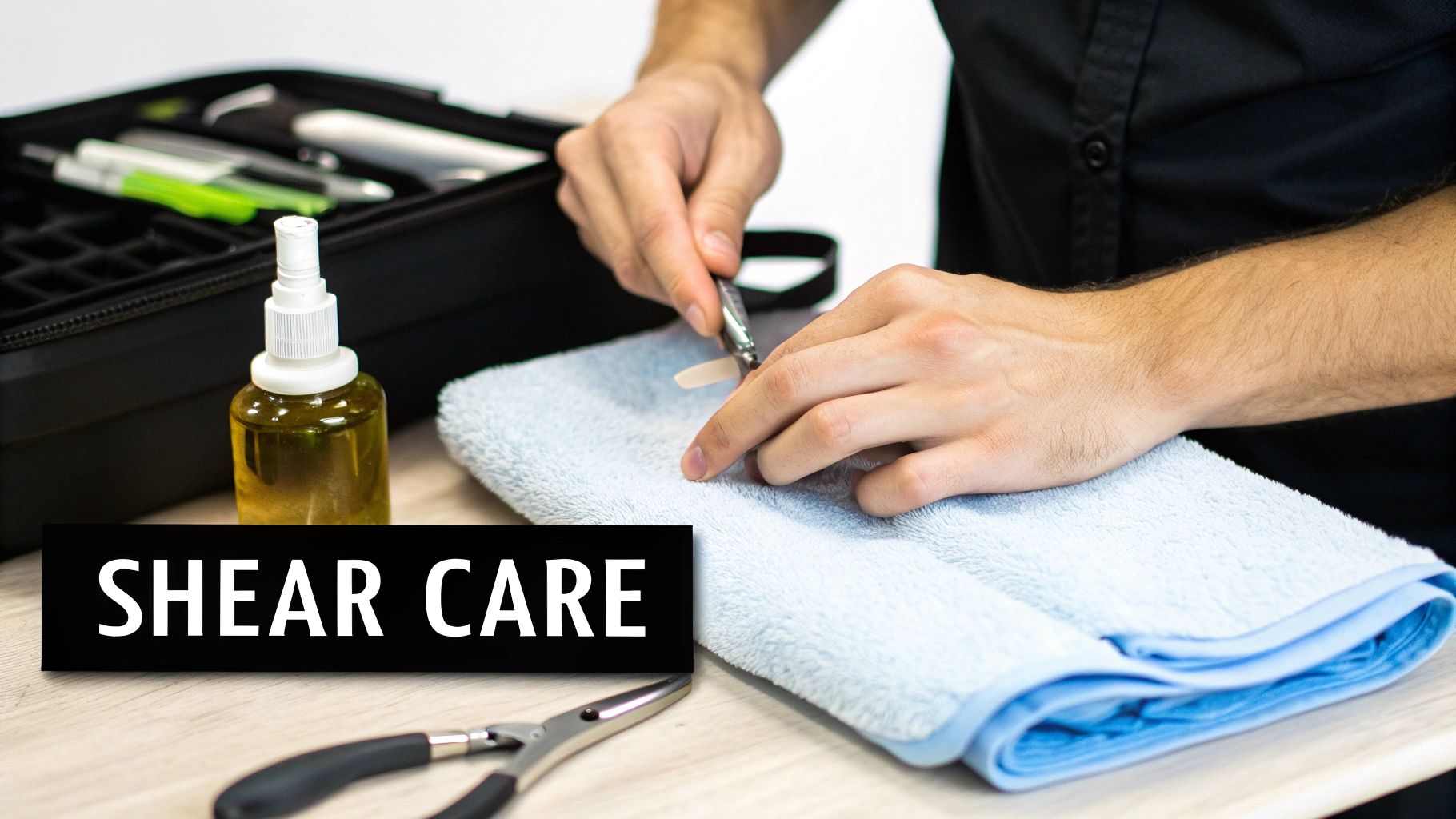
A top-tier pair of professional dog grooming shears is a serious investment in your craft and your business. Just like any precision tool, they need consistent care to perform at their best. If you neglect them, you’ll quickly turn a sharp, reliable instrument into a dull, hair-folding nightmare.
Thankfully, proper shear care isn’t a huge chore. It’s all about building simple habits. Spending just a few minutes at the end of each day can add years to the life of your shears, ensuring every cut is as clean and effortless as the first. Think of it as protecting the tools that make you money.
Your Daily Shear Care Routine
The end of a long day is the perfect time for a quick maintenance check. This little three-step ritual is your best defense against corrosive moisture and tiny hair particles that can wear down your blades and pivot screw.
- Clean Thoroughly: Grab a soft, dry cloth and meticulously wipe down the blades. Get all the hair, dander, and styling product off. Don’t forget to focus on the area around the pivot screw—that’s where debris loves to hide.
- Dry Completely: Moisture is the arch-nemesis of high-carbon steel. Make sure your shears are 100% dry after you clean them. Even a tiny bit of dampness left overnight can start the rusting process.
- Oil the Pivot Point: Open your shears to a 90-degree angle and put just one drop of quality shear oil right where the blades meet. Open and close them a few times to work the oil into the joint, then wipe any excess off the blades. This keeps the action silky smooth and pushes out any lingering moisture.
Daily oiling isn’t just about preventing rust. It actively flushes out those tiny hair fragments and gunk from the pivot area, which cuts down on friction and wear. It’s the secret to keeping your shears feeling brand new.
Knowing When It’s Time for a Tune-Up
Even with perfect daily maintenance, your shears will eventually need a professional sharpener. A dull blade isn’t just frustrating; it’s a safety issue. It will pull and snag a dog’s coat, which is uncomfortable and stressful for them. Learning to spot the signs of a dulling edge is a crucial skill for any groomer.
Keep an eye out for these red flags:
- Folding Hair: The blades start pushing the hair over instead of slicing right through it.
- Pulling or Snagging: You can feel the shears catching in the coat rather than gliding smoothly.
- Increased Hand Fatigue: You find yourself squeezing harder just to get a clean cut.
If you spot any of these signs, it’s time to stop and send your shears out to a pro. Whatever you do, don’t try to sharpen them yourself unless you have the right equipment and training. You can easily ruin the delicate convex edge for good.
Professional servicing restores that factory-sharp edge and makes sure your investment in professional dog grooming shears lasts for years to come. Ultimately, great care is the bedrock of a long and successful grooming career.
Your Top Questions About Dog Grooming Shears, Answered
Even after you’ve got the basics down, a few questions always seem to come up when you’re shopping for new shears. Let’s tackle some of the most common ones I hear from fellow groomers. Getting these details straight is what separates a good tool kit from a great one.
Think of this as the final polish on your shear knowledge, giving you the confidence to pick the perfect tool for any coat that walks through your door.
What’s the Real Difference Between Convex and Beveled Blades?
This is probably one of the most critical things to understand because it completely changes how a shear cuts. The blade edge is where the magic happens. A convex edge, which you’ll often hear called a Japanese edge, is ground to an incredibly fine, razor-sharp angle. This is what gives you that silky, buttery-smooth cut. For finish work, scissoring a poodle topknot, or getting a flawless look on a well-prepped coat, nothing beats it.
On the other hand, a beveled edge is a more rugged, workhorse-style blade. It’s ground at a steeper angle, making it tougher and more forgiving if it hits a small tangle. You’ll often find beveled edges, sometimes with tiny micro-serrations, on shears designed for bulk work or for beginners. But for that show-quality, polished finish that clients love, the convex edge is the true professional standard.
How Do I Pick the Right Size Shear?
Getting the size right is all about matching the tool to the job and the dog. Shear size is measured from the very tip of the blade down to the end of the finger ring, and there’s no single “best” size. It all depends on what you’re trying to accomplish.
- Shorter Shears (6.5 to 7.5 inches): These are your detailers. Think of them as your precision instruments for trimming around paws, shaping faces, and navigating those tricky, sensitive spots where you need total control.
- Longer Shears (8 to 10 inches): When you’re facing a big job, like scissoring the body of a Standard Poodle or a Golden Doodle, these are your best friends. They let you cover more ground with each snip, which saves your hands and speeds up the groom significantly.
If you’re just starting to build your professional toolkit, an 8-inch straight or curved shear is a fantastic all-rounder. It’s long enough to be efficient on body work but still gives you enough control for most other tasks.
Can I Just Use Human Hair Scissors on My Dog?
I get asked this all the time, and the answer is always a hard no. They might look the same, but they are built for entirely different purposes.
Dog fur is a whole different beast—it’s thicker, often much coarser, and far denser than human hair. When you try to cut it with scissors designed for fine human hair, the blades will dull almost instantly. Worse, they’ll start to fold and pull the fur instead of cutting it, which is painful for the dog and can permanently ruin the scissor’s alignment. Professional dog grooming shears are constructed from tougher steel specifically to handle the demands of animal coats, ensuring a clean, safe cut every single time.
At Ur Pet Store, we know that having the right tools isn’t just a preference—it’s a necessity. We stock high-quality grooming supplies made from the best materials because we believe you deserve performance and durability you can count on. Plus, with our fast and free shipping, you can get the professional-grade tools you need delivered straight to your salon. Check out our collection today at https://urpetstore.com.