

Blog
A Groomer’s Guide to Professional Dog Grooming Shears

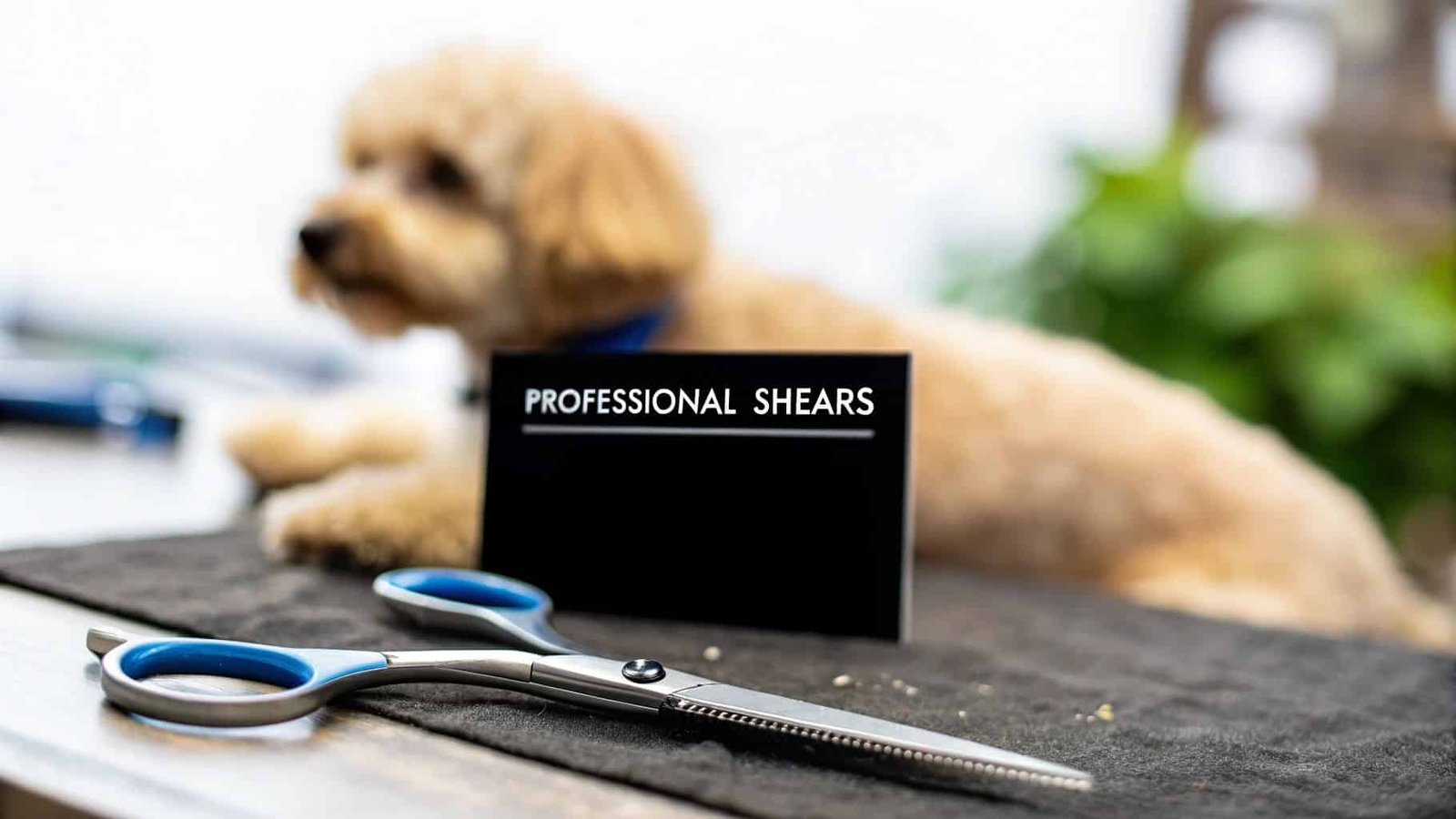
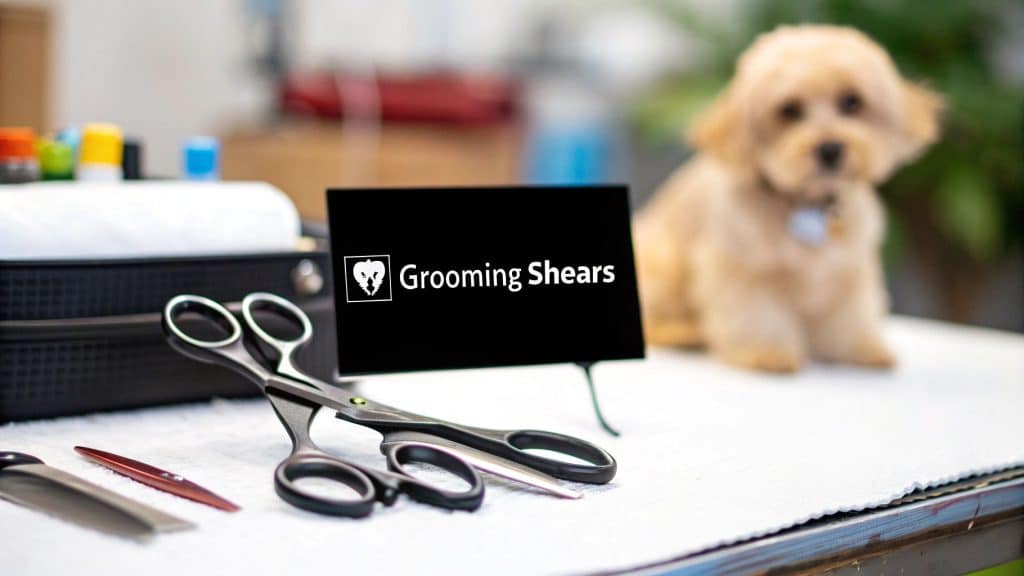
If you’re serious about grooming, whether as a professional or a dedicated pet owner, your shears are everything. They’re not just scissors; they’re precision instruments designed specifically for the unique challenge of cutting animal fur. Think of them as the foundation of your entire toolkit—an investment that pays off in safety, quality, and a much happier dog.
Why Professional Shears Make All the Difference
Let’s get one thing straight: the scissors in your kitchen drawer are not fit for grooming your dog. It’s like trying to cook a gourmet meal with a butter knife. Sure, you might eventually get the job done, but the process will be frustrating, the result will be a mess, and you risk hurting someone—in this case, your furry best friend.
Professional dog grooming shears are in a completely different league. They are forged from high-quality steel, with blades honed to slice effortlessly through all kinds of fur, from silky fine coats to thick, wooly ones. This clean-cutting action is crucial. It prevents the painful snagging and pulling that happens with dull or poorly designed scissors, which is often what makes dogs dread grooming in the first place.
The Core Advantages of Quality Shears
The upgrade to a professional pair of shears isn’t just about getting a cleaner cut. The real benefits are found in the safety, comfort, and precision they bring to every single grooming session.
- Enhanced Safety: A sharp, perfectly balanced shear gives you predictable control. You know exactly how it will cut, which drastically reduces the risk of accidental nicks. A tool that doesn’t pull or snag also means a calmer dog, and a calm dog is always a safer dog on the table.
- Superior Ergonomics: Ever felt that ache in your hand or wrist after a long grooming session? Professional shears are designed with ergonomics in mind to minimize that exact strain. For a pro who grooms all day, this is non-negotiable. For an owner at home, it just makes the job far more comfortable.
- Unmatched Precision: The artistry of grooming lies in the details. The weight, balance, and specialized blade design of professional shears give you the control to create beautifully smooth finishes, blend lines seamlessly, and sculpt with confidence. You simply can’t achieve that level of detail with a clunky, generic pair of scissors.
Investing in quality shears is really an investment in your dog’s comfort. A clean, quiet snip from a sharp tool is so much less stressful than the grinding, pulling sound of a dull one. It builds trust and makes every future groom that much easier.
When you get right down to it, these tools are built to perform and to last. The superior steel holds a razor-sharp edge much longer, which means less time and money spent on sharpening. That durability, combined with the professional-level finish they deliver, makes them one of the most worthwhile upgrades you can make to your grooming kit.
To make the distinction crystal clear, let’s break down how professional shears stack up against the standard pet scissors you might find at a big-box store.
Professional vs Standard Shears At a Glance
The differences are stark, from the materials used to the final result on the dog’s coat.
| Feature | Professional Dog Grooming Shears | Standard Pet Scissors |
|---|---|---|
| Blade Material | High-carbon stainless steel (e.g., Japanese 440C, VG-10) for a harder, sharper, more durable edge. | Softer, lower-grade stainless steel that dulls quickly. |
| Blade Edge | Convex or beveled edges, hand-honed for a razor-sharp, smooth cut. | Typically a simple, machine-ground beveled edge that can crush or fold hair. |
| Ergonomics | Designed with offset, crane, or swivel handles to reduce hand, wrist, and shoulder fatigue. | Basic, symmetrical handles that cause strain over time. |
| Tension System | Adjustable screw or dial system to fine-tune blade tension for different coat types. | Often a simple, non-adjustable screw or rivet. |
| Durability & Lifespan | Built to last for years with proper care and can be sharpened multiple times. | Considered disposable; often not worth the cost of sharpening. |
| Performance | Slices cleanly through fur, preventing pulling and split ends for a flawless finish. | Tends to snag, pull, or bend hair, leading to an uneven cut and discomfort for the dog. |
| Cost | Higher initial investment reflects superior quality and longevity. | Inexpensive and widely available. |
Seeing them side-by-side really highlights why professionals don’t compromise. The initial investment in a quality pair of shears pays for itself over and over in performance, durability, and the well-being of the dogs you work on.
Decoding the Different Types of Grooming Shears
Stepping into the world of professional dog grooming shears can feel a lot like walking into a seasoned chef’s kitchen. You’re surrounded by specialized tools, and it’s clear each one has a specific job. A chef wouldn’t use a cleaver to peel a grape, and a groomer needs the right shear for each part of the groom. Getting to know your tools is the first step toward mastering the craft.
Think of your shear collection as a team of specialists. You’ve got your workhorse, your artist, and your finisher. Using the right one at the right time not only gives you a beautiful, professional-looking groom but also makes the entire process safer and quicker for both you and the dog.
The Workhorse: Straight Shears
Straight shears are, without a doubt, the foundation of any grooming toolkit. These are your go-to scissors for the heavy lifting—removing bulk and creating those clean, sharp lines. If you were building a house, these would be the saws you use to frame the walls. They’re absolutely essential for getting the basic shape and structure of the haircut right.
You’ll find yourself reaching for them constantly for trimming the larger parts of the body, like the back, sides, and legs. On a Schnauzer, for instance, a good pair of straight shears is what creates that crisp, ruler-straight skirt line. Their power is in their simplicity and their ability to deliver a perfectly uniform finish over flat areas of the coat.
The Artist: Curved Shears
Where straight lines end, curves begin. Curved shears are the sculpting tools in your arsenal, specifically designed to shape and contour the rounded parts of a dog’s body. They let you follow the natural curves of the animal, creating a soft, seamless look that straight shears just can’t manage on their own.
These are your secret weapon for tasks like:
- Shaping Topknots: Creating that perfect, round head on a Poodle or Bichon Frise.
- Rounding Paws: Giving feet that neat, tidy, “teddy bear” look.
- Contouring Ribcages and Hindquarters: Blending the body into the legs without any awkward angles.
Without a good set of curved shears, trying to achieve those beautiful, flowing lines that define so many breed-specific styles would be a constant struggle. They’re the tools that really elevate a simple trim into a work of art.
This diagram breaks down the core principles that separate a basic scissor from a true professional tool.
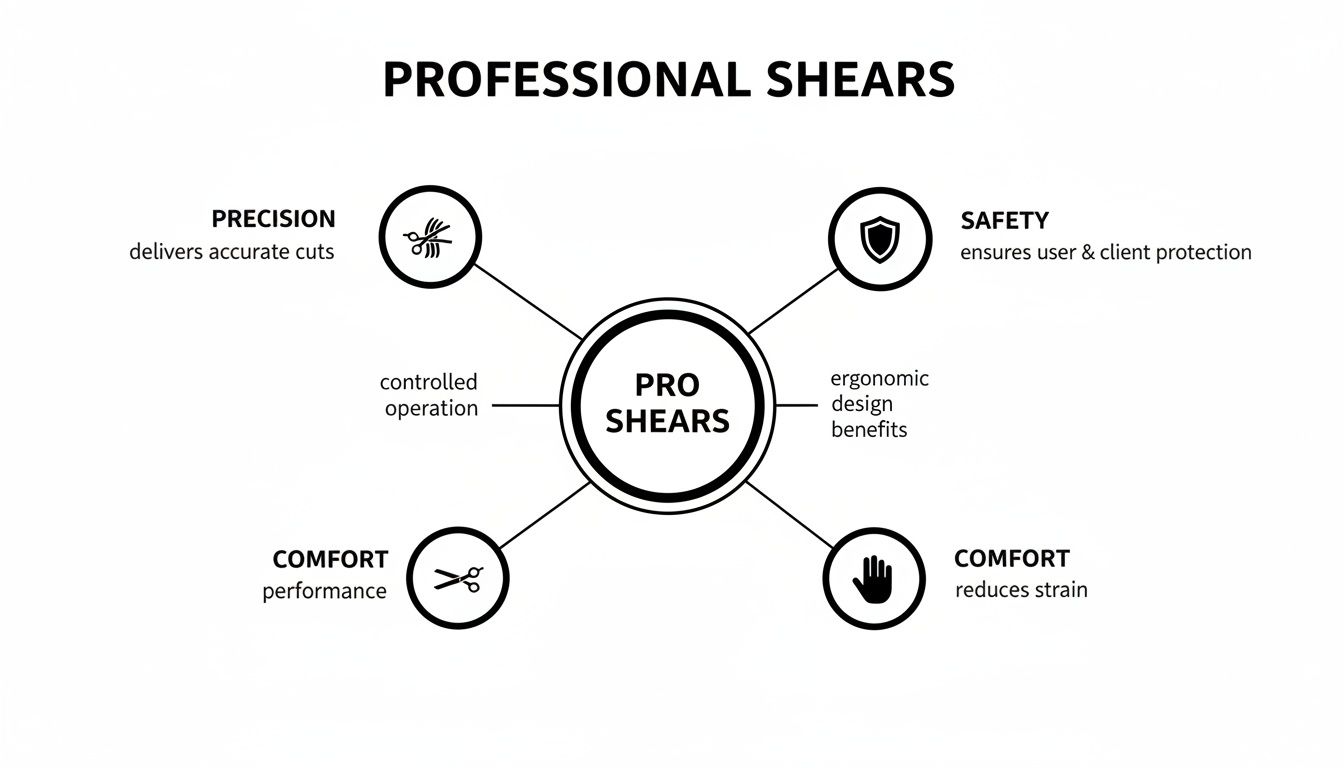
You can see how precision, safety, and comfort all have to work together. One without the others just doesn’t cut it.
The Finisher: Thinning and Blending Shears
Finally, let’s talk about the finishing touches. Thinning and blending shears don’t take off chunks of hair. Instead, they have teeth on one or both blades that only cut a portion of the hair with each snip. This allows you to soften harsh scissor marks, remove bulk without sacrificing length, and seamlessly blend different coat lengths together.
Think of them as the “eraser” for scissor marks. After you’ve used your straights on a Golden Retriever’s coat, you might go back over the edges with thinning shears to get that natural, feathery finish. It’s no surprise that the global pet grooming market is projected to hit $30.3 billion by 2034. This growth is pushing innovation in tools like these, especially since over 300,000 professional groomers depend on high-quality shears every single day. If you’re interested, you can discover more insights about the growing pet grooming market and the technology behind these essential tools.
Understanding Shear Materials and Blade Design
When you’re ready to move beyond basic shears, the real magic is in the details—specifically, the steel they’re made from and the way the blades are shaped. These two factors are what separate a pair of shears that just cuts hair from a professional tool that glides through a coat like butter.
Think of it like a chef’s knife. Anyone can chop a vegetable, but a high-end blade made from superior steel holds its edge longer and makes the work feel effortless. It’s the same with grooming shears. The quality of the metal and the geometry of the edge are the difference-makers that determine sharpness, longevity, and the final look of your groom.
The Gold Standard of Steel
When you start looking at professional-grade shears, one name comes up again and again: Japanese 440C stainless steel. There’s a good reason for this. It’s a fantastic alloy that’s become the benchmark in the grooming industry for its incredible hardness and resistance to rust and corrosion.
What does that mean for you? Shears made from 440C can be honed to a wickedly sharp edge that stays sharp. You’ll get more crisp, clean cuts between professional sharpenings, which not only saves you money but also gives you a more reliable, consistent finish on every dog you groom. While other great materials like German stainless steel are out there, Japanese 440C is truly the go-to for pros who can’t afford to compromise.
To get a real sense of a shear’s durability, look for its Rockwell Hardness rating (HRC). It’s a simple score that tells you how tough the steel is.
For premium shears, you want to see a number in the 58-62 HRC range. A higher rating means harder steel, which translates directly to better edge retention. That’s the kind of resilience you need for a tool that gets used all day, every day.
Decoding Blade Edge Geometry
The steel is only half the story. The actual shape of the cutting edge—its geometry—is just as crucial. You’ll generally run into two main types, and each one is built for a different kind of job.
- Convex Edge: This is the superstar of the grooming world. Picture the blade of a high-end samurai sword or a sushi chef’s knife—it’s honed to a razor-fine, almost rounded edge. This design creates an incredibly smooth, quiet, and precise cut. It’s what you need for finish work and for creating those flawlessly blended styles.
- Beveled Edge: Think of this as the rugged workhorse. Beveled edges are ground at a steeper angle, making them incredibly durable. They’re not quite as silky-smooth as a convex edge, but they can take a beating, making them great for bulk work or powering through thick, tough coats. You’ll often find them on thinning shears to give the teeth extra strength.
For most groomers, the convex edge is the way to go. It just glides through the coat without snagging or pushing the hair, which is key for getting a beautiful finish and keeping the dog comfortable. When you combine that perfect edge with high-quality steel, you get a tool that feels less like equipment and more like a part of your own hand.
To help you sort through these options, here’s a quick comparison of the most common materials and blade edges you’ll encounter.
Shear Material and Blade Edge Comparison
| Attribute | Japanese 440C Steel | German Stainless Steel | Convex Edge | Beveled Edge |
|---|---|---|---|---|
| Primary Use | High-performance finishing and precision work. | Durable, everyday grooming; often for workhorse shears. | Polished finish work, fine scissoring, detail trimming. | Bulk cutting, thinning, coarse coat work. |
| Sharpness | Holds a razor-sharp edge for an extended period. | Holds a good, durable edge; slightly less fine. | Exceptionally sharp, like a razor blade. | Sharp but less fine; ground for durability. |
| Feel | Smooth, crisp, and effortless cutting action. | Solid and reliable feel, often a bit heavier. | Silky, smooth, and quiet gliding action. | A more audible “crunch” or snipping sound. |
| Durability | High hardness (58-62 HRC); resists nicks and wear. | Very durable and corrosion-resistant. | Requires careful handling; can be damaged if dropped. | Very tough and forgiving; less prone to damage. |
| Best For | Professionals who need top-tier performance. | Groomers needing a reliable, all-around shear. | Show-quality finishes and advanced styling. | Heavy-duty tasks and blending thick fur. |
Ultimately, choosing between these options comes down to what you’ll be doing most. A groomer focused on high-end, detailed styling will get the most out of a Japanese 440C shear with a convex edge. Someone who needs a tough, reliable tool for daily de-matting and bulk removal might prefer a German steel shear with a beveled edge.
How Ergonomics and Handle Design Impact Your Groom
Dog grooming is a marathon, not a sprint. You’re on your feet, focused, with shears in hand for hours every day. Choosing shears based only on the blade is like picking a world-class running shoe without checking if it fits. It’s the handle design and the overall ergonomics that will ultimately determine your comfort, control, and career longevity.
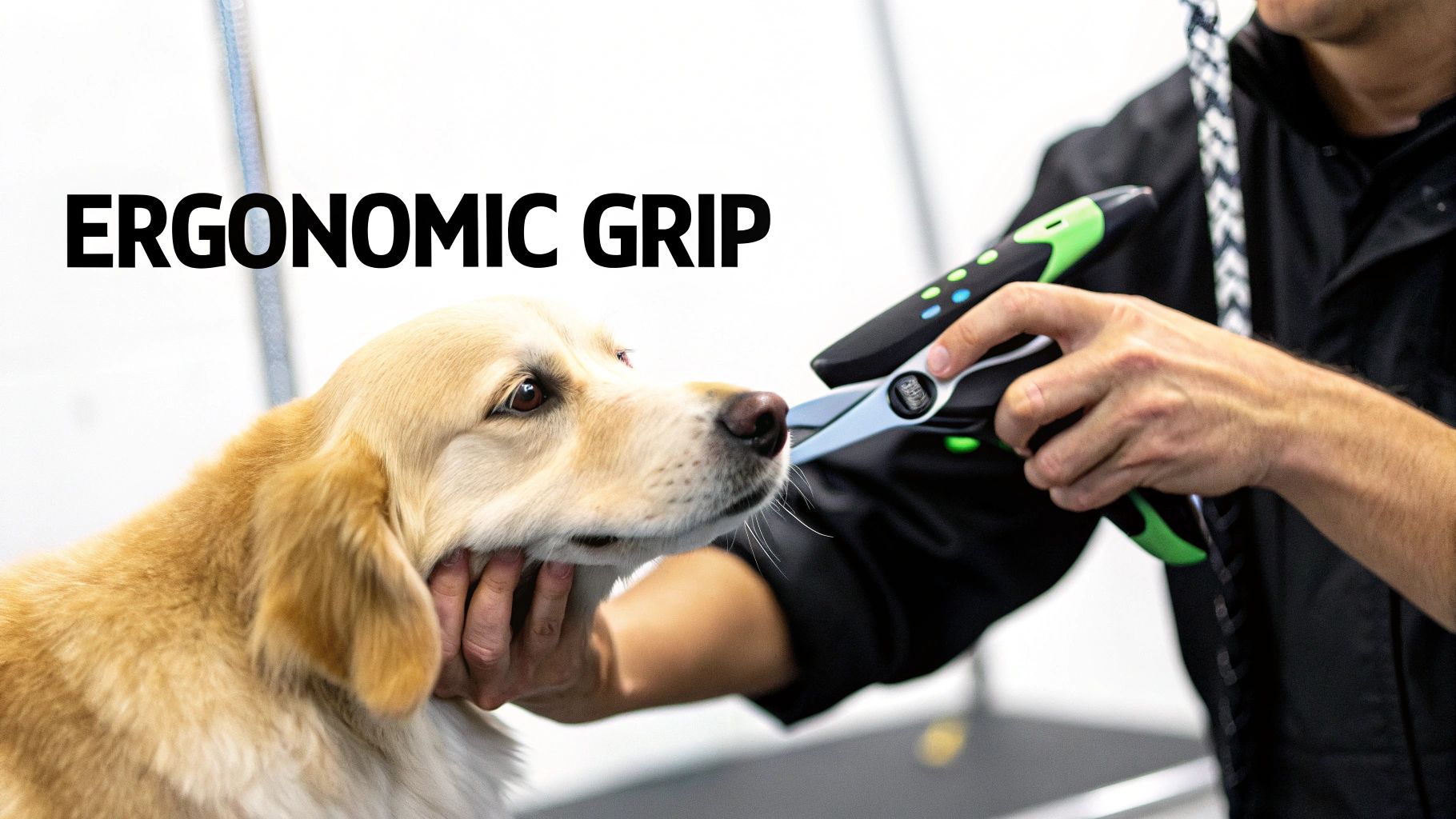
Think about it: an awkward handle forces your hand, wrist, and even your shoulder into unnatural, strained positions. Over a single grooming session, that leads to tired hands and shaky lines. Multiply that by hundreds of dogs, and you’re looking at a recipe for repetitive stress injuries. The right ergonomic design makes your shears feel like they’ve always been there—a true extension of your hand, not a clumsy tool you have to wrestle with.
Finding Your Perfect Fit
Thankfully, handle designs have come a long way, with specific styles developed to make a groomer’s life easier. Each one positions your hand a little differently, offering its own mix of comfort and cutting agility.
- Opposing Grip: This is the old-school, classic design. The finger and thumb holes are perfectly symmetrical and line up directly. It’s simple, but it forces you to lift your elbow high and can put a lot of tension on your wrist and thumb.
- Offset Grip: A huge improvement for most groomers. The offset handle has a shorter thumb shank, which lets your thumb sit in a more natural, relaxed position. This simple change reduces how much you have to stretch your thumb and is a workhorse design for all-day use.
- Crane Grip: Many pros consider this the pinnacle of ergonomic design. The crane grip features a dramatically angled thumb ring and a shank that drops downward. This lets you keep your elbow low and your wrist straight, taking a massive amount of strain off your shoulder and arm.
When your hand is relaxed, your cuts are more precise. Ergonomics isn’t just about preventing injury—it’s about enabling better artistry. A comfortable grip translates directly to a smoother, more confident finish on the dog’s coat.
Customizing for Comfort and Control
Beyond the main handle shape, a few small details can completely change the feel of your professional dog grooming shears. Look for a removable finger rest (also called a tang). This little post gives your pinky finger a place to sit, which adds a surprising amount of stability and control to your cuts.
Another key feature is removable finger inserts. These are the soft plastic rings that sit inside the finger and thumb holes. They let you dial in a perfectly snug fit, which is crucial for preventing your shears from slipping and giving you better feel and control.
A good ergonomic grip can make a huge difference, with some studies showing they can reduce hand fatigue by as much as 35% over a long day. This demand for user-centric design is a major factor in the U.S. shear market, which continues to grow. If you’re interested in the business side of things, you can learn more about trends in the pet grooming market and see how much of a role ergonomics now plays.
Matching Shears to Your Dog’s Breed and Coat
Choosing the right pair of grooming shears is never a one-size-fits-all deal. The perfect tool for a Poodle would be a frustrating choice for a Golden Retriever. Think of it like a painter’s toolkit: you wouldn’t use a tiny detail brush to cover a large wall, right? In the same way, your dog’s specific coat type is the single biggest factor in picking the shear that will give you beautiful, professional-looking results.
Getting this match right makes the entire groom safer and more efficient. It’s the difference between fighting with the fur and gliding through it to create that stunning, well-finished look you’re after. Let’s break down which shears work best for the most common coat types.
For Silky and Long Coats
Breeds like the Shih Tzu, Maltese, and Yorkshire Terrier have those gorgeous, flowing single-layer coats. While this fur is a magnet for tangles, it’s also the perfect canvas for creating incredibly smooth, clean lines. Your absolute workhorse here will be a pair of longer straight shears, usually in the 7 to 9-inch range.
The longer blade lets you make those long, continuous passes that are crucial for avoiding choppy-looking marks, especially on the body and skirt. A good pair of straight shears will feel like it’s floating through that silky hair, giving you a flawless, polished finish without a struggle. Of course, keeping the coat well-brushed is half the battle, and using something like a double-sided pet grooming brush is a great way to stay on top of knots before you even start scissoring.
For Thick Double Coats
Dogs like Golden Retrievers, German Shepherds, and Huskies are built for the elements with a thick, soft undercoat and a layer of tougher guard hairs on top. This double coat is fantastic for insulation, but it can get bulky and matted if it’s not properly maintained.
For these breeds, thinning and blending shears are your best friend. They are the ideal tool for debulking that dense undercoat without chopping into the length of the topcoat. This keeps the dog’s natural look intact while improving airflow and preventing painful mats from forming. Using them to tidy up the chest and hindquarters can create a neat, natural finish that looks clean but not overly styled.
Remember, the goal with a double coat is never to remove all the undercoat with shears. It’s about selectively thinning it to add shape and comfort. Thinners let you do this subtly, preserving the coat’s purpose while enhancing its look.
For Curly and Wiry Coats
Finally, let’s talk about the curly and wiry coats you see on Poodles, Bichon Frises, and a lot of terriers. This type of coat has incredible texture and volume, which makes it a dream for sculpting and shaping. The undisputed champion for this job is the curved shear.
Trying to create a Poodle’s perfectly rounded topknot or shape a cute, teddy-bear paw with straight shears is a recipe for frustration. Curved shears are literally built to follow those contours, making it so much easier to get the soft, rounded shapes that are hallmarks of these breeds. They give you the precision control you need to truly sculpt the fur, turning a simple trim into a work of art.
Protecting Your Investment with Proper Shear Care
Think of a set of high-quality grooming shears like a chef’s prized knives. They’re a precision tool, a true investment in your craft and the comfort of the dogs you work on. If you want them to deliver that flawless, crisp cut year after year, you can’t just toss them in a drawer and forget about them. Neglecting your shears is the fastest way to ruin their delicate balance and razor-sharp edge.
The good news is, keeping them in peak condition is easy. A simple daily care routine is your best defense against wear and tear. It only takes a minute or two, but this small commitment can dramatically extend the life of your shears, ensuring they operate as smoothly as the day you brought them home.
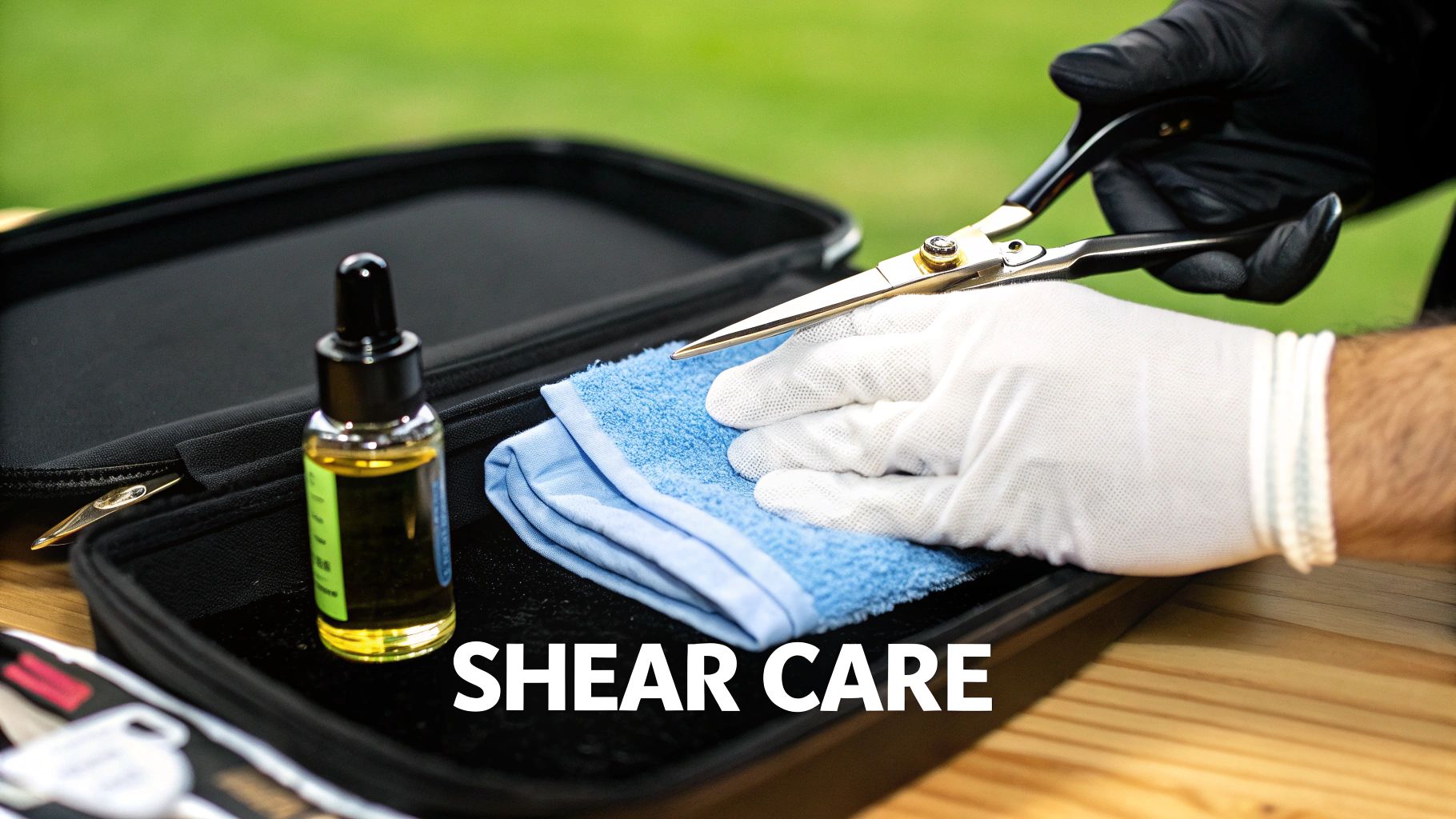
Your Daily Shear Maintenance Checklist
At the end of every single grooming day, make these three steps a non-negotiable habit. It’s the secret to keeping your tools in prime condition.
- Clean Thoroughly: Grab a soft, dry cloth and meticulously wipe away every trace of hair, dander, and moisture. Get the inside and outside of the blades. Even a tiny bit of leftover fur can wick moisture and invite corrosion.
- Dry Completely: This is critical. Make sure every part of the shear is bone dry, especially around the pivot point where the screw holds everything together. Moisture is the number one enemy of the high-carbon steel used in great shears.
- Oil the Pivot Point: Apply one single drop of high-quality shear oil right onto the pivot screw. Open and close the blades a few times to work the oil into the joint, then wipe away any excess. This keeps the cutting action silky smooth and pushes out any hidden moisture.
Pro Tip: How do you know it’s time for a professional sharpening? The classic sign is when your shears start folding or bending the hair instead of slicing through it cleanly. A dull edge snags fur, which is uncomfortable for the dog and frustrating for you.
Proper care is more important than ever, as modern tools are built to last. The industry saw a huge shift after 2010 toward cordless technology, and with the right maintenance, today’s tools can easily last 5-10 years. You can find a fantastic selection of these durable grooming and cleaning tools online from suppliers who know their stuff.
With e-commerce now making up 30-40% of sales in major markets, getting your hands on professional-grade supplies has never been easier. If you’re interested in the data behind this trend, you can read the full research on U.S. pet grooming products.
Finally, let’s talk storage. Always, always store your shears in a padded case. Tossing them unprotected into a drawer is a recipe for nicks, dings, and misaligned blades. A simple case protects your investment and keeps your shears ready for action.
A Few Common Questions About Grooming Shears
Diving into the world of professional grooming shears can feel a bit overwhelming at first. When you’re ready to invest in quality tools, a few practical questions always pop up. Let’s clear the air and tackle some of the most common ones I hear from new groomers and dedicated owners alike.
What’s the Best “First Pair” of Shears for a Beginner?
If you’re just starting out, your first and most important tool is a solid pair of 7-8 inch straight shears. Think of this as your foundational workhorse—the one pair you’ll reach for constantly. They’re perfect for all the basics, from general trimming and shaping the body to setting clean, straight lines on legs.
Get comfortable with those first. Once you’ve got the feel for them, you can start building out your toolkit. Adding a good pair of curved shears and thinning shears will open up a whole new world of possibilities, letting you tackle tricky spots like rounded paws or beautifully blend and soften a finished groom.
How Often Do I Really Need to Sharpen My Shears?
This one comes down to a simple answer: it depends on how much you use them.
A professional groomer who’s working on multiple dogs every single day will likely need to get their shears sharpened every 3-6 months. On the other hand, if you’re a pet owner grooming your own dog at home, you might only need a professional sharpening once a year or even every couple of years.
The real test is how they perform. The moment your shears start folding or pushing the hair instead of making that crisp, clean snip, it’s time. That’s your cue that the edge is dull and needs to be professionally restored.
Can I Just Use My Own Hair Scissors on My Dog?
Please don’t. I know it’s tempting, but human hair scissors and dog grooming shears are engineered for completely different jobs. A dog’s coat is far more dense, coarse, and varied than human hair, and professional shears are built to handle that. They’re more durable and often have special features, like micro-serrated blades, designed to grip slippery fur for a safer, more precise cut.
Trying to use scissors made for fine human hair on a thick coat will likely just pull and snag the fur, which is painful for your dog. You’ll end up with a choppy, uneven mess and, worse, a much higher risk of accidentally nicking their skin.
Ready to equip yourself with the right tools for the job? Find the perfect pair of professional-grade shears at Ur Pet Store and feel the difference quality makes. Shop our curated collection now.