


Blog
How to Protect Hardwood Floors from Dog Scratches (Without Giving Up Your Floors)


You love your dog. You also love your hardwood floors. And somewhere between the zoomies after bath time and the sprint to the door when the mail arrives, those two loves start to feel like they are at war.
I refinish hundreds of floors a year in Atlanta homes, and I own dogs myself. I get asked this question constantly: Do I have to choose? The honest answer is no. You do not have to rip out your floors, and you do not have to crate your dog every time the mail arrives. But you do need a plan, because no hardwood floor on earth is truly scratch-proof, and the people who keep their floors looking great over the long haul treat maintenance as a rhythm, not an emergency.
Here is how to protect your hardwood the smart way.
Start With Realistic Expectations
Before we talk tactics, let us set the honest bar. A dog that lives indoors will, at some point, put a mark on your floor. That is not a sign you picked the wrong floor or the wrong dog. It is physics. What you are trying to do is slow the wear curve so your floors look beautiful for a decade between major work, rather than looking tired after two years.
If you accept that small imperfections are part of a home where something actually lives, you will be a much happier floor owner.
Know Your Floor Toughness

Not every hardwood floor has the same resistance to claws. The industry measures this with something called the Janka hardness scale. The higher the number, the harder the wood.
- White oak: 1,360 Janka. The workhorse of American homes. Plenty tough for most dogs.
- Red oak: 1,290 Janka. Slightly softer than white oak but still solid.
- Hickory: 1,820 Janka. Noticeably harder, great for big or active dogs.
- Brazilian cherry (jatoba): 2,820 Janka. One of the hardest species commonly installed in homes.
- American walnut: 1,010 Janka. Gorgeous, but softer. Expect to see more wear.
- Pine: around 690 Janka. Beautiful, historic, and very soft. Dog nails will leave a mark.
The finish matters just as much as the species. A modern aluminum oxide waterborne finish is far more scratch-resistant than an older oil-based polyurethane, and it is also lower in odor during application if you ever need work done with pets in the house. If you are building or refinishing and dogs are part of your life, ask your contractor specifically for a commercial-grade waterborne finish with aluminum oxide. That one choice can double the practical lifespan between refinishes.
The Five Habits That Actually Move the Needle
These are the boring, unsexy habits that separate homes with beautiful ten-year-old floors from homes where the floors look rough after two. None of them requires a lifestyle overhaul.
1. Trim nails every three to four weeks. This is the single biggest factor. Long nails click. Clicking means impact. Impact means tiny dents and scratches that add up over months. If clipping yourself stresses you out, a groomer visit every three weeks is cheap insurance for floors that cost thousands.
2. Put down runners in the highways. Dogs have a route. From their bed to the door. From the kitchen to the couch. Follow the traffic pattern for a day, and you will see exactly where to place a low-profile runner or rug with a non-slip pad. You do not need to carpet the whole house. You need to protect the three or four lanes they actually use.
3. Mat the water bowl area. Water is the silent killer of hardwood. A splashy drinker plus a wood floor equals cloudy patches and, eventually, black stains that soak into the grain. A waterproof silicone mat under the bowl solves it in ten seconds.
4. Use real entry mats, inside and out. Most scratches come from grit, not claws. Tiny pieces of driveway, sidewalk, and yard hitch a ride on paws and act like sandpaper. A substantial outdoor mat plus an absorbent indoor runner at every door cuts that grit dramatically.
5. Keep paws dry after rain and baths. Keep a towel by the back door. Quick wipe of the paws before they sprint across the kitchen. Your future self will thank you.
Spot-Fixing Minor Scratches at Home
Small surface scratches do not need a contractor. A couple of tricks work well:
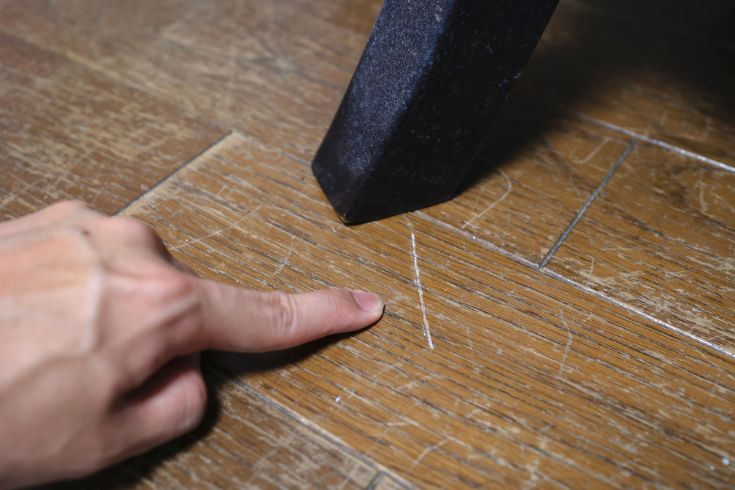
- The walnut rub. Take a raw walnut, break it in half, and rub the meat along the scratch. The natural oils darken the line and blend it into the surrounding wood. This works surprisingly well on medium and dark floors.
- Touch-up markers. Hardware stores sell wood repair markers in common tones. Choose one slightly lighter than your floor, test it in a closet first, and color the scratch.
- Blended wax sticks. For slightly deeper scratches that have taken out a tiny bit of wood, a wax fill stick in a matching tone fills and seals in one step.
These tricks handle cosmetic wear. They are not meant for deep gouges or a worn-through finish.
When DIY Stops Working
There are a few signs that tell you it is time to bring in a pro rather than reach for another bottle of touch-up:
- Finish is worn through to raw wood in front of a couch, a door, or the water bowl. Raw wood soaks up everything, including pet stains, and the damage spreads quickly.
- Boards are cupping (edges higher than the center) around the water bowl or crate. That means moisture has penetrated.
- Dark black stains in specific spots, usually near where a dog has had accidents. Urine that reaches the wood itself is a real problem, not just a surface one.
- Large areas look dull or hazy, no matter how much you clean.
At that point, you have two very different paths. A screen-and-recoat, sometimes called a buff-and-coat, is the preventive option. A technician lightly abrades the existing finish and applies a fresh top coat. It freshens the floor, restores shine, and adds a new sacrificial layer. It does not remove deep scratches, but it resets the clock on wear. Done every three to five years, it can push a full refinish out by a decade or more, and it costs a small fraction of a full refinish. You are looking at a few hundred dollars for a screen and recoat on a typical living area, compared to several thousand for a full refinish of the same space.
A full refinish is the reset button. The floor is sanded back to bare wood and refinished from scratch. You get a brand new surface. It is also dustier, more disruptive, and more expensive.
This is where it pays to talk to someone who does this for a living. When a client is on the fence, a good contractor will tell you honestly whether you can squeeze two more years out of a screen and recoat, or whether the floor is already past that point. If you are weighing it and want a second opinion, professional hardwood refinishing companies usually offer free in-home assessments.
Refinish or Replace?
The last question people ask me: at what point do you just rip it out?
Rarely. Solid hardwood can typically be refinished six to ten times over its lifetime, which is many decades of use. Even most engineered hardwoods can handle at least one or two refinishes if the top veneer is thick enough. Replacement is usually only necessary when the wood itself is structurally damaged (think flood, severe cupping, or extensive termite or subfloor issues), not because it has scratches. If a contractor tells you the only fix is tearing it out, get a second opinion before you write that check.
The Bottom Line
You can live with hardwood floors and live with dogs. Thousands of people do it beautifully. The trick is to stop thinking about scratch prevention as a one-time project and start thinking about it as a quiet rhythm: trimmed nails, runners in the right places, mats under bowls and at doors, quick spot fixes when needed, and a screen and recoat every few years. Do those things, and your floors will outlast several dogs and still look like something to be proud of.
Your dog is not the enemy of your floors. Neglect is.