

Blog
Best Professional Dog Grooming Clippers for Every Coat Type

When you start looking for the best professional dog grooming clippers, you’ll quickly see names like the Andis Excel Pro-Animal 5-Speed and the Wahl KM10 pop up again and again. There's a good reason for that—they're powerful, reliable workhorses. But the "best" clipper really comes down to your specific needs. What works for a Poodle's curly coat won't be the perfect fit for a Golden Retriever's dense undercoat.
Your decision hinges on your dog's coat, how often you'll be grooming, and whether you want the unstoppable power of a cord or the go-anywhere freedom of a cordless model. These tools are built to tackle everything from wispy fur to tough, matted messes, all while keeping the cut smooth and precise.
Why Your Choice of Clippers Matters
Picking the right clippers isn't just about getting a good haircut; it's the single most important decision you'll make for a safe, efficient, and stress-free grooming session. It's like a chef choosing their knife—the right tool for the job makes all the difference. Grab a cheap, underpowered clipper, and you're setting yourself up for snagged hair, a choppy finish, and a miserable experience for you and your dog.
Professional-grade clippers are in a completely different league. They have powerful motors that don't bog down or pull, even in the thickest fur—a common failing of clippers you'd find at a big-box store. You also get access to a huge range of blades and attachments, giving you total control over the length and style.
Investing in a quality set of clippers pays off in several ways:
- Safety and Comfort: A sharp, powerful blade cuts cleanly, which means no painful pulling and a much lower risk of skin irritation.
- Efficiency: You’ll finish the groom faster. This is a huge win, especially if you have a dog that gets anxious or just plain bored.
- Professional Results: The finish is smoother and more even. It's that "just-from-the-groomer" look, right at home.
- Long-Term Value: These tools are built to last. With a little care, a high-quality clipper will keep running strong for years, saving you money in the long run.
This decision tree gives you a great visual starting point, helping you think through the process from coat type to power source and your own experience level.
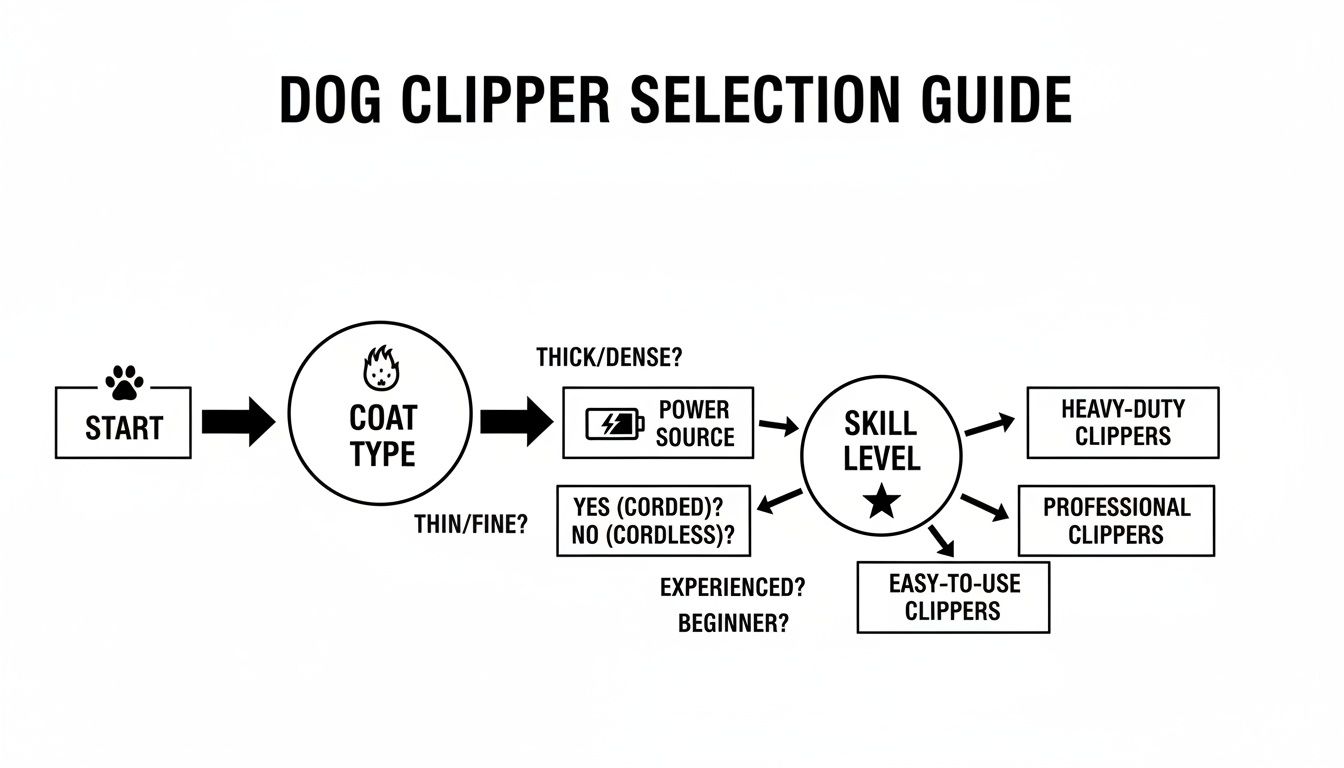
As the chart shows, finding the perfect clipper is all about balancing these three key factors. We'll dive deep into each one as we go. To see all the tools we've hand-picked for groomers, take a look at our full range of grooming and cleaning supplies.
Understanding Clipper Motors, Blades, and Power
When you’re trying to choose the best professional dog grooming clippers, the first thing to look at is what’s under the hood. Just like a car’s performance hinges on its engine, a clipper’s real-world effectiveness comes down to its motor.
Getting a handle on the different motor types is your first step toward finding a tool that can tackle your dog’s specific coat without bogging down, overheating, or pulling on their fur. Think of the motor as the heart of your clippers—it’s what delivers the power and speed you need for a smooth, safe groom.
The Engine Room: Clipper Motor Types
The motor is the workhorse. It dictates everything from how fast the blades move to how much thick, matted fur the clippers can power through. You'll generally run into three main types in the professional world, and each one has its own distinct personality.
A little bit of knowledge here goes a long way in matching the tool to the job. This table breaks down what you can expect from each motor type.
Dog Clipper Motor Types Compared
| Motor Type | Power & Speed | Best For | Pros | Cons |
|---|---|---|---|---|
| Rotary | High Power, Variable Speed | All coat types, heavy-duty & matted fur | Extremely versatile, powerful, durable | Can be heavier, generates more heat |
| Magnetic | Low Power, High Speed | Light touch-ups, fine coats | Lightweight, fast for finishing | Lacks power for thick coats, can snag |
| Pivot | High Power, Low Speed | Noise-sensitive dogs, medium coats | Quiet, cool-running, strong | Slower blade speed isn't ideal for fine finishing |
As you can see, there isn't one "best" motor—it's all about what you need to do. A pro grooming a dozen different breeds a day will almost certainly reach for a rotary motor, while someone just tidying up their poodle's face and feet might love a quieter pivot motor.
The demand for great grooming tools is exploding. The global market for electric pet clippers was valued at $630.50 million in 2024 and is projected to hit $1,125.75 million by 2032. This just goes to show how many people are investing in pro-quality gear for better, safer results at home. You can dig into more pet grooming market trends on fortunebusinessinsights.com.
Decoding Clipper Blade Numbers and Materials
Once you've got a motor in mind, the next piece of the puzzle is the blade. Clipper blades are far from one-size-fits-all; they are specialized tools precision-engineered to leave a specific length of fur. Cracking the code on their numbering system is the key to getting the exact haircut you want.
Simply put, the number on a clipper blade tells you how much hair it will leave behind. It’s a bit counterintuitive, but a higher number means a shorter, closer cut.
For instance, a #10 blade is a grooming staple. It leaves about 1/16th of an inch of hair, making it perfect for sanitary trims, paw pads, and general-purpose work on a clean coat. On the flip side, a #4F blade leaves a much longer 3/8ths of an inch, giving you that longer, fluffier finish.
You’ll also see a letter after the number, which is just as important:
- F (Finish Cut): These blades have teeth that are spaced very close together. They’re designed to give a smooth, velvety look and should only be used on clean, tangle-free fur.
- Skip-Tooth: These blades have wider-spaced, alternating teeth. This design helps them feed thick, matted, or wiry fur into the cutting blade, making them ideal for a first pass or a rough cut. They won't leave a smooth finish.
Blade Materials Matter for Durability
The metal your blade is made from directly impacts its sharpness, how hot it gets, and how long it lasts. Investing in a quality material from the start means fewer replacements and a better, more comfortable groom for your dog.
- Stainless Steel: This is the industry standard for a reason. It's durable, resists corrosion well, and holds a sharp edge for a good amount of time. A reliable workhorse.
- Carbon-Infused Steel: By infusing steel with carbon, manufacturers make it much harder. This means it can hold a razor-sharp edge for much longer, making it a great upgrade for anyone who grooms frequently.
- Ceramic: The superstar feature of ceramic is that it stays cool. It doesn't conduct heat like metal, so it remains more comfortable on the dog's skin during long clips. The trade-off? It's more brittle and can shatter if you drop it.
- Titanium-Coated: This is a premium choice where a steel blade is coated with titanium. This treatment boosts its strength and durability while making it highly resistant to rust and corrosion. A long-lasting, top-tier option.
By understanding how motors and blades work as a team, you're well on your way to picking a set of professional clippers that will feel like an extension of your own hand and perform reliably for years to come.
Corded or Cordless? Picking Your Power Source
One of the first big forks in the road when choosing clippers is deciding between corded and cordless. It's a lot like picking a power drill for a big project. That corded drill will give you unstoppable torque all day long, but the cordless one lets you get into tight corners and move around without tripping over yourself.
There’s no single "best" answer here. The right choice really comes down to where you groom, the types of coats you're tackling, and just your personal style of working. Let's break down the pros and cons of each to help you figure out what makes the most sense for you.
The Case for Corded Clippers: Unstoppable Power
Corded clippers are the traditional workhorses of the grooming world, and for good reason: unwavering power. When you're plugged into the wall, you get a steady, consistent stream of energy. That means no power fade halfway through a difficult coat and no dead batteries at the worst possible moment.
For a busy groomer with back-to-back appointments, this reliability is everything. Picture yourself working on a heavily matted Newfoundland or a double-coated Bernese Mountain Dog—a corded model ensures you have all the muscle you need from the first clip to the last. They are built for the marathon, not the sprint.
Of course, the trade-off is the cord itself. It can get tangled around the grooming table leg, snag on your shoes, or get in the dog's way, forcing you to constantly manage it. Being tethered to an outlet also limits your movement, which can be a real hassle with a wiggly dog.
The Freedom of Cordless Clippers: Unmatched Flexibility
Cordless clippers offer one huge, game-changing advantage: total freedom of movement. With no cord to fight, you can approach a dog from any angle with ease. This makes grooming sensitive spots like paws, sanitary areas, and faces so much simpler. It's especially great for anxious dogs, as you can move with them instead of being anchored in one spot.
Don't think of today's cordless clippers as weak. Modern battery technology has come a long way. Many professional models use powerful lithium-ion batteries that provide long runtimes—often 2 to 3 hours on a single charge—and keep the power steady right until the battery is depleted. They also tend to be lighter and more ergonomic, which means less strain on your hand and wrist over a long day. Mobile groomers and pet owners in small apartments often swear by them.
The cordless electric pet clippers segment is a dominant force, commanding 44.9% of the market share. This highlights a clear preference among both professionals and home users for the convenience and flexibility that battery-powered tools provide.
The main thing to manage is battery life. You have to be disciplined about keeping your batteries charged, and having at least one spare ready to swap in is a must. And while they are incredibly powerful, they may not always match the raw, sustained torque of a top-tier corded model for the absolute toughest jobs.
How to Make the Right Choice for You
So, which one is it? The best way to decide is to look at your day-to-day needs. This quick breakdown should help you weigh what matters most.
| Feature | Corded Clippers | Cordless Clippers |
|---|---|---|
| Power Consistency | Excellent; constant, non-fading power. | Good to Excellent; top models hold power well, but battery life is finite. |
| Mobility | Limited; you're tethered to an outlet. | Excellent; complete freedom to move around the table. |
| Best For | High-volume salons, extremely thick or matted coats. | Mobile groomers, anxious dogs, home grooming, detail work. |
| Runtime | Unlimited. | Limited by battery life (typically 1-3 hours). |
| Weight | Often heavier and bulkier. | Generally lighter and more ergonomic. |
Here’s a little secret from the pros: you don't have to choose just one. Many experienced groomers use a hybrid approach. They’ll pull out a powerful corded clipper to plow through the heavy-duty bodywork, then switch to a nimble cordless model for finishing touches, paws, and those tricky, delicate areas. This gives them the best of both worlds—raw power when they need it and surgical precision when it counts.
Reducing Noise and Vibration for Anxious Dogs
Ever wonder why your dog starts trembling the moment you pull out the clippers? To a sensitive pup, that high-pitched whine and buzzing isn't just a sound—it's a terrifying, vibrating monster coming right at them. That sensory overload is a huge reason grooming sessions can quickly turn into a stressful battle for both of you.
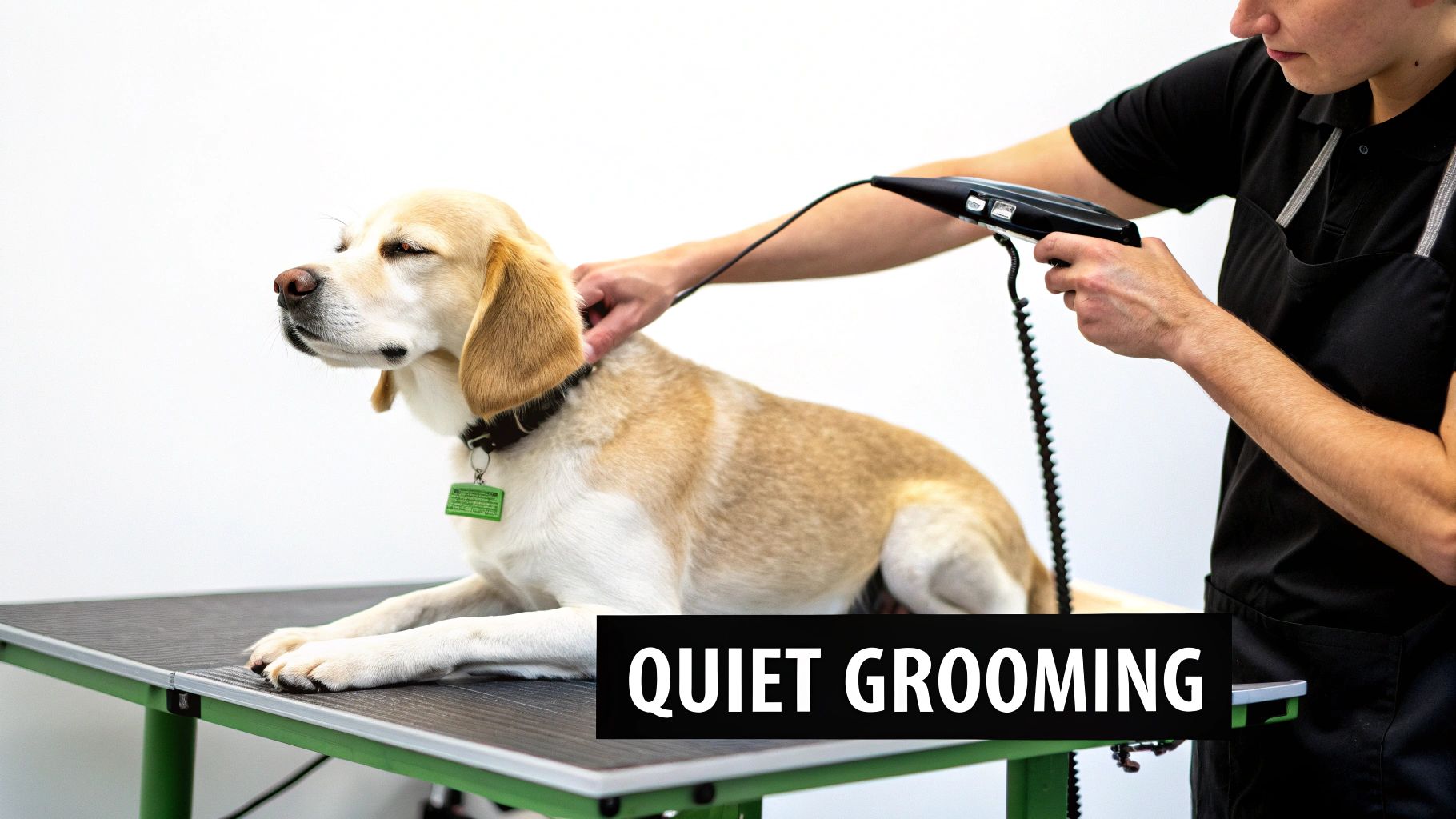
Choosing clippers designed for quiet operation can completely change the game. It helps turn a dreaded chore into a calmer, more manageable experience. When your dog isn't panicked, you can work more safely and efficiently, getting a much cleaner cut without all the wrestling.
Why Quiet Clippers Make a Difference
The magic behind a quieter clipper is all in the engineering. Top brands use some smart tricks to muffle noise and smooth out the tremors that set a dog on edge. It’s like the difference between driving a clunky old pickup truck and a smooth, modern sedan—one rattles your bones, while the other glides.
Here’s a peek under the hood at what makes a clipper less intimidating:
- Insulated Motor Housings: Think of it like soundproofing a room. Special materials are packed inside the clipper's casing to absorb and deaden the noise from the motor.
- Precision-Balanced Motors: The best rotary motors are carefully balanced to cut down on internal shaking. This means less vibration traveling from the clipper, through your hand, and onto your dog's body.
- Lower Speeds: Some clippers, especially those with pivot motors, run at a lower strokes-per-minute (SPM). The blades move a bit slower, but the trade-off is a massive reduction in both noise and vibration.
When you pair a quiet clipper with a gentle hand and plenty of praise, you create a much more positive atmosphere. A great tip is to start the session with a relaxing brush-out using a quality double-sided pet grooming brush. This helps your dog settle in and associate grooming time with something pleasant.
How to Identify a Low-Noise Clipper
You don't have to rely on guesswork to find a quiet model. Manufacturers often provide a key number to look for: the decibel (dB) rating.
A lower dB rating is always better. To put it in perspective, a normal conversation is about 60 dB, and a loud vacuum cleaner can easily hit 70-80 dB. Many of the best low-noise clippers operate in the 50-65 dB range, which is far less jarring for a dog’s sensitive ears.
Grooming technology is advancing quickly to meet the needs of anxious pets. Noise reduction and vibration control have become critical features driving market innovation, with a growing number of pet owners investing in professional-level tools for calmer at-home grooming. You can learn more about how grooming trends are evolving on clipit-grooming.com.
Vibration is harder to find on a spec sheet, but a good rule of thumb is that cordless models and those with ergonomic, rubberized grips tend to transfer less of it to your hand. Your best bet is to dive into user reviews. Look for comments from groomers who specifically mention using the clippers on skittish or noise-sensitive dogs. Their real-world feedback is invaluable. By focusing on these features, you’re not just buying a tool—you’re investing in your dog’s comfort and well-being.
Keeping Your Clippers in Tip-Top Shape
Getting a great pair of professional clippers is only half the battle. How you take care of them is what truly dictates how well they perform and how long they'll last. Think of your clippers like the engine in a race car—they need consistent, routine maintenance to run cool, stay powerful, and deliver a perfect finish every time.
If you skip this stuff, you're asking for trouble. You'll end up with dull blades, clippers that get way too hot, and a motor that's struggling to keep up. A little TLC not only saves you cash on repairs and replacements down the line but also makes the whole experience safer and more comfortable for the dog on your table. These simple habits are what protect your investment.
The Daily Clean-Down Routine
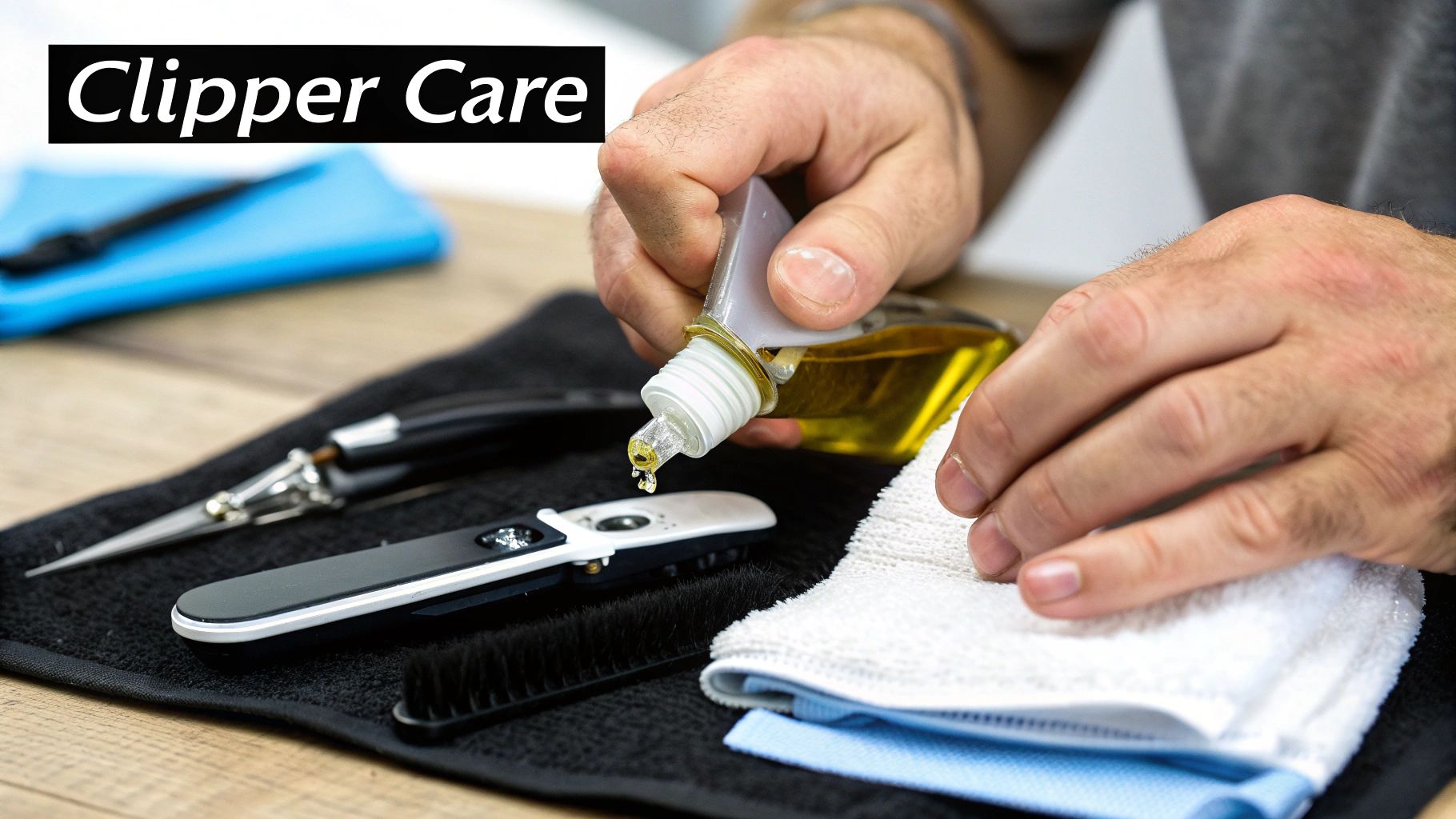
After every single groom, your clippers and blades need a good cleaning. No exceptions. Fur, dander, and coat oils build up fast, creating friction that heats things up and puts a serious strain on the motor. This isn't just a friendly tip; it's the bedrock of good clipper care.
First things first, pop the blade off the clipper body. Grab a small, stiff brush and get to work, clearing out all the hair from the blade, the clipper's blade drive, and any air vents on the housing. This one little step stops all that gunk from getting sucked into the motor where it can do some real damage.
For a more thorough clean, reach for a blade wash. These solutions are made to cut through the grime and oils that a brush just can't handle, making sure the blade's cutting surfaces glide smoothly instead of snagging.
Oil: The Secret to a Cool, Smooth Cut
Once your blades are clean and bone-dry, it's time to oil them up. Honestly, this is probably the most critical part of the whole process. Oiling is what slashes friction, keeps heat in check, and helps your blades stay sharp for so much longer. Without it, you've just got metal grinding on metal, which is the fastest way to a dull, useless blade.
Applying oil takes about 10 seconds:
- Put three drops of clipper oil across the blade’s teeth—one on the left, one on the right, and one right in the middle.
- Add one small drop to the back of each rail where the moving blade slides.
- Flip the clippers on for a few moments to let the oil work its way into all the moving parts.
- Wipe away any excess with a soft cloth. You don't want oil getting all over a clean coat!
Proper maintenance is non-negotiable for tool longevity. Blades that are regularly cleaned and oiled can last up to twice as long as neglected ones, maintaining their cutting power and reducing the need for frequent sharpening or replacement.
Knowing When It's Time for a Tune-Up
Even with the best care, some parts are just built to wear out. The blade drive is the perfect example. It's the small plastic or metal piece that makes the cutting blade oscillate back and forth. As it gets worn, you'll start to notice your clippers aren't cutting as well or they're getting louder.
Most pros swap out their blade drive every 3-6 months, depending on how heavy their workload is. It’s a cheap part that makes a world of difference in your clippers' performance. Learning to spot the signs of wear before it affects your grooming is a skill that really separates the seasoned pros from the rest.
We're Here For You at Ur Pet Store
Picking out the right pair of professional clippers is a big decision, but it's really just the first step. Here at Ur Pet Store, we don’t see a sale as the end of the road; we see it as the beginning of a partnership. Our goal is to make sure you have everything you need to feel confident and successful, long after you click "buy."
That commitment starts with what we choose to stock. Before any clipper makes it onto our virtual shelves, we've put it through its paces. We look at everything—performance, how well it's built, and all the safety features. You're not just buying a tool; you're getting a piece of equipment that we've personally vetted to meet true professional standards.
Peace of Mind with Every Purchase
We get it. Buying high-quality grooming gear online requires a lot of trust. That’s why we’ve built our entire process around making you feel secure and supported from start to finish.
When you shop with us, you can always expect:
- Free and Fast Shipping: We know you're eager to get started. That's why we ship your tools quickly, with most orders arriving at your door in just 4–5 days, completely free.
- Hassle-Free Returns: Sometimes a tool just isn’t the right fit. If that happens, our simple return process makes it easy to send it back and find one that works better for you.
- Clear Warranty Support: No one likes jumping through hoops. We stand by our clippers with a straightforward warranty, so you're always covered if a problem pops up.
More Than Just a Store
We want to be more than just a place you buy things—we want to be your go-to resource for grooming. Need help figuring out the right blade for a Poodle topknot? Looking for a replacement part? Our team is always here to lend a hand. That’s what the Ur Pet Store experience is all about.
The professional grooming industry is huge, with over 300,000 groomers in the U.S. alone. And it's not just the pros; 41% of dog owners are now grooming at home. This growing community needs reliable tools and support they can count on. For a deeper dive, check out pet grooming market insights on market.us.
We also know that the bond with our pets goes way beyond grooming. That's why you'll also find a curated selection of thoughtful presents for dog owners in our store, perfect for celebrating that special relationship. From the workhorse clippers you rely on every day to a heartfelt gift, we're here to support every part of your journey with your pet.
Frequently Asked Questions
When you're gearing up with a new set of professional clippers, it's natural to have a few questions. After all, this is a serious tool for a serious job. We've gathered some of the most common questions we get from both seasoned pros and dedicated pet parents to help clear things up.
Let's get you the answers you need to groom with total confidence.
Why Can't I Just Use Human Clippers on My Dog?
This is probably the most important question we get, and it's all about safety and effectiveness. While they look similar on the surface, clippers designed for people are worlds apart from those made for dogs. Human clippers have weaker motors and blades with very fine teeth, built for our relatively thin hair.
Try using those on a dog's thick coat, and you'll run into trouble fast. The motor will struggle, causing it to pull and snag the fur instead of cutting it. It’s painful for the dog and can easily lead to skin irritation or even nicks. The best professional dog grooming clippers are built with the horsepower and blade design needed to move through dense animal fur smoothly and safely.
How Often Should I Sharpen My Clipper Blades?
Think of your blades like a chef’s knives—sharpness is everything. How often you need to sharpen them really boils down to how much you use them.
- Professional Groomers: If you're grooming dogs all day, every day, your blades are working hard. Plan on getting them sharpened every 4 to 6 weeks to keep them in prime condition.
- Home Groomers: For those grooming just one or two dogs at home, you can go much longer. Sharpening every 6 to 12 months is a good rule of thumb, but it depends on your dog’s coat.
The biggest clue? When your blades start dragging or leaving tracks in the fur instead of making a clean slice, they're dull. Pro tip: always keep a freshly sharpened backup of your most-used blade sizes on hand so you never have to pause a groom.
How Can I Stop My Clippers from Overheating?
Hot clippers are a big problem. They're uncomfortable to hold, hard on the motor, and can seriously burn a dog's sensitive skin. The two main causes are simple: friction and poor maintenance.
A hot blade can get hot enough to cause a first-degree burn in just a few seconds. Always, always touch the blade to the back of your own hand periodically during a groom. It's a non-negotiable safety check.
Here’s how to keep your clippers cool under pressure:
- Clean and Oil Relentlessly: This is your number one defense. A clean, well-lubricated blade generates far less friction, and therefore, less heat.
- Use a Coolant Spray: A quick spritz of a quality blade coolant can drop the temperature in seconds while also blasting out trapped hair.
- Swap Your Blades: This is a classic pro technique. Have two of your favorite blades ready. When one gets warm, switch it out for the cool one and let the other rest.
- Check Your Blade Drive: This little plastic piece works hard. A worn-out blade drive makes the motor struggle, creating extra heat. Replace it as part of your regular maintenance.
What Is the Best Way to Store My Blades?
Good storage is what separates a long-lasting blade from a rusty, chipped one. Once you've cleaned and oiled your blades, you need to keep them safe and dry.
Many groomers use dedicated blade cases or mount magnetic strips on the wall. This keeps blades organized and prevents their delicate cutting teeth from getting knocked around. The worst thing you can do is toss them into a drawer where they can get damaged or exposed to moisture. A little care here goes a long way in protecting your investment and ensuring your best professional dog grooming clippers are always ready to perform.
At Ur Pet Store, we’re here to support you with not just the best tools, but also the knowledge to use them. Dive into our handpicked collection of grooming supplies and find the perfect clippers for you and the dogs you care for.