

Blog
A Cat Owner’s Guide to Pet Grooming Scissors

Think of pet grooming scissors as a specialized instrument, not just a pair of scissors you’d find in a kitchen drawer. They’re engineered specifically for your cat's fur, with safety features like rounded tips and blades designed to cut hair, not skin. Using them correctly can make a world of difference for your cat's comfort and keep them looking their best.
Your Guide to At-Home Cat Grooming
Grooming your cat at home can be so much more than just a quick trim. It’s a quiet moment that reinforces the bond you share. When you regularly maintain their coat with the right tools, you're not just keeping them looking neat; you're actively contributing to their health.
With a good pair of pet grooming scissors, you can prevent painful mats from forming, cut down on shedding around the house, and get a close look at their skin to catch any potential issues before they become serious problems. This guide is here to walk you through it all, transforming a task that might feel a little intimidating into a simple, rewarding routine.
The Growing Trend of At-Home Pet Care
More and more, pet owners are taking grooming into their own hands. This isn't just about saving a trip to the groomer; it's about wanting a deeper connection and providing top-notch care right at home. The numbers back this up, too. The global market for curved pet grooming scissors alone hit a staggering USD 185.4 million in 2024, which shows just how many owners and pros are investing in quality tools.
This is especially true in the United States, where pets are part of about 70% of households. That's a huge community of people looking for the best ways to care for their furry family members. You can learn more about these pet care market trends to see how the whole industry is shifting.
The right tools are the foundation of a safe and stress-free grooming session. Investing in quality scissors designed for pets is the first step toward becoming a confident at-home groomer.
Building Your Basic Toolkit
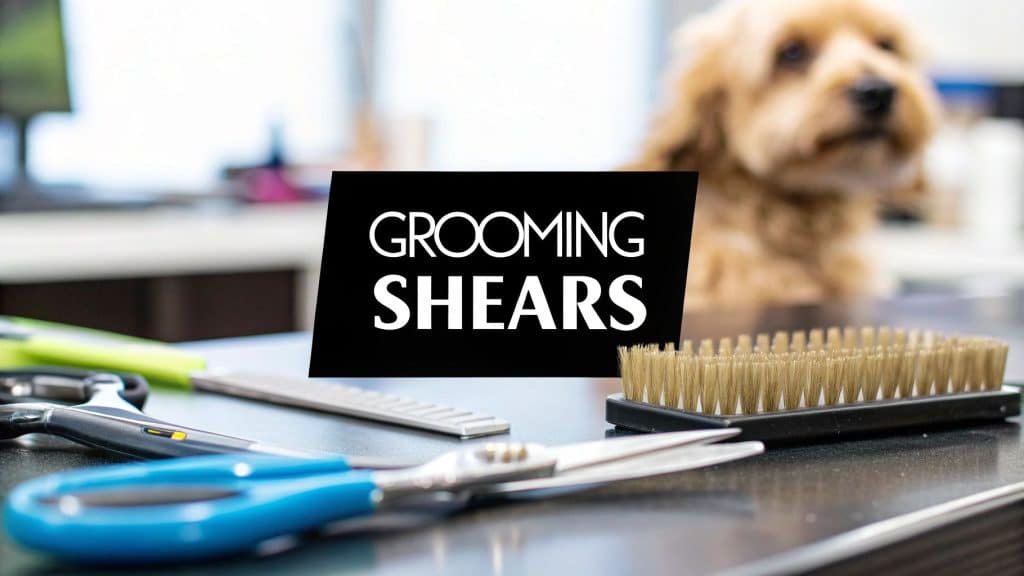
While grooming scissors are the star of the show, they work best when they're part of a team. A few other key items will round out your kit and set you up for success from the start.
- Blunt-Tipped Scissors: This is your go-to tool. The rounded ends are crucial for safely trimming fur, especially around tricky spots like the face and paws.
- A Sturdy Comb: You'll need this for working through tangles and, just as importantly, for creating a protective barrier between the scissor blades and your cat’s skin.
- A Gentle Brush: Brushing regularly is your first line of defense against mats. It removes loose hair before it has a chance to tangle. A good double-sided pet grooming brush is a fantastic, versatile tool for any cat owner to have on hand.
Choosing the Right Type of Grooming Scissors
Walking into the world of pet grooming scissors can feel a lot like stepping into a professional chef’s kitchen—there's a specific tool for every single job. You wouldn't try to peel an apple with a bread knife, right? The same logic applies here. Getting to know the different kinds of shears is the key to handling any grooming task safely and getting great results.
Picking the right tool isn’t just about making your cat look good; it's about making the whole process stress-free and comfortable for them. Before you even pick up a pair of scissors, it's worth thinking about your cat's personality. This little decision tree can help you figure out if at-home grooming is the right move for your furry friend.
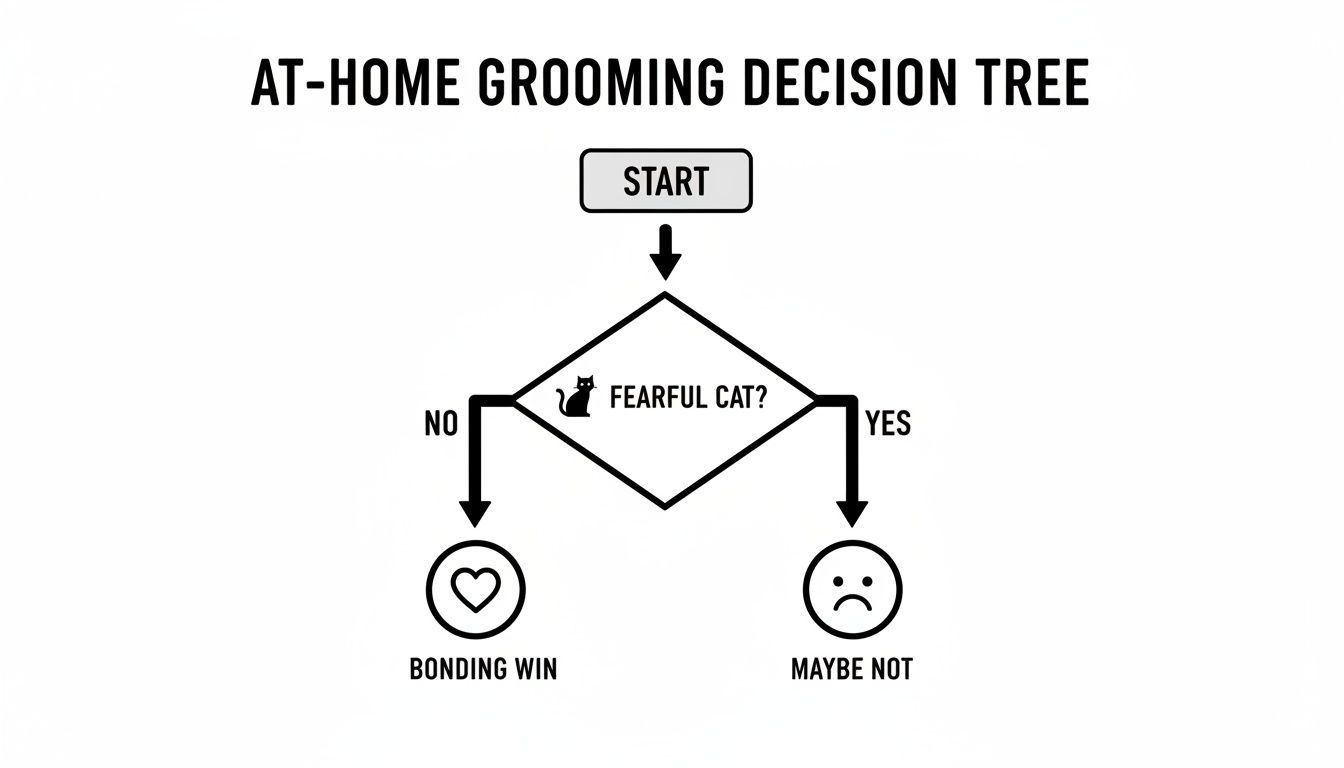
As you can see, a cat's temperament is everything. For a calm, trusting cat, a grooming session can be a wonderful bonding experience. For a nervous one, it might be best left to the pros.
Straight and Curved Scissors: The Foundation
Think of straight scissors as your all-purpose workhorse. They’re built for creating clean, straight lines, making them perfect for trimming larger, flat areas on a long-haired cat’s body. If you’re just building your grooming kit, a quality pair of straight scissors—preferably with blunt safety tips—is the first thing you should buy.
Curved scissors, on the other hand, are the artists in your toolkit. Their blades have a gentle arc designed to follow the natural curves of your cat's body, which makes them absolutely essential for trimming around sensitive and rounded spots.
These are your go-to shears for safely shaping fur around tricky areas like:
- Paws and in between paw pads
- The face and ears
- The sanitary area (or "tushy")
The value of these specific tools is clear when you look at the numbers. By 2024, the market for pet grooming scissors hit a staggering USD 140 million, with curved scissors making up a huge piece of that pie. It just goes to show how much pet owners and pros depend on these specialized designs for careful, precise work. You can get more details on the growth of the grooming tool market to see just how popular they’ve become.
Pro Tip: When you're working near the face, ears, or paws, always reach for small, curved scissors with rounded safety tips. That simple design feature dramatically lowers the risk of accidentally poking or injuring your cat if they suddenly move.
Thinning and Chunker Shears for a Polished Finish
After you’ve done the basic shaping with straight or curved scissors, you might find some spots are still a bit too bulky or dense. That's where texturizing shears save the day.
Thinning shears are easy to spot—they have one normal blade and one with fine teeth, like a comb. They're designed to remove excess weight from the coat without taking off length. Think of them as selectively snipping out a few hairs at a time, which is perfect for softening harsh scissor lines and blending different lengths together. They work wonders on a thick neck ruff or fluffy "britches."
Chunker shears are basically a more aggressive version of thinners. Their teeth are wider and spaced further apart, so they remove more fur with each cut. They help create a soft, textured, and more natural-looking finish. For most cat parents grooming at home, thinning shears are all you’ll ever need. But if you’re aiming for that perfectly coiffed, show-ready look, chunkers are a fantastic tool to have.
To help you decide, here’s a quick breakdown of which scissors do what.
Which Grooming Scissors Are Right for Your Cat
| Scissor Type | Primary Use for Cats | Best For |
|---|---|---|
| Straight Scissors | General trimming on flat body areas, setting straight lines. | Long-haired cats needing a basic trim on their back and sides. |
| Curved Scissors | Safely trimming around curved areas like paws, face, and tail. | All cat owners, especially for grooming sensitive, rounded spots. |
| Thinning Shears | Removing bulk, softening harsh lines, and blending fur lengths. | Cats with thick, dense fur that needs to be thinned without losing length. |
| Chunker Shears | Texturizing and creating a soft, natural finish (removes more fur). | Advanced groomers aiming for a stylized or show-quality appearance. |
Ultimately, having a pair of straight and a pair of small, curved safety scissors will cover almost all of your at-home grooming needs. Thinning shears are a great next step if you find you need more control over your cat's thick coat.
What to Look for in Scissor Materials and Blades
The real difference between a budget pair of scissors that snags and pulls fur and a professional tool that glides through it comes down to two things: the metal and the blade design. Getting these right is the secret to investing in a pair of scissors that's not just effective, but also safe for your cat.
It’s no surprise that quality tools are becoming a bigger deal for pet owners. In the wider pet grooming market, shears and trimming tools are actually the fastest-growing segment. While shampoos still bring in the most money overall, the boom in tool sales shows that people are finally realizing how much of a difference the right equipment makes. You can actually dive into the consumer purchasing patterns to see this shift for yourself.
Scissor Material: The Foundation of Quality
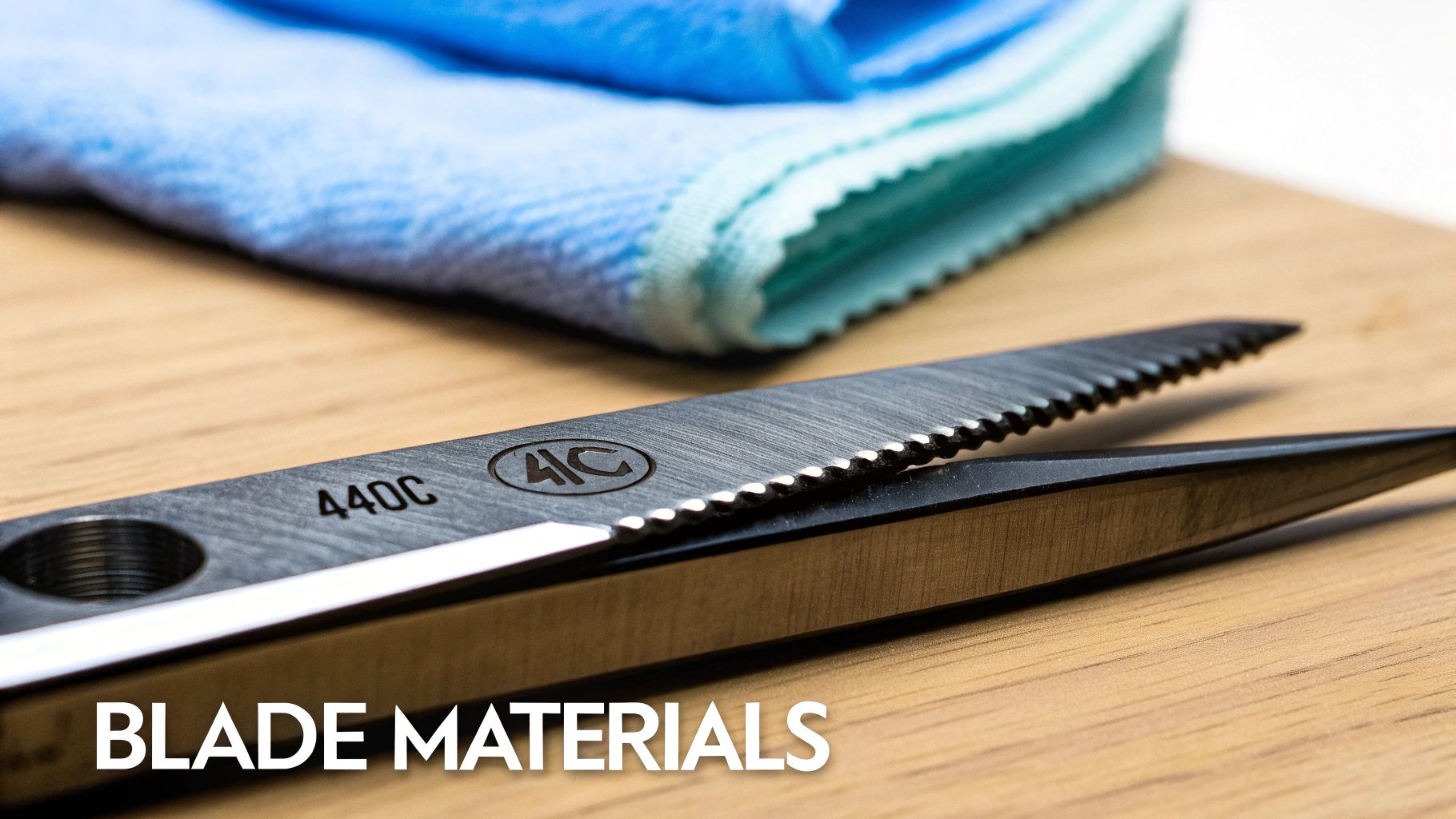
The type of steel used to make a pair of scissors dictates everything—its sharpness, how long it stays sharp, and its ability to fight off rust. It’s like the difference between a cheap kitchen knife and a professional chef's blade. One gets the job done, but the other does it with precision, ease, and lasts a lifetime.
-
Standard Stainless Steel: This is your basic, entry-level material. It’s a solid starting point for occasional home grooming because it's pretty durable and resists corrosion well enough.
-
Japanese 440C Stainless Steel: This is the gold standard in the grooming world. It's a premium steel with a much higher carbon content, which means it can be hardened to create a razor-sharp edge. More importantly, it can hold that edge for a very long time. This steel is also fantastic at resisting rust, which is crucial for protecting your investment.
When you choose a higher-grade steel like Japanese 440C, you’re paying for less frequent sharpening, a buttery-smooth cut that won't tug on your cat's fur, and a tool that will truly last for years with just a little care.
Blade Edges Explained
It’s not just about the metal. The way the blade's edge is actually shaped, or "ground," completely changes how the scissors perform. You'll mainly see two types: beveled and convex. Each one has a job to do.
Convex Edge Blades
You might hear these called a Japanese-style edge. The blade has a subtle curve that tapers down to an incredibly fine point. This design gives you a remarkably sharp and smooth cutting motion, which is why professional groomers love it for getting that perfect, flawless finish.
Beveled Edge Blades
This is the classic, more traditional edge. You'll notice a distinct angle ground onto one or both of the blades. It might not feel quite as silky as a convex edge, but a beveled blade is an absolute workhorse. It's tough as nails and fantastic for general-purpose grooming, especially for powering through thicker fur without getting dull. You'll often find this robust edge on thinning and chunker shears.
How to Safely Use Grooming Scissors on Your Cat
When it comes to using pet grooming scissors on your cat, the most important tools are actually preparation and patience, not just fancy scissoring techniques. Your main goal should be creating a calm, quiet space where both you and your cat feel totally secure. A stressed-out cat is a wiggly cat, and that’s when accidents happen.
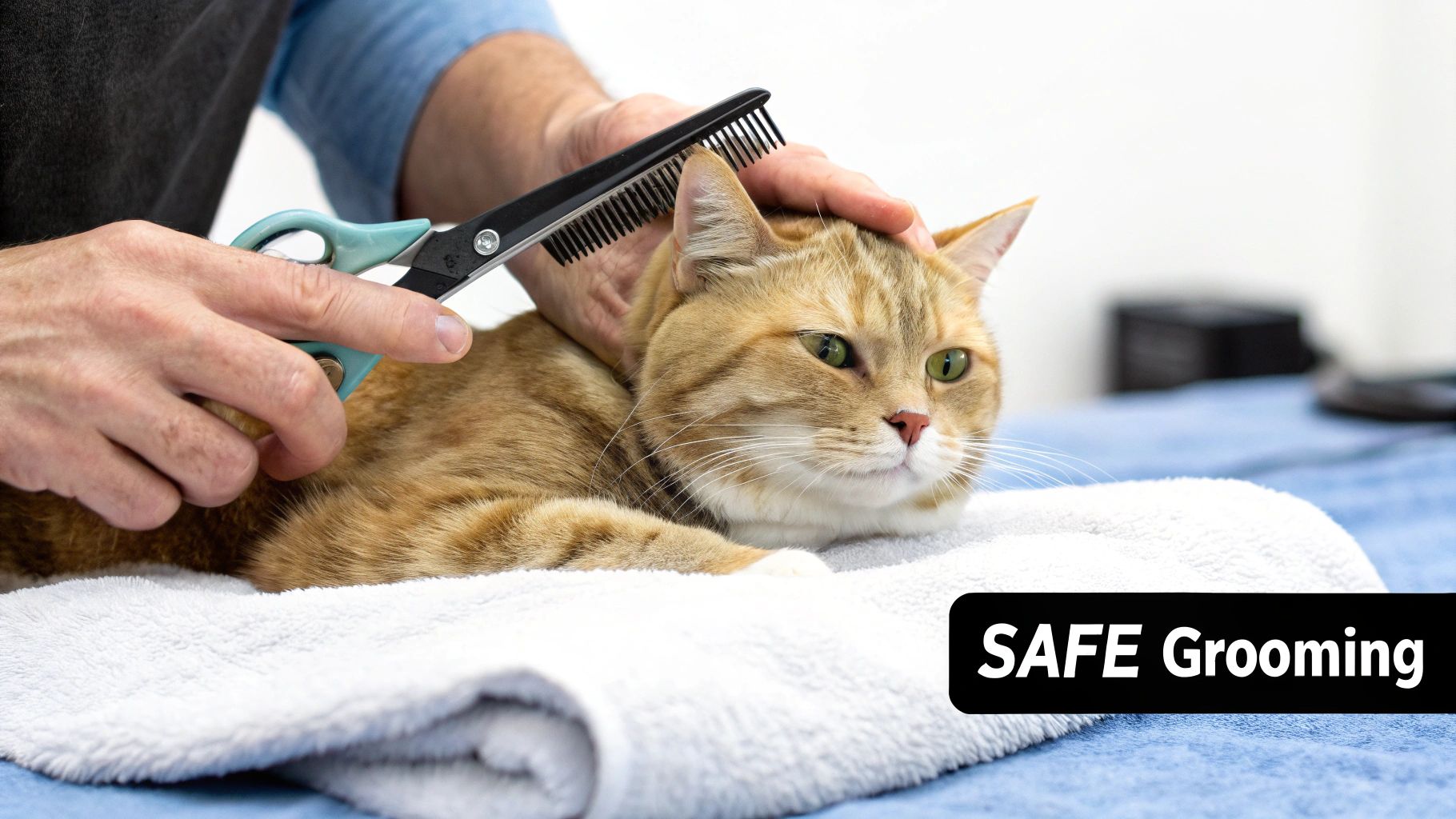
Timing is everything. Try to pick a moment when your cat is already relaxed and mellow—maybe after a good meal or a long nap. The last thing you want to do is try and groom a cat with a case of the zoomies. If you're new to this, having a friend or family member gently hold and reassure your cat can be a game-changer.
Mastering Safe Handling Techniques
The right way to hold the scissors is key to preventing any nicks or cuts. A golden rule to live by: never, ever cut fur unless you can clearly see the scissor tips and your cat's skin. Sticking to this one simple habit will drastically lower any risk.
Here's a pro tip: use a comb as your safety shield. Just slide a fine-toothed comb between your cat’s skin and the piece of fur you need to trim. This creates a physical barrier, letting you snip away at the hair sticking up above the comb without the blades getting anywhere near their delicate skin.
Safety First: Always reach for scissors with blunt or rounded tips, especially when working near sensitive spots like the face, ears, and paws. They're specifically designed to prevent accidental pokes if your cat suddenly moves. And always, always keep the scissor tips pointing away from your cat's body.
A Step-by-Step Safety Checklist
Before you make that first snip, it helps to run through a quick mental checklist. Making these steps a habit will not only build your confidence but also help your cat learn to trust the process.
-
Create a Calm Space: Find a quiet room where you won't be interrupted. A sturdy table with a non-slip mat works great. For cats that get a bit nervous, giving them a secure spot to settle in is a must. Many find that a comfortable cat hammock for large cats can create an elevated and relaxing grooming station.
-
Use the Comb as a Shield: Remember the trick? Always place the comb flat against their skin, lifting the mat or long fur up through the teeth. You’ll cut parallel to the comb, keeping the scissor blades safely above it.
-
Make Small, Confident Snips: Don't try to remove a whole mat in one big chop. It’s much safer to use a series of small, controlled snips. This approach gives you far more control and precision.
-
Know When to Stop: Keep the first few grooming sessions short and positive. If you see signs of stress—like a twitching tail, flattened ears, or a low growl—that’s your cue to stop for the day. Pushing a cat past its comfort zone will only teach it to hate grooming time.
Maintaining Your Scissors for Long-Lasting Performance
Think of your grooming scissors like a chef’s favorite knife. They’re an investment, and with just a little bit of care, they’ll give you years of smooth, safe performance. If you let them go, though, you’ll end up with dull blades that pull on fur instead of slicing through it—and that’s no fun for your cat.
The best approach is a simple, two-minute ritual after every grooming session. It's a small habit that makes a huge difference in protecting your tools and keeping them ready for the next trim.
Your Daily and Weekly Care Routine
Cleaning the blades right after you finish grooming is the most important thing you can do. All that fur, skin oil, and dander can build up, making the scissors feel sticky and even leading to rust down the road.
Here's a simple breakdown:
- Wipe Down the Blades: Grab a soft, dry cloth (microfiber is perfect for this) and gently wipe the blades, starting from the pivot screw and moving toward the tips. This gets all the hair and gunk off.
- Apply a Drop of Oil: About once a week, put a single drop of scissor oil right on the pivot point where the blades meet. Open and close the scissors a few times to work the oil into the joint, keeping the action smooth.
- Wipe Away Excess: Use your cloth to wipe any extra oil off the blades. You don't want that getting onto your cat's clean coat next time.
How you store them matters, too. Tossing your scissors into a drawer with other tools is just asking for nicks and misaligned blades. Keep them safe in the case they came in or in a padded sleeve to protect those delicate cutting edges.
Tension and Sharpening Know-How
The secret to that buttery-smooth cut is all in the tension. If the tension is too loose, the blades will just fold the fur over instead of cutting it. But if it’s too tight, you’ll wear down the edges much faster and give your hand a workout.
The Tension Test: Hold the scissors up with the finger loops pointing to the ceiling. Lift one handle so the blade is horizontal, then just let it drop. On a perfectly tensioned pair, the blade should close on its own about two-thirds of the way.
Eventually, if your scissors start snagging or you feel like you have to force them to cut, it’s time for a professional sharpening. Please don't try this at home! It takes special equipment to get the blade edge angle just right. For most people grooming a cat at home, you'll probably only need this done every 1-2 years.
While we're focused on pet scissors, the core principles of keeping tools clean and sharp apply to all sorts of things. You'll find similar advice in guides for pruning scissors and general tool care. And for everything else you need, you can explore our full range of grooming and cleaning supplies to build out your perfect at-home kit.
Your Cat Grooming Questions, Answered
Stepping into the world of at-home cat grooming can feel a little daunting. You’ve got the cat, you’ve got the motivation, but you’ve also got questions. That’s completely normal. Getting good answers is the first step toward making grooming a safe, positive, and even bonding experience for you and your kitty.
Let's tackle some of the most common things cat parents ask about pet grooming scissors.
Probably the biggest question we hear is, "Can't I just use my regular scissors from the kitchen drawer?" The answer, in short, is a hard no. Your craft or kitchen scissors just aren't built for the job. They’re missing the most important safety feature: the blunt or rounded safety tips that prevent you from accidentally poking your cat if they make a sudden move. Beyond that, the blades themselves are different. Cat fur is way thicker than human hair, and it needs a specialized blade that cuts cleanly instead of folding or pulling the fur—which is uncomfortable for your cat and frustrating for you.
Nailing the Finer Points
Once you know you need the right tool, a few more practical questions usually pop up. Getting these details right from the start makes all the difference.
-
What's the best scissor size for a cat? When it comes to cats, think small. A pair of scissors between 4.5 and 6.5 inches gives you the perfect balance of control and precision. This smaller size is crucial for navigating the delicate curves around your cat’s paws, face, and sanitary areas without feeling clumsy.
-
How often should I get my scissors sharpened? If you're just doing occasional trims at home, you won't need to worry about this too often. You'll probably only need a professional sharpening every year or two. You’ll know it’s time when you feel the blades start to snag or bend the fur instead of slicing through it with a satisfying, crisp snip.
Remember, the goal here is to make grooming feel like a normal part of your routine, not a battle. Your patience and a pocketful of treats are just as vital as the scissors themselves.
The key is to go slow. Start by just letting your cat sniff the closed scissors. Let them get used to the tool being near them. Then, maybe touch the blunt side to their back, followed by a treat and a "good kitty!" By keeping those first few sessions super short—we’re talking one or two snips, max—you'll build a foundation of trust that makes everything easier down the road.
At Ur Pet Store, we're here to help you get the right gear for the job. You can find our complete collection of groomer-approved, pet-safe supplies by visiting our online store today.