

Blog
A Guide to Professional Dog Grooming Clippers

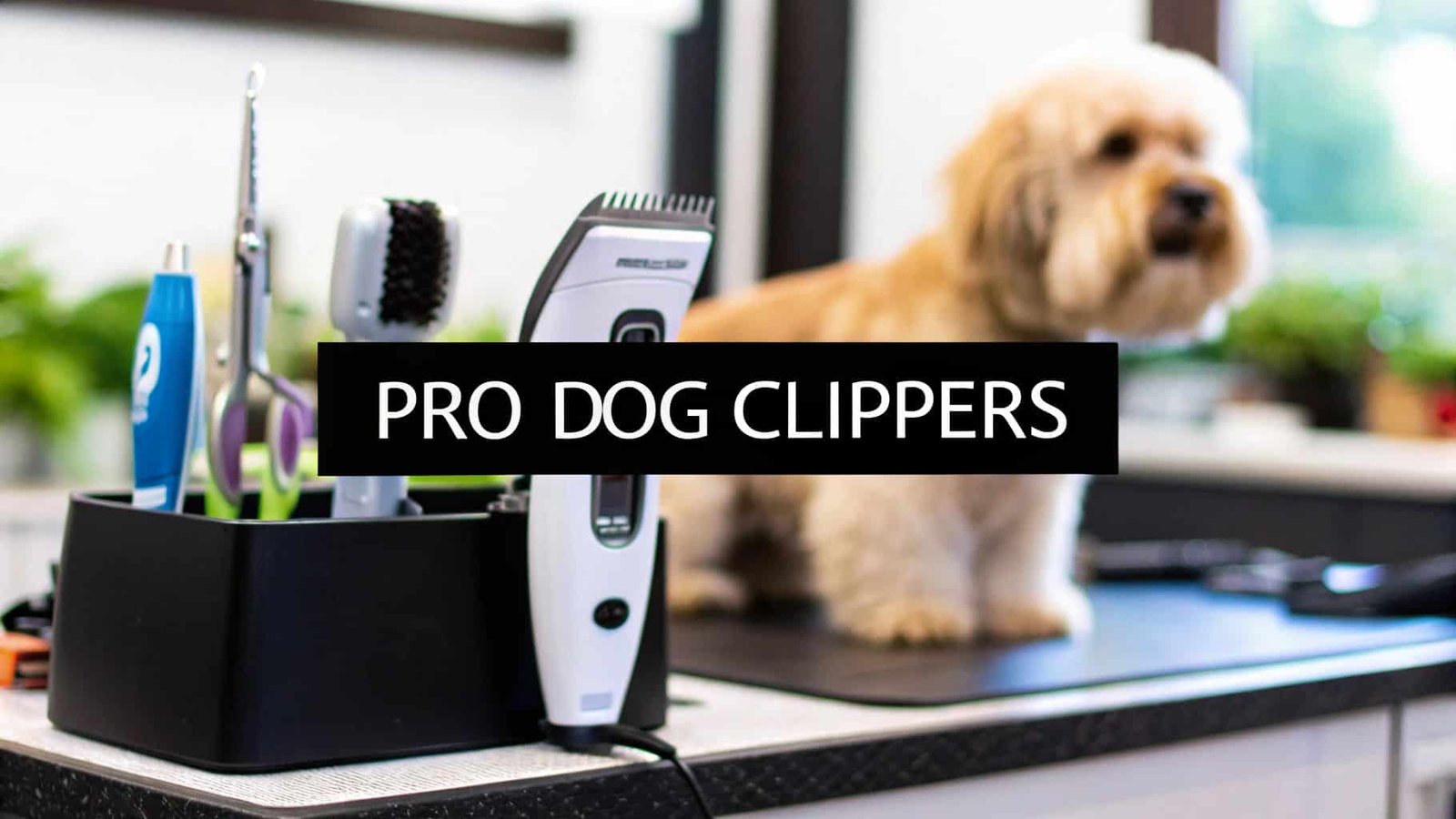
Picking the right clippers can mean the difference between a frazzled, uneven trim and a smooth, salon-quality groom right in your own home. Professional dog grooming clippers are a real investment in your dog’s comfort and safety, offering a level of power and precision that your average pet store clippers just can’t touch. Think of it as the ultimate upgrade for your grooming kit.
Why Professional Clippers Are a Grooming Game Changer
Ever tried cutting a thick steak with a butter knife? Sure, you might saw through it eventually, but it’s going to be a messy, frustrating ordeal. That’s pretty much what it’s like using standard clippers on a dog with a thick or matted coat. It’s a surefire way to snag hair, irritate their skin, and make grooming a stressful experience for everyone involved.
This is exactly where professional-grade clippers come in. They aren’t just a little bit better—they’re in a whole different league. These tools are built from the ground up with top-tier components meant to handle the incredible variety of dog coats, from a Yorkie’s fine, silky hair to a Husky’s dense double coat.
The Core Advantages of Professional Tools
When you invest in a professional-grade tool, you’re putting efficiency, safety, and quality first. Grooming sessions become quicker, more comfortable for your dog, and deliver that polished look every single time. This is all thanks to a few key upgrades that truly set these clippers apart.
And it’s not just us saying it. There’s a growing trend of pet owners making the switch. The market for cordless dog grooming clippers was valued at around USD 150 million in 2024 and is expected to hit USD 250 million by the end of the decade. With an estimated 70% of households in North America owning a pet in 2023, it’s clear people are getting serious about grooming. You can learn more about the rise of professional-grade grooming tools on datahorizzonresearch.com.
So what do you actually get with that upgrade?
- Powerful Motors: They have the muscle to glide through thick, matted fur without slowing down or painfully pulling on your dog’s hair.
- Durable, High-Quality Blades: Usually made from high-carbon steel or ceramic, these blades stay sharper longer and run cooler, protecting your dog’s sensitive skin from burns.
- Ergonomic Design: Since pros use these for hours, they’re built to be comfortable in your hand, which means less fatigue for you and more control for those tricky spots.
By choosing professional dog grooming clippers, you’re not just buying a tool; you’re adopting a better grooming philosophy. It’s about transforming a chore into a positive bonding experience that keeps your dog looking and feeling its best.
Ultimately, making the switch means less struggle and more professional results, right from your home. And with Ur Pet Store’s focus on quality materials, plus our fast, free shipping, getting your hands on the right tools has never been easier.
Understanding the Engine Inside Your Clippers
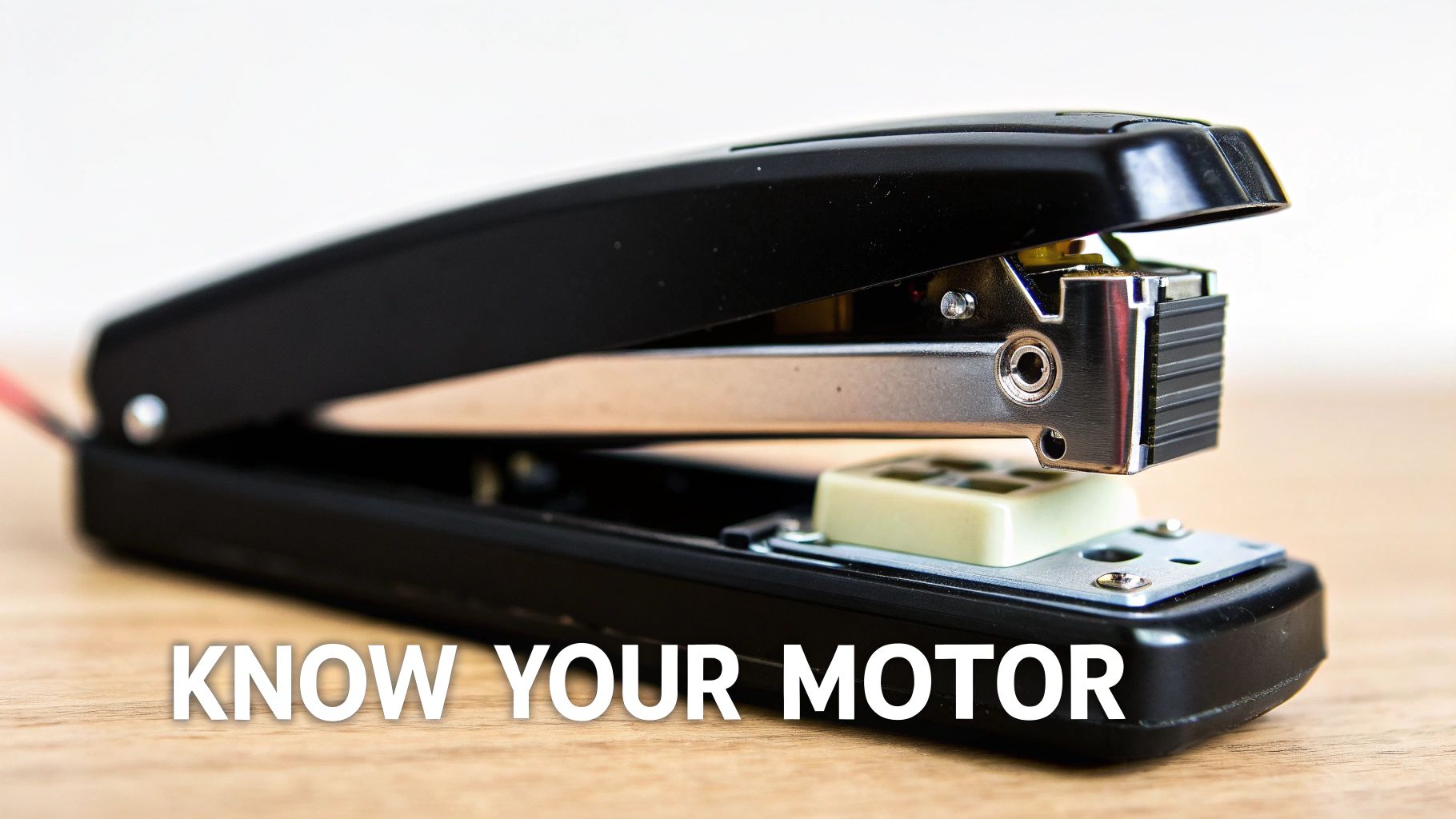
To really get what sets professional-grade clippers apart, you have to look under the hood. The motor is the heart of the machine, the single biggest factor determining its power, speed, and how it performs on the grooming table. Picking the right motor is like choosing an engine for a truck—what you need for a light errand isn’t going to cut it when you’re hauling a heavy load.
Once you know the difference between motor types, you can see past the marketing hype and pick a tool that can genuinely handle your dog’s coat. It’s the key to investing in clippers that won’t burn out, snag fur, or turn grooming into a wrestling match.
The Powerhouse: Rotary Motors
Think of a rotary motor as the V8 engine of the grooming world. It’s hands-down the most powerful and versatile option out there, which is why it’s the gold standard in nearly all professional-grade clippers. These motors are built for pure torque and endurance, letting them plow through the thickest, toughest coats without even flinching.
Whether you’re dealing with a Siberian Husky’s dense double coat or a Poodle’s tight curls, a rotary motor delivers the consistent, reliable power you need. They also tend to be impressively durable and run relatively quiet, which is a huge plus for nervous dogs. Because of their balanced design, they work with the widest variety of blade sizes and speed settings.
Here’s the bottom line: for tough jobs, multiple dogs, or professional work, a rotary motor is non-negotiable. Its raw power keeps the clippers from getting bogged down, giving you a smoother, safer, and faster groom every single time.
Other Common Motor Types
While rotary motors own the professional space, you’ll see a few other types out there, usually in clippers designed for more specific, lighter-duty tasks.
- Magnetic Motors: These are the simple, reliable workhorses you’ll often find in entry-level clippers. They use a spring and an electromagnet to drive the blade. They don’t pack the punch of a rotary motor, but they’re great for light touch-ups, finish work, or dogs with single coats and fine hair.
- Pivot Motors: These are a step up from magnetic motors in terms of power. They actually run at a lower blade speed but have more torque, which makes them surprisingly effective for cutting through thick or even damp fur. You don’t see them as often in the top-tier professional clippers, though.
Decoding Strokes Per Minute (SPM)
Once you’ve got the motor figured out, the next spec you need to look at is Strokes Per Minute (SPM). This number simply tells you how many times the cutting blade moves back and forth in one minute. But it’s not just about raw speed; it’s about matching the right speed to the right job.
Think of it like sanding wood. To strip off thick old paint, you’d want a powerful, slower-speed sander that won’t get bogged down. For that final, glass-smooth finish, you’d grab a high-speed sander. Clipper speed works exactly the same way.
Lower SPM (around 2,000-3,000):
- More Torque: Slower speeds give the motor more muscle behind each stroke. This is what you need to power through mats and dense bulk without stalling.
- Runs Cooler: Less friction means the blades don’t heat up as fast, which is critical for keeping the dog comfortable and safe during long grooms.
- Best for Bulk Removal: This is your go-to setting for that first “rough-in” cut on a coat that’s gotten a little out of hand.
Higher SPM (3,500+):
- Smoother Finish: The rapid blade movement shears the hair cleanly, leaving a beautiful, velvety finish that’s perfect for show-quality looks.
- Faster Cutting: On a clean, well-maintained coat, you can fly through the groom at high speed.
- Ideal for Fine Coats: Works wonderfully on silky or fine-haired breeds where you need finesse more than brute force.
Most true professional clippers come with at least two speed settings, giving you the flexibility to shift from low-torque power to high-speed finishing with the flick of a switch. That kind of versatility is the mark of a great tool. At Ur Pet Store, we make sure our curated selection includes clippers with robust motors and versatile speed options, all backed by our commitment to quality materials and fast, free delivery.
Selecting the Right Blades for a Flawless Finish
If the clipper motor is the engine, the blades are the tires. They’re where the rubber meets the road—or in this case, where steel meets fur. The blade you choose is everything; it dictates the quality of the cut, the safety of the dog, and the final look you’re trying to achieve.
At first glance, all the numbers, materials, and tooth designs can feel a little overwhelming. But once you understand what they all mean, it’s actually pretty simple. Getting this part right is what turns a good groom into a great one.
Blade Materials Matter
What a blade is made of has a huge impact on its performance, how long it lasts, and, most importantly, how hot it gets during a grooming session. In the pro grooming world, two materials dominate the scene, each with its own clear advantages.
- High-Carbon Steel: This is the classic, workhorse material for most professional blades. Steel is tough as nails, holds a sharp edge for ages, and can be resharpened over and over again, which makes it a smart investment. The only real downside is that it heats up, so you’ll need to take breaks or use a coolant spray on longer grooms.
- Ceramic: The superstar quality of ceramic blades is their heat resistance. They can stay up to 75% cooler than steel during a long session because ceramic just doesn’t conduct heat as well. That means a much lower risk of accidentally burning a dog’s sensitive skin and a more comfortable experience all around. They stay sharp for a very long time, but they are more brittle—drop one on a hard floor, and it might shatter.
A popular pro-tip is to use a hybrid setup: a ceramic cutting blade paired with a steel comb blade. This gives you the best of both worlds—a cool-running cutting surface with the durability of a steel base.
Demystifying the Blade Numbering System
Those numbers stamped on the blades might look like a secret code, but they’re just a simple guide to how much fur the blade will leave behind. It’s a lot like a photographer choosing different lenses: a #3F blade is your wide-angle for covering large areas of the body, while a #40 is your macro lens for getting super close for detailed work.
Here’s the main rule to remember: the higher the blade number, the shorter the cut. A lower number leaves the fur longer. This system gives you the precision you need for everything from a short summer shave-down to a fancy, breed-specific style. It’s this desire for professional-level results at home that’s driving huge growth in the pet care world. The global pet hair trimmer market, which was USD 2.63 billion in 2024, is expected to more than double to USD 5.62 billion by 2035. You can read more about the expanding pet clipper market and its trends on metatechinsights.com.
To make it even easier, here’s a quick-reference guide to some of the most common blade sizes and what they’re used for.
Dog Grooming Clipper Blade Guide
This table breaks down common blade numbers, showing you exactly how much hair they leave and what jobs they’re best suited for.
| Blade Number | Cut Length (mm) | Best For |
|---|---|---|
| #40 | 0.25 mm | Surgical prep, pads of feet, sanitary trims (Pro use only) |
| #10 | 1.5 mm | Standard “kennel cut,” face, feet, sanitary areas, matted coats |
| #7F | 3.2 mm | Smooth body clip for a short, clean summer look |
| #5F | 6.3 mm | Leaves a bit more length for a fluffier body finish |
| #4F | 9.5 mm | A popular “puppy cut” length for a teddy bear look |
| #3F | 13 mm | Ideal for very long body cuts on non-matted coats |
Having this chart handy can save you a lot of guesswork and help you pick the perfect tool for the job every time.
Skip-Tooth Versus Finish-Cut Blades
Last but not least, you’ll see that some blades have an “F” after the number (like #7F), while others are just the number. This one little letter tells you a lot about how the blade will perform.
Finish-Cut (F) Blades: These blades have teeth that are all perfectly even and the same length. This design glides through clean, tangle-free fur to produce an incredibly smooth, velvety finish. If you want that polished, show-dog look, an “F” blade is what you need.
Skip-Tooth Blades: On these blades, every other tooth is shorter. This creates a staggered, comb-like effect that helps feed thick, matted, or wiry fur into the cutting teeth much more easily. They’re fantastic for the initial rough cut to remove bulk from a neglected coat, but they leave a more textured, uneven finish. A groomer will almost always go back over the coat with an F blade to smooth everything out.
At Ur Pet Store, we know that having the right tools makes all the difference. Our collection of professional dog grooming clippers and blades is chosen with quality and performance in mind, so you can always find the perfect match for any coat. Plus, with our fast, free shipping, you can get exactly what you need delivered right to your door without the wait.
Matching Clippers to Your Dog’s Unique Coat
Choosing professional dog grooming clippers isn’t a one-size-fits-all deal. What works like a dream on a Golden Retriever might just get tangled up in a Poodle’s curly coat. The real secret to a safe, efficient, and beautiful groom is matching the clipper’s features to your dog’s specific coat type.
Think of it like buying tires. You wouldn’t put slick racing tires on a truck that’s about to head down a muddy backroad, right? In the same way, the powerful, high-torque clippers you need for a dense undercoat are total overkill for a dog with fine, silky hair. This is where we connect the dots between those technical specs and actual dog breeds.
Tackling Thick Double Coats
Breeds like Huskies, German Shepherds, and Golden Retrievers are famous for their formidable double coats—a dense, woolly undercoat protected by a longer topcoat. This combination is notorious for bogging down clippers that aren’t up to the task. For these dogs, you absolutely need a grooming tool with some serious muscle.
Your best bet here is a heavy-duty rotary motor clipper, especially one with a lower speed setting. The high torque plows through that thick fur without getting stuck, and the lower SPM (strokes per minute) keeps the blades from getting dangerously hot during the long grooming sessions these coats often require.
It’s no surprise that more owners are investing in professional-grade tools. The global dog grooming market, valued at USD 9.38 billion in 2024, is expected to climb to USD 15.83 billion by 2032. With a whopping 67% of US households owning pets in 2023, the demand for effective at-home grooming solutions has never been higher. You can learn more about the booming dog grooming industry on verifiedmarketresearch.com.
Fine and Silky Coats
What about dogs like Yorkshire Terriers, Maltese, and Shih Tzus? They have fine, silky hair that’s more like human hair. It grows continuously and doesn’t have a thick undercoat, which means it’s prone to tangles but is actually pretty easy to cut. For these breeds, raw power isn’t the priority—you want precision and agility.
A lightweight, high-speed clipper is the perfect match. The high SPM delivers a clean, sharp cut that leaves a smooth, polished finish. Since you’re often doing more detailed styling around the face and paws, a lighter, more ergonomic design will save your hand from getting tired and give you much better control.
A quick but crucial tip: always brush the coat thoroughly before you even think about clipping. Managing shed and getting that pristine finish often requires specialized gear, and understanding the best vacuums for dog hair can offer some great insights into keeping your home hair-free.
Curly and Wiry Coats
Poodles, Schnauzers, and a lot of terrier breeds throw a different kind of curveball with their curly or wiry coats. These textures are dense and can easily snag if you’re not careful. The goal is to get a clean cut without pulling the hair, which calls for a smart combination of power and the right blade.
A versatile, multi-speed rotary motor clipper is your go-to tool here. You can dial it down to a lower speed for more torque to power through dense sections, then crank it up to a higher speed for finishing touches.
Of course, the clippers are only half the equation. The blade you choose is just as important. This simple chart breaks it down:
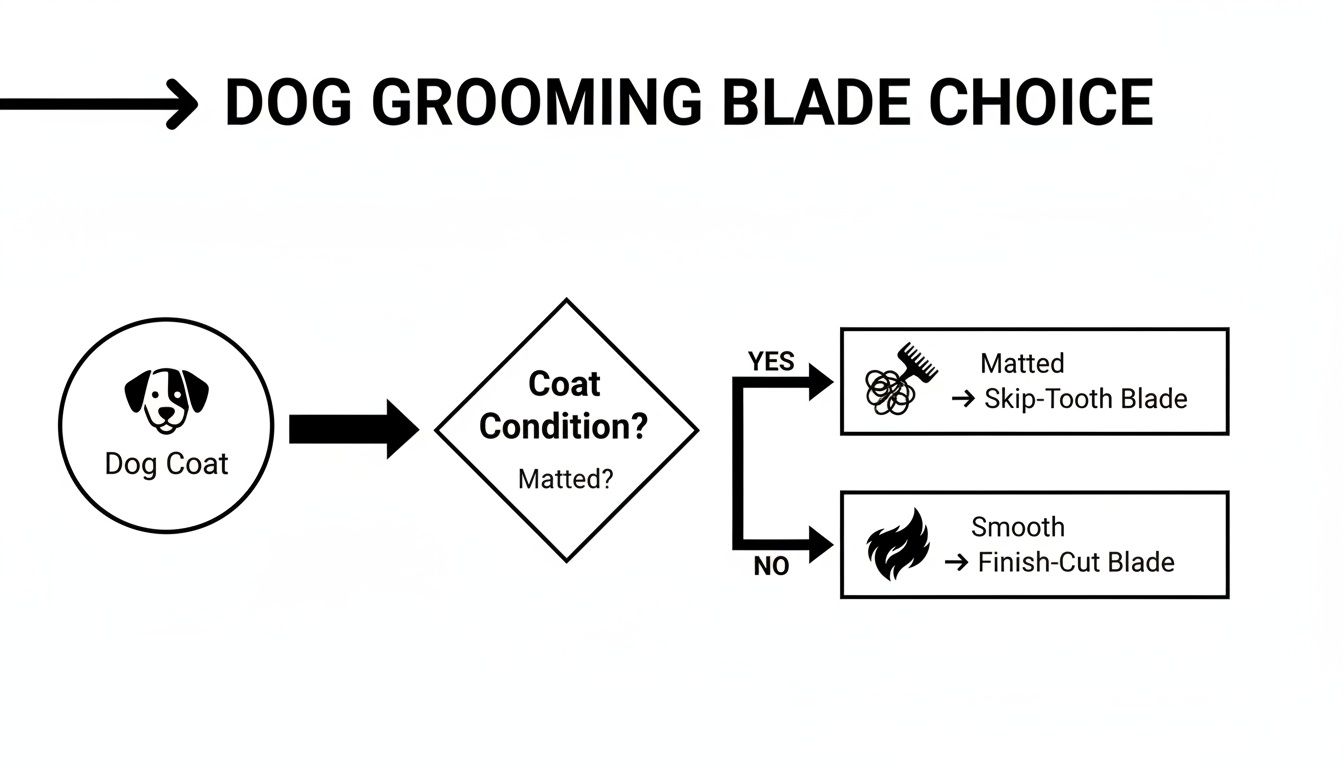
As you can see, a matted coat needs a skip-tooth blade to get underneath the knots. For a smooth, well-brushed coat, a finish-cut blade will give you that polished, show-ready look.
Good prep work is non-negotiable for these coats. Using a quality brush before you start can make a world of difference. For those really tough tangles, you might find our guide on the benefits of a double-sided pet grooming brush helpful.
By understanding these key differences, you can confidently pick the perfect professional dog grooming clippers from Ur Pet Store. Our hand-picked selection ensures you get quality materials built for any coat, and with our fast, free delivery, you’ll have the right tool for the job before you know it.
Essential Maintenance to Keep Your Clippers Running Smoothly
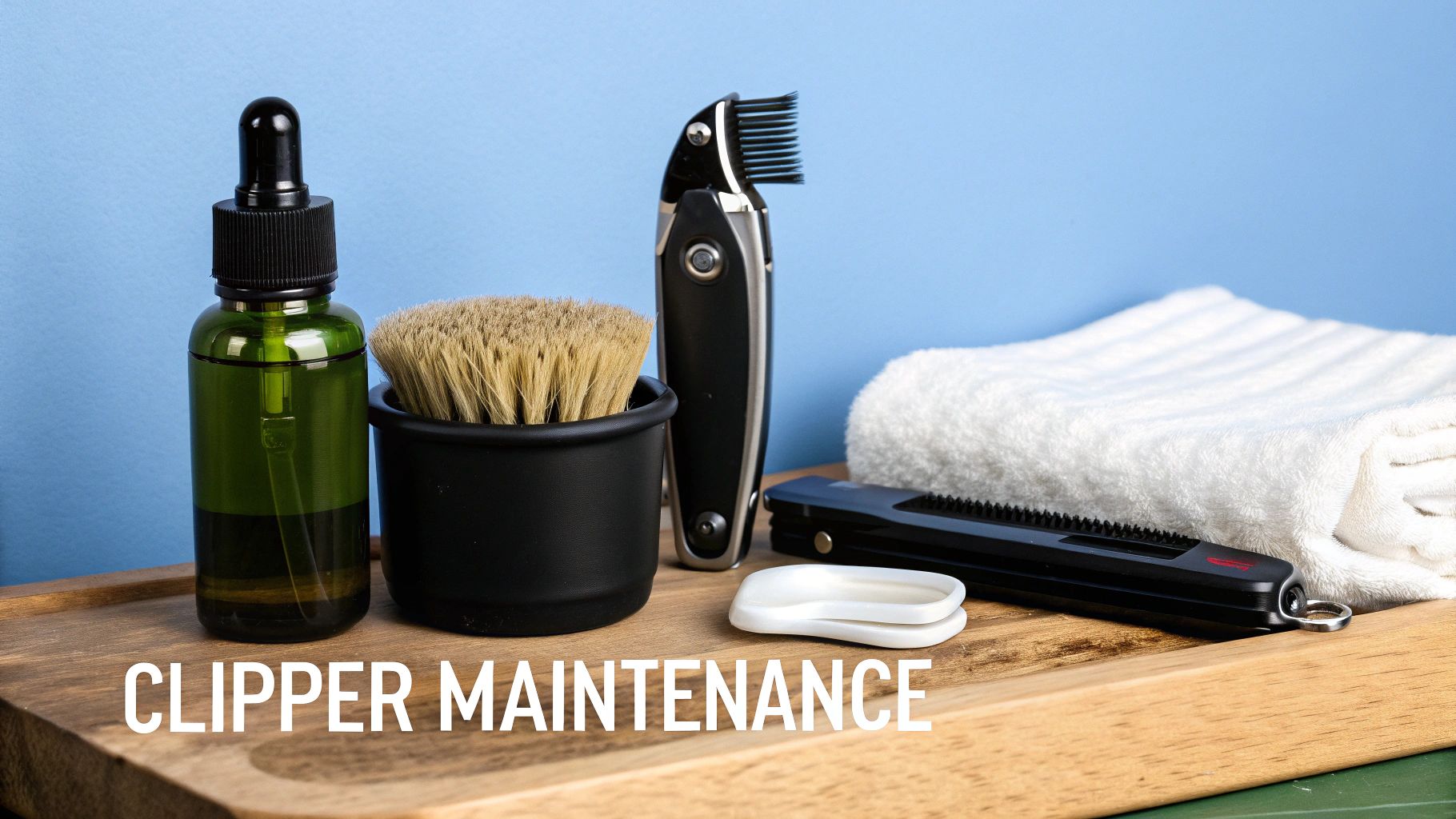
Getting a set of professional dog grooming clippers is a great start, but keeping them in top shape is where the real work—and reward—lies. Think of it like a high-performance car; you wouldn’t just drive it without ever changing the oil, right? Your clippers are the same. A little bit of care goes a long way.
Neglecting maintenance is a recipe for disaster. You’ll end up with blades that snag, a motor that strains, and a tool that just doesn’t last. The good news is, a simple routine that takes maybe five minutes after each groom can keep your clippers running beautifully for years.
The Non-Negotiable Post-Groom Checklist
Make these steps an unbreakable habit. It’s the single best thing you can do to protect your investment and ensure a safe, comfortable groom every time.
- Clean Them Out, Every Single Time: Hair and dander are the enemy. After you switch off the clippers, grab a small brush and get all that gunk out from between the blade teeth and around the moving parts. If you let it build up, it acts like a sponge for moisture, leading to rust and excess friction.
- Oil, Oil, and Oil Again: Friction equals heat. Heat dulls your blades and, worse, can burn your dog’s skin. A few drops of clipper oil across the top of the blades is all it takes. Just run the clippers for a few seconds to let it work its way in. This simple step can keep blades up to 20°F cooler—a huge difference your dog will definitely appreciate.
- Store Them Smart: Once they’re clean and oiled, put your clippers away somewhere dry and safe. A dedicated case or a hook on the wall is perfect. This keeps them safe from being knocked over, which can throw the blades out of alignment, and protects the motor from moisture.
Managing Heat During Longer Sessions
Even the best-maintained clippers will get warm during a big job, like a full-body trim on a thick-coated breed. Hot blades aren’t just uncomfortable; they can cause painful clipper burn.
Here’s a quick pro tip: To check if a blade is too hot, carefully touch it to the inside of your wrist. If you can’t hold it there for five seconds, it’s way too hot for your dog’s skin.
The best way to manage heat on the fly is with a can of blade coolant. These aerosol sprays are fantastic—they cool the metal instantly, blast away hair buildup, and add a quick shot of lubrication. A quick spritz every 10-15 minutes can be a real game-changer, letting you finish the groom without having to stop and swap out blades.
You can find top-notch coolants, oils, and brushes right alongside our other essential grooming and cleaning supplies. Building these simple habits ensures your clippers perform like new for years, keeping every groom safe and stress-free for your best friend.
Your Top Questions About Professional Clippers Answered
Even after getting a handle on the technical stuff like motors and blades, you probably still have a few questions floating around. That’s completely normal. Here, I’ll tackle the most common things people ask, whether they’re grooming at home or running a busy salon.
How Often Do Clipper Blades Need to Be Replaced?
There’s no magic expiration date on clipper blades; their lifespan really comes down to how much you use them and how well you take care of them. If you’re just grooming your own dog at home, a good high-carbon steel blade can easily last for years as long as you keep it clean, oiled, and get it sharpened once in a while.
You’ll know it’s time when the blade stops cutting like butter. If you start to feel it snagging or pulling hair instead of slicing right through, it’s a clear sign your blade is dull. At that point, you can either send it out for a professional sharpening or grab a new one.
Are Cordless Clippers Really as Powerful as Corded Models?
They absolutely are these days. Modern lithium-ion batteries and super-efficient rotary motors have completely changed the game. The best professional dog grooming clippers on the market now offer all the power and torque you’d expect from a corded model, but without the cord.
This is a huge plus for freedom of movement, letting you get to those tricky spots without getting tangled up. That said, in a high-volume salon where clippers run all day long, some groomers still lean on their trusty corded clippers. It just eliminates any chance of a battery dying mid-groom on a packed day.
Can I Just Use Human Hair Clippers on My Dog?
Please don’t. I know it’s tempting, but it’s a really bad idea. Dog clippers are built differently from the ground up. They have much beefier motors designed to power through thick, often matted fur that would completely stall out a pair of clippers made for human hair.
It’s not just about power, either. The blades themselves are designed for a dog’s coat. They manage heat better and are shaped to glide safely over a dog’s sensitive skin. Using the wrong tool will lead to a painful experience for your dog, with lots of pulling and skin irritation, and a choppy, frustrating result for you.
What Should I Do If My Clippers Start Getting Hot?
Hot blades are a real problem and can be very uncomfortable, or even burn, your dog’s skin. This is a common issue during longer grooming sessions. The pro’s trick is to always have a second, identical blade on hand. When one gets hot, you simply swap it out for the cool one and keep going.
Another great option is a dedicated blade coolant spray. A quick spritz instantly cools the metal down and adds a bit of lubrication. But remember, the best defense is a good offense: oiling your blades regularly reduces friction, which is the root cause of heat in the first place.
At Ur Pet Store, we’re passionate about giving you access to the best tools for the job. We believe every pet deserves to look and feel their best. Take a look at our full collection of professional grooming supplies and remember, we offer fast and free shipping on every order. Find the perfect clippers for your best friend today at urpetstore.com.