

Blog
A Guide to Professional Dog Grooming Clippers

Picking the right professional dog grooming clippers is the secret weapon for a safe, efficient, and beautiful groom. Think of them like a chef's knife set; a powerful rotary motor clipper is your workhorse for thick, heavy coats, while a lightweight cordless model gives you the precision you need for those tricky, delicate areas.
Choosing Your First Professional Dog Grooming Clippers
Whether you’re a seasoned pro setting up your own salon or a dedicated pet owner looking to step up your game, choosing your first pair of professional dog grooming clippers feels like a big commitment. It's because the right tool can turn a potentially stressful chore into a smooth, rewarding experience for both you and the dog.
This is about more than just cutting hair—it's about having the control, safety, and confidence to get that polished, salon-quality look. We’ll break down the essential factors that make the difference between a frustrating trim and a flawless finish, so you can invest in a tool that’s perfect for you.
Why Professional Grade Matters
Making the jump to professional clippers is a game-changer. These tools are built like tanks, designed for heavy-duty performance and incredible durability. They offer power and reliability that you just won't find in basic consumer-grade models.
A professional clipper is engineered to glide through all kinds of coat types without snagging, pulling, or overheating—all of which are absolutely critical for a dog's comfort and safety. The demand for these high-quality tools is booming. The global pet grooming market was valued at a massive US$68.3 billion in 2022 and is on track to hit around US$135 billion by 2032.
With North America holding about 38.5% of the dog clipper market, it's clear these tools have become essential for salon pros and at-home grooming enthusiasts alike.
A professional clipper is an investment in quality and safety. Its ability to cut cleanly and efficiently reduces grooming time and minimizes stress on the animal, making the entire process more pleasant.
Key Clipper Features at a Glance
Before we get into specific models, let's zoom in on the core features that should guide your decision. We've put together a quick reference table to help you understand what matters most.
| Feature | Why It Matters for Grooming | Ideal for These Situations |
|---|---|---|
| Motor Type & Power | The "engine" of your clippers. More power means it can handle thick, matted coats without struggling. | Rotary Motors: Heavy-duty, all-around use. Magnetic Motors: Lighter tasks, finishing work. |
| Blade System | Determines versatility. Detachable blades let you switch lengths; adjustable blades are simpler. | Detachable: Professionals needing various lengths. Adjustable: Home users, quick touch-ups. |
| Ergonomics & Design | How it feels in your hand. A comfortable, balanced clipper reduces fatigue during long sessions. | Lightweight/Cordless: Delicate areas, freedom of movement. Ergonomic Grips: All-day salon use. |
| Noise & Vibration | A quiet, low-vibration clipper is a must for keeping anxious or noise-sensitive dogs calm. | Low-Vibration Models: Puppies, senior dogs, and any dog with grooming anxiety. |
This table gives you a bird's-eye view, but understanding each element in more detail is what will truly help you find the perfect match for your grooming needs.
Key Factors to Consider
Now, let's unpack those features a bit more. Each one plays a direct role in how the clippers will perform on different coats and in different grooming situations.
Here’s what we’ll cover to help you make the best choice:
- Motor Power and Type: This is the engine behind the blades. It determines whether your clipper will slice through a matted Doodle coat or get bogged down.
- Blade Systems: We’ll look at the pros and cons of versatile detachable blades versus the straightforward simplicity of adjustable ones.
- Ergonomics and Design: How the clipper feels in your hand after an hour of grooming is just as important as how it cuts.
- Noise and Vibration Levels: This is a huge factor, especially for dogs that are skittish or new to grooming.
While this guide focuses on professional-grade clippers, if you're just getting started with grooming at home, you might want to check out some great advice on the best dog grooming clippers for home use for recommendations tailored to beginners.
Diving Into Clipper Motors: Corded Power vs. Cordless Freedom
The motor is the engine of your clippers. Plain and simple. It’s what drives the power, the speed, and the tool's ability to tackle a tough coat without quitting on you. Just like you wouldn't use a scooter to tow a boat, you need the right motor for the job at hand. Getting a handle on how clippers are powered is the first real step to picking a tool that won't let you down.
Your very first decision point is almost always corded versus cordless. This choice goes way beyond just convenience—it’s about balancing raw, unstoppable power against total freedom of movement. Each has its place, and the right one for you depends on your grooming setup and what you value most.
The Workhorse: Corded Clippers
Corded clippers are the old guard, the tried-and-true workhorses you’ll find in almost every busy salon. They plug right into the wall, giving you a constant, powerful stream of energy that never, ever fades. This makes them the undisputed champions for heavy-duty work, like powering through a thick Samoyed double coat or a matted Poodle.
With a corded model, you'll never have that sinking feeling of a battery dying right in the middle of a complex cut. That consistent power keeps the blade speed steady, which is key for getting a clean, even finish every single time. For a professional groomer with back-to-back appointments, that kind of reliability is everything.
The Game-Changer: Cordless Clippers
Powered by modern lithium-ion batteries, cordless clippers have completely changed the grooming game. Their biggest selling point? Maneuverability. Without a cord tangling around the grooming table, your legs, or the dog itself, you can glide around tricky spots like bellies, armpits, and paws with total ease.
This freedom is a lifesaver when you're working with a nervous or wiggly dog. You can approach from any angle without a dangling cord spooking them, which helps keep the whole experience much calmer. For mobile groomers or anyone grooming at home without a dedicated, outlet-heavy setup, they're pretty much essential.
Don't think you're sacrificing much power, either. Technology has come a long way. In fact, the market shows just how popular they've become. In 2023, while corded clippers brought in around US$0.98 billion, cordless models were right behind them at US$0.72 billion. That means nearly 40–45% of the market has already cut the cord, driven by the sheer flexibility they offer. You can read more about the latest trends in the animal clippers market for further insights.
Under the Hood: Rotary vs. Magnetic Motors
Okay, so we've talked about the power source. Now let's get into the engine itself. Think of it like this: a magnetic motor is a reliable little sedan for daily driving, while a rotary motor is a rugged 4×4 built to go anywhere.
- Magnetic Motors: These run on a simpler setup using a spring and an electromagnet to move the blade. They tend to be lighter and quieter, which makes them great for light touch-ups, finishing work, or for dogs with fine, easy coats. They just don't have the muscle for big, demanding jobs.
- Rotary Motors: This is the gold standard for professional grooming. Rotary motors use a gear-driven system that delivers far more torque and consistent power. It’s what lets you chew through any coat type you can imagine—thick, matted, wiry, you name it. Most of these clippers also give you variable speed settings for more control.
The Bottom Line: If you're looking for true, professional-grade performance that can handle any dog that walks in the door, a rotary motor is a must-have. Its raw power and versatility make it the clear winner for both salon and serious home groomers.
All this motor power translates directly into a number you'll see a lot: Strokes Per Minute (SPM). This simply tells you how many times the cutting blade moves side-to-side in one minute. A higher SPM usually gives you a faster, smoother cut, which is critical for getting that polished, professional look without leaving annoying tracks in the coat. Modern powerhouses, like the Andis eMERGE, feature robust rotary motors that hit around 4,500 SPM, built specifically for high-volume, efficient grooming.
Matching Clippers and Blades to Your Dog’s Coat
Picking out a great pair of clippers is a fantastic start, but the real secret to a perfect groom is pairing them with the right blade for your dog’s coat. It’s like being an artist—you wouldn't use a giant, wide brush for fine details on a canvas. In the same way, the heavy-duty setup needed for a Newfoundland’s thick coat is totally wrong for the delicate, silky hair of a Yorkie.
Let’s be honest, not all dog coats are created equal. Using a beast of a clipper on a dog with a thin coat is just overkill. On the flip side, trying to tackle a matted double coat with a light-duty tool will just lead to frustration, snagged hair, and a very unhappy dog. The goal is to match the clipper's power and the blade's design to the specific texture of your dog's fur for a safe, comfortable, and efficient groom every single time.
This chart gives you a quick visual on how to think about matching the right clippers to your dog's needs.
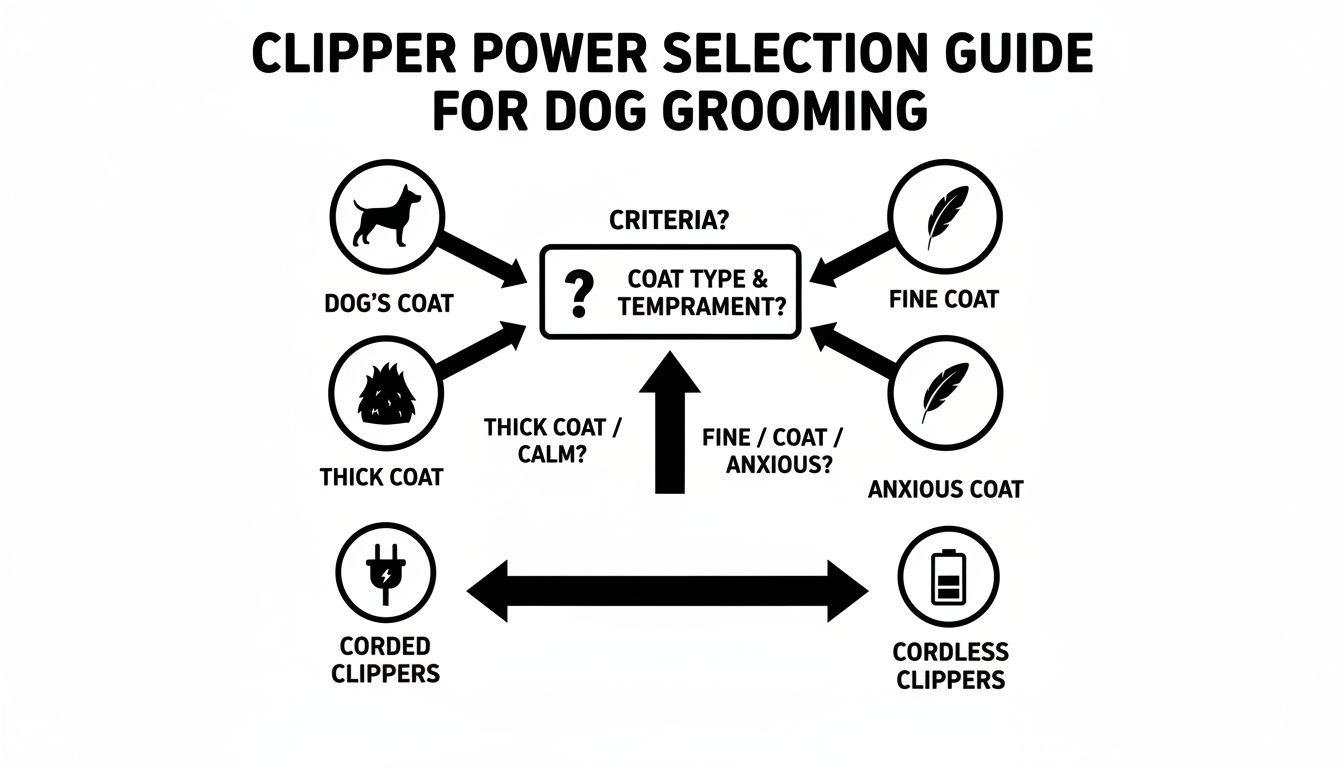
As you can see, those powerful, corded clippers are often the best bet for tough, thick coats. But for more sensitive pups or finer coats, the freedom of a cordless model can make the whole experience much smoother.
Decoding Different Dog Coat Types
Before you can choose the right tools, you have to know what you’re working with. Dog coats generally fall into a few major categories, and each one comes with its own set of grooming challenges.
- Fine and Silky Coats (e.g., Yorkshire Terriers, Maltese): This hair is gorgeous but tangles if you just look at it the wrong way. You don’t need a ton of power here; a quiet, lightweight clipper with a fine-toothed blade will give you that smooth finish without stressing out a small dog.
- Thick Double Coats (e.g., Huskies, German Shepherds): This is where raw power is a must. You’ve got a dense, woolly undercoat and a tougher outer coat to get through. A high-torque rotary motor is non-negotiable if you want to glide through that fur instead of getting stuck.
- Dense Curls (e.g., Poodles, Doodles): Curly coats are famous for matting right up against the skin. For these, you need a combination of power to handle the density and the right kind of blade to get underneath any mats safely.
- Wiry Fur (e.g., Terriers): Coarse and stiff, wiry hair requires a powerful clipper that can cut it cleanly instead of just bending it out of the way.
A quick but important tip: before you even think about clipping, especially with double-coated or curly breeds, you have to brush them out thoroughly. A good double-sided pet grooming brush is perfect for pulling out that loose undercoat and working through minor tangles. This prep work makes the clipper's job ten times easier and saves your dog from painful pulling.
Understanding the Blade Numbering System
The numbers stamped on clipper blades can look like a secret code, but they actually follow one simple, backward rule: the higher the blade number, the shorter the hair it leaves behind. A lower blade number leaves the hair longer.
For example, a #10 blade is a grooming staple that leaves the hair super short, about 1/16th of an inch. On the other hand, a #4 blade leaves a much fluffier coat at about 3/8ths of an inch.
This system gives you incredible control over the final look, letting you do anything from a close "summer shave" to a longer, cuddly trim for the colder months.
Choosing Between Blade Styles
On top of the numbers, blades also come in two main styles: Finish Cut (often marked with an "F") and Skip-Tooth (ST). Knowing when to use each one is key to getting that professional look and dealing with any tough coat situations.
Finish Cut (F Blades)
Just as the name suggests, these are your go-to for a smooth, velvety finish.
- Design: The teeth are all the same length and are set close together.
- Best For: Coats that are already brushed out and free of tangles. They give a beautiful, even cut that looks polished and clean.
- When to Use: Grab a #7F or a #5F for body work after all the prep is done.
Skip-Tooth (ST Blades)
Think of these as your problem-solvers, built to tackle matted or unruly coats.
- Design: They have an alternating tooth pattern, with every other tooth being shorter. This helps feed more hair into the blade, letting you get under mats and through thick patches.
- Best For: The initial rough cut on a very dense or neglected coat.
- When to Use: A #7 ST is a popular choice for safely powering through mats before you switch to a finish blade to clean everything up.
Clipper and Blade Recommendations by Coat Type
To bring it all together, here's a quick-reference table to help you match the right motor, blade style, and blade numbers to some of the most common coat types you'll encounter.
| Coat Type and Example Breeds | Ideal Motor Type | Recommended Blade Style | Popular Blade Numbers |
|---|---|---|---|
| Fine & Silky (Yorkie, Silky Terrier, Maltese) | Rotary or Magnetic (lower speed) | Finish Cut (F) Blades | #10, #7F for body; #3F, #4F, #5F for a longer "puppy cut" |
| Thick Double Coat (Husky, Malamute, German Shepherd) | High-Torque Rotary | Skip-Tooth (ST) for initial bulk, Finish Cut (F) for final pass | #7 ST, #5 ST for tough spots; #7F, #5F for body finishing |
| Dense & Curly (Poodle, Doodle, Bichon Frise) | Powerful Rotary | Skip-Tooth (ST) for matting, Finish Cut (F) for a smooth result | #7 ST for mat removal; #4F, #5F, #7F for body work |
| Wiry & Coarse (Terriers, Schnauzers) | High-Speed Rotary or Magnetic | Finish Cut (F) Blades (after hand-stripping or combing) | #10 for sanitary areas; #7F, #5F for body trims |
| Combination Coats (Golden Retriever, Spaniels) | Versatile Rotary (variable speed) | Finish Cut (F) Blades; guard combs are useful here | #10 for paws/sanitary; #7F for body, or a #30 blade with a guard comb |
This table is a great starting point, but remember that every dog is an individual. You might need to experiment a little to find the perfect combination for your specific dog.
By taking the time to understand your dog’s unique coat and learning how different clippers and blades work together, you’re setting yourself up for success. This knowledge empowers you to work more efficiently, get fantastic results, and most importantly, keep your dog safe and happy during grooming.
Keeping Your Clippers in Top Shape
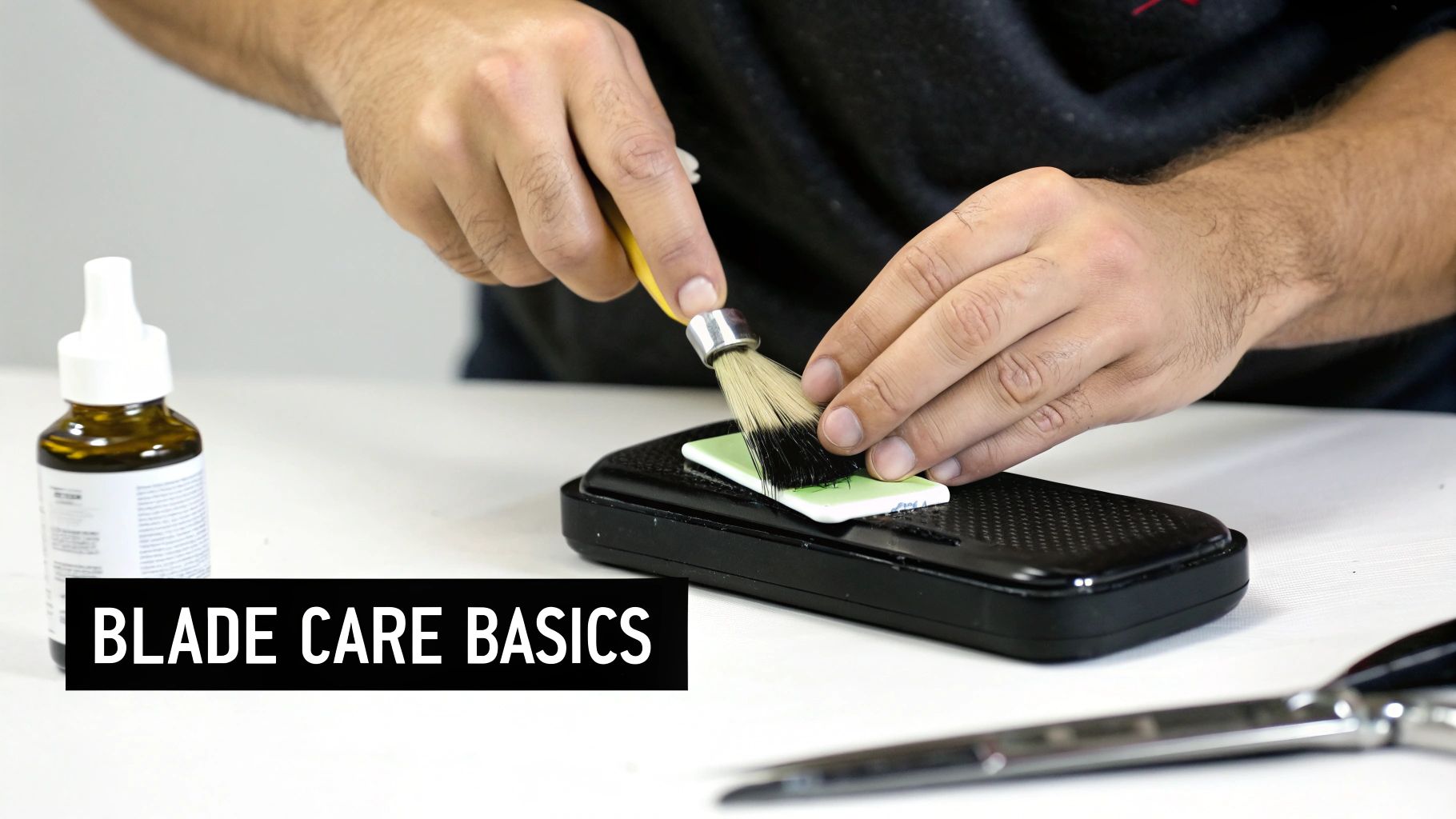
Think of your professional dog grooming clippers as an investment. Like any high-performance tool, they need consistent care to do their job right. A chef wouldn’t start service with a dull knife, and a groomer shouldn't start a clip with poorly maintained clippers. It's not just about making them last longer—it's about ensuring every groom is safe, smooth, and comfortable for the dog.
When you skip the basic upkeep, things go downhill fast. Blades get dull and start pulling hair, motors strain and overheat, and the lifespan of your expensive clippers gets cut short. The good news is, a simple routine is all you need to protect your investment and keep your tools running like new for years.
The Daily Clean and Oil Ritual
After every single grooming session, your clippers and blades need a little TLC. Hair, dander, and skin oils build up in a flash, creating friction that heats up the blade and wears down its edge. Honestly, neglecting to clean them is the quickest way to ruin a perfectly good set of blades.
Make this simple routine a habit—it'll become second nature.
- Clear the Debris: First, unplug your clippers. Grab a small, stiff brush (you probably got one in the box) and clear all the trapped hair from the blade, the drive lever, and any air vents on the clipper body.
- Use a Blade Wash: Pour a small amount of blade wash into a shallow dish. With the clippers running, dip just the teeth of the blade into the solution for a few seconds. This flushes out all the tiny gunk and disinfects the blade at the same time.
- Dry and Oil: This part is critical. Turn the clippers off and wipe the blade completely dry with a clean cloth. Then, turn them back on and apply 2-3 drops of quality clipper oil across the teeth. Add one more drop on each side where the blades slide against each other. Let the clippers run for another 10-15 seconds to spread the oil evenly.
Oiling your blades is non-negotiable. It’s like changing the oil in your car—it lubricates the moving parts, cuts down on friction, prevents rust, and pulls heat away from the metal. The result is a smooth, cool cut, every single time.
Why Blade Coolant Is Your Secret Weapon
Ever touched a blade mid-groom and felt how hot it gets? During long sessions, especially on a thick or matted coat, blades can heat up enough to cause "clipper burn," a nasty skin irritation for the dog. This is where blade coolant spray becomes a groomer's best friend.
A good coolant is a multi-tasking marvel. It instantly cools the metal, adds a bit of lubrication, and helps blast away stubborn hair particles. Keep a can within arm’s reach and give your blades a quick spritz every 10-15 minutes of continuous use. A good rule of thumb: touch the blade to the inside of your wrist. If it’s too hot for you, it’s way too hot for the dog.
You can check out our full range of grooming and cleaning supplies to find the right products for keeping your tools in prime condition.
How to Spot a Dull Blade and When It's Time to Sharpen
Even with the best care in the world, blades don't stay sharp forever. A dull blade doesn't just give a bad haircut—it snags and pulls, which is painful for the dog and leaves an ugly, choppy finish. It also makes your clipper's motor work way harder than it should, leading to burnout.
Here are the tell-tale signs that your blades need professional sharpening:
- It’s Pulling Hair: The blade catches and yanks at the fur instead of gliding through it.
- You See "Track Lines": The blade leaves visible lines in the coat that you can’t seem to blend away.
- It Stops Cutting: The blade seems to just slide right over clean fur without actually cutting it.
- It's Getting Louder: A dull blade often makes the clippers noisier and vibrate more as the motor struggles to power through.
The demand for great tools is no surprise, considering the pet care industry is booming. The global pet grooming services market was valued at an estimated US$6.89 billion in 2024 and is expected to climb to US$10.35 billion by 2030. As professional grooming prices continue to rise, many dedicated owners are finding that a quality pair of clippers pays for itself after just a few at-home grooms. You can discover more insights about the growing dog clippers market to see why keeping these valuable tools in great shape is so important.
Safe Clipper Handling for a Stress-Free Groom
Owning the best professional dog grooming clippers is a great start, but how you handle them makes all the difference. For a dog, the noise, vibration, and new sensation of clippers can be genuinely frightening, especially if they’ve never been groomed before. Your technique is what turns a scary experience into just another part of their day.
It all comes down to building trust. If you're calm and confident, the dog picks up on that and learns there's nothing to fear. Rushing or forcing a scared pup will only make them dread the next grooming session even more.
Introducing Clippers to a Nervous Dog
The very first time a dog meets a pair of clippers, you shouldn't even be cutting hair. Think of it as a casual meet-and-greet. The whole point is to get the dog used to the tool's sight, sound, and feel before you ever start a trim. And your best friend in this process? Positive reinforcement.
Start with the clippers turned off and just let the dog sniff them. When they do, give them a really good treat. Next, turn the clippers on but keep them a few feet away. Let the dog get used to the hum. As they stay calm, slowly bring the clippers closer, rewarding them with praise and more treats. The final step is to let them feel the vibration—with a blade guard on or the blade removed—by gently placing the handle against their body.
A dog’s comfort level dictates the pace. By linking the clippers with awesome things like treats and praise, you're essentially rewriting their emotional response from "scary monster" to "treat machine."
A calm environment helps tremendously. Set up a quiet grooming spot away from household chaos. For dogs that get extra anxious, having a familiar comfort item nearby, like their calming dog bed, can give them a safe space to relax before and after the groom.
Essential Handling Techniques for Safety
Once your dog is comfortable with the clippers, your focus shifts to the physical handling. Using the right technique is about more than just a good-looking cut; it's about preventing painful nicks, razor burn, and skin irritation.
Stick to these pro handling tips every single time:
- Go With the Grain: Always glide the clippers in the same direction the hair grows. Shaving against the grain cuts the hair much closer to the skin and massively increases the chance of catching and pulling.
- Keep the Blade Flat: Never, ever dig the blade's teeth into the skin. The blade should always lie flat against the dog's body, letting the guard comb do its job of lifting the hair into the cutting blade.
- Use a Scooping Motion in Tricky Spots: For areas with loose skin like armpits, hocks, and the flank (where the leg joins the body), use a gentle scooping motion to lift the clippers up and away from the skin. This prevents loose skin from getting accidentally pulled into the blade.
- Stay Focused: Grooming isn't the time to multitask. Distractions can lead to accidents. For professional groomers, interruptions are a real issue, which is why some are looking into tools like AI receptionist solutions specifically for pet groomers to handle calls and keep their focus entirely on the dog.
Another huge help is choosing clippers with low vibration and a quiet motor. These models are built specifically for sensitive pets, reducing the sensory overload that makes so many dogs anxious and turning grooming into a much more pleasant task for everyone involved.
Got Questions? We’ve Got Answers.
Even after you've done your research, some practical questions always pop up once you have a new tool in your hands. When that tool is a pair of professional dog grooming clippers, getting clear answers is key to feeling confident and keeping your dog safe.
Let's dive into some of the most common questions we hear from new and experienced groomers alike. Think of this as your go-to guide for those "what if" moments that inevitably arise mid-groom.
How Often Do I Really Need to Sharpen My Clipper Blades?
This is easily one of the most important questions we get, and the honest answer is: it depends. There’s no magic number on a calendar. It all comes down to how much you use them and, more importantly, how they’re performing.
A professional groomer working on multiple dogs a day might need to send their blades out for sharpening every 4 to 6 weeks. That constant use on all sorts of coats—from wiry to silky—takes a toll on the cutting edge.
For a pet owner who only clips their dog a few times a year, once a year might be all you need. The real secret is learning to listen to your tools. A dull blade is more than just frustrating; it’s uncomfortable and unsafe for the dog.
Your blades will tell you when they’re ready for a tune-up. If they start to snag or pull hair instead of slicing cleanly, leave track marks behind, or just struggle to get through the coat, it’s time to find a professional sharpening service.
Can I Just Use My Dog Clippers on My Cat?
We hear this one a lot, and we always urge extreme caution. While it seems like a practical shortcut, the physical differences between dog and cat skin make this a very risky proposition.
Simply put, we strongly advise against it. Cat skin is incredibly thin and much more elastic than a dog’s. This makes it dangerously easy to nick, pull, or severely cut with the power and blade action of standard dog clippers. A serious injury can happen in the blink of an eye.
While some highly experienced professionals might occasionally use specific quiet, cool-running clippers on a cat with severe matting, it's a job best left to them. For everyone else, the safest bet is to invest in clippers designed specifically for cats or to seek out a groomer who specializes in feline clients. It's just not worth the risk.
What’s the Difference Between Clippers and Trimmers, Anyway?
It’s easy to get these two mixed up, but they’re built for completely different tasks. Think of it like a painter’s toolkit: you have your wide rollers for the big walls and your tiny detail brushes for the trim.
Clippers are the rollers. They’re your heavy-duty workhorses, built with powerful motors and wide blades to remove bulk hair and set the length all over the body. They have the muscle to power through thick, matted, or curly coats efficiently.
Trimmers are the detail brushes. They are smaller, lighter, and much quieter. Their job is all about precision and finesse. The compact size and narrow blades are perfect for getting into those delicate, hard-to-reach spots where a full-size clipper would be clumsy and unsafe.
Here’s a quick cheat sheet for when to grab which tool:
-
Reach for your Clippers for:
- Full-body haircuts and shaping.
- Plowing through dense double coats or tough mats.
- Any large surface area where you need to take off a lot of hair.
-
Grab your Trimmers for:
- Cleaning up feet and getting the hair between paw pads.
- Detailing around the face, eyes, and muzzle.
- Doing sanitary trims around the belly and tail area.
A professional groomer needs both, no question. For at-home groomers, a quality pair of professional dog grooming clippers is your first priority. But adding a small trimmer to your arsenal will seriously level up the finish and safety of your grooms, giving you that polished, professional look without risking your dog’s safety in sensitive areas.
Ready to find the perfect grooming tools for your beloved pet? Explore our curated collection of high-quality clippers, trimmers, and grooming supplies at Ur Pet Store. We offer durable, safe, and effective products to make every grooming session a success. Shop now at Ur Pet Store and enjoy free shipping on all orders.