


Blog
The Ultimate Guide to Quiet Clippers for Dog Grooming

The best quiet clippers for dog grooming are more than just tools; they're a solution. Designed with low-decibel motors and minimal vibration, they are specifically built to dial down a pet's fear and anxiety during a trim. The goal is to transform a task that's often stressful into a calm, manageable experience for both you and your dog.
Transform Grooming from a Chore to a Bonding Experience
Does the sight of grooming clippers send your pup scrambling under the couch? You're not alone. That familiar scene of an anxious dog and a frustrated owner plays out in homes everywhere. The harsh, jarring buzz of traditional clippers can turn a simple haircut into a wrestling match, creating a negative cycle that gets harder to break each time.
But what if you could flip the script? Imagine if grooming could be a quiet, peaceful moment of connection instead of a major source of stress. That's exactly what quiet clippers for dog grooming make possible.
The Shift to Stress Free Grooming
Modern pet care is about more than just the basics; it’s about nurturing our animals' emotional well-being. Quiet clippers are a perfect example of this evolution. By dramatically cutting down the noise and vibration, they tackle the very things that trigger grooming-related fear. This lets you work confidently while your dog can finally relax.
A single tool can genuinely redefine your entire grooming routine, helping you build trust and patience. Instead of fighting with a nervous pet, you can focus on giving them a smooth, professional-looking trim in a calm, quiet space.
A Game-Changer for Anxious Dogs: It's no surprise that the global pet grooming market is projected to hit USD 22.7 billion by 2033. A big part of that growth is driven by owners seeking out stress-reducing tools just like these. When you consider that up to 70% of dogs show fear of loud clippers, the need for a better way becomes crystal clear.
Switching to quiet clippers provides a clear set of advantages that benefit everyone involved.
Why Quiet Clippers Make All the Difference
| Benefit | Impact on Your Dog | Impact on You |
|---|---|---|
| Reduced Anxiety | Less fear and panic, making grooming a tolerable—or even enjoyable—experience. | A much less stressful grooming session without a wriggling, unhappy pet. |
| Increased Safety | A calm dog is less likely to jerk or move suddenly, lowering the risk of nicks or cuts. | You can groom with more confidence and precision, ensuring a safer process. |
| Positive Association | Helps overwrite negative memories, teaching your dog that grooming can be a gentle activity. | Builds a stronger bond based on trust, turning a chore into quality time. |
Ultimately, a quiet groom is a better groom. It's an investment in your dog's comfort and your own peace of mind.
Building a Foundation of Trust
Using a tool that doesn't frighten your dog is about so much more than just getting the job done. It's an investment in your relationship. Each calm grooming session reinforces the idea that this is a safe, and maybe even pleasant, activity.
- Fosters a Positive Connection: Quiet sessions feel more like a gentle interaction, similar to petting or brushing, which strengthens your bond.
- Empowers You at Home: You gain the freedom to provide consistent, quality care without the hassle and expense of frequent trips to the groomer.
- Creates Lasting Calm: A positive grooming routine can help lower your dog's overall anxiety, especially when paired with other comforting items like a calming dog bed.
Thoughtful gestures are key to deepening the bond with your furry friend. If you're looking for more ways to enhance the joy of pet ownership, you might find some great ideas in this collection of gifts for animal lovers. This guide will walk you through everything you need to know to choose the best clippers and use them like a pro, turning a dreaded chore into a cherished ritual.
What Makes a Clipper Genuinely Quiet?
Ever picked up a pair of clippers and wondered why one sounds like a lawnmower while another just purrs? It's not a fluke. The difference between a peaceful grooming session and a stressful one often comes down to some fascinating engineering choices. When you understand what’s happening under the hood, you can easily spot the marketing fluff and choose a tool that will actually keep your dog calm.
Think of it this way: a clipper's motor is its engine. Just like with cars, some are built for brute force and make a racket, while others are engineered for a smooth, quiet ride.
It All Starts with the Motor
The motor is, without a doubt, the biggest factor in how loud a clipper gets. When you're shopping around, you'll generally run into three main types, each with its own personality when it comes to noise and vibration.
Rotary Motors: These are the gold standard for quiet grooming. Think of them as the electric vehicle of the clipper world—their smooth, circular motion is naturally balanced and efficient. This design cuts down on the jerky, back-and-forth action that creates that classic loud buzzing and rattling, making them the hands-down winner for noise-sensitive dogs.
Pivot Motors: Pivot motors are a solid middle-of-the-road choice. They're not as zippy as rotary motors, but they pack more of a punch than magnetic ones. Their slow, deliberate power is great for cutting through thick coats, but that power comes at the cost of more noise and vibration compared to a rotary.
Magnetic Motors: These are the old-school muscle cars. They're fast, powerful, and often pretty loud. They work using a spring and an electromagnet to snap the blades back and forth at incredible speeds. While they get the job done quickly, that aggressive, high-speed movement is what produces the intimidating buzz that sends so many dogs running.
For a grooming experience that’s actually quiet, a rotary motor is almost always your best bet. Its design is just fundamentally better at turning power into a clean cut, not wasted noise.
A quality clipper with a rotary motor can operate below 60 decibels (dB)—that’s about the same volume as a normal conversation. On the flip side, many magnetic motor clippers can easily scream past 75 dB, which is closer to the roar of a vacuum cleaner.
Why Decibels Don't Tell the Whole Story
A low dB rating is a fantastic start, but a dog's sensitive ears care just as much about the kind of sound a clipper makes. A low, consistent hum is far less scary than a high-pitched whine, even if they register at the same volume.
This is where vibration becomes a huge deal. Vibration is just noise that you can feel. If the clipper is rattling uncomfortably in your hand, imagine how that feels on your dog’s skin. It’s an unsettling sensation that can cause a lot of anxiety. Rotary motors are the champs here, too, since their smooth operation creates far less of that jarring physical vibration.
The Unsung Heroes: Blades and Materials
It’s not just about the motor. The blades themselves play a surprisingly big role in keeping things quiet. It boils down to simple physics—some materials just absorb sound and vibration better than others.
Ceramic Blades: Ceramic is a groomer's best friend for quiet clippers. It's naturally less resonant than steel, which means it dampens vibrations instead of amplifying them. The result is a much quieter cut. As a bonus, ceramic blades don't heat up as fast, keeping your dog more comfortable, especially during longer grooming jobs.
Steel Blades: Steel blades are tough and easy to sharpen, but they're also more likely to vibrate and make noise. That said, premium steel blades coated with titanium or carbon can make a real difference. The coating reduces friction, which in turn lowers both heat and noise.
The shape of the blade teeth matters, too. Blades that are designed to cut cleanly in a single pass don't force the motor to work as hard. A motor that's struggling is a motor that's getting loud. When the blades glide through the coat like a hot knife through butter, the whole machine runs more quietly and efficiently.
In the end, the quietest clippers are a complete system. You're looking for that perfect harmony: a smooth rotary motor paired with vibration-absorbing ceramic blades. That’s the combination that delivers a tool that’s not just quiet to your ears, but calm to the touch—the key to a truly stress-free groom.
How to Choose the Right Quiet Clippers for Your Dog
So, you understand the "why" behind quiet clippers. Now, let's get into the "how"—turning that knowledge into a smart purchase. Picking the right quiet clippers isn't just about grabbing the one with the lowest decibel rating off the shelf. It’s about finding a tool that fits your dog, your own comfort, and your grooming goals. The right pair should feel like an extension of your hand, turning a potentially stressful task into a calm, confident one.
The demand for better at-home grooming tools has exploded, with North America now making up a 45.3% share of the pet grooming market. It's no surprise. Innovations like quiet clippers can slash grooming time by 25-30% and seriously reduce the risk of nicks and cuts on anxious pets. Let's walk through what really matters.
Deciphering Decibel Levels for Your Dog
First things first: the noise level. This is measured in decibels (dB), and for a nervous dog, it’s the most critical factor. While a lower number is always better, it helps to have a real-world reference point.
A good rule of thumb is to aim for clippers that operate at 60 dB or lower. Think of this as the level of a normal conversation or the hum of your refrigerator. It’s a consistent, low-level sound that’s far less startling than the jarring buzz of older, traditional clippers.
If your dog is especially sound-sensitive, hunting down a model that runs below 50 dB can be a game-changer. You'll typically find this ultra-quiet performance in clippers that combine top-tier rotary motors with smooth-cutting ceramic blades.
This decision tree can help you visualize the path to the perfect clippers, breaking down the choices by motor, noise, and blade type.
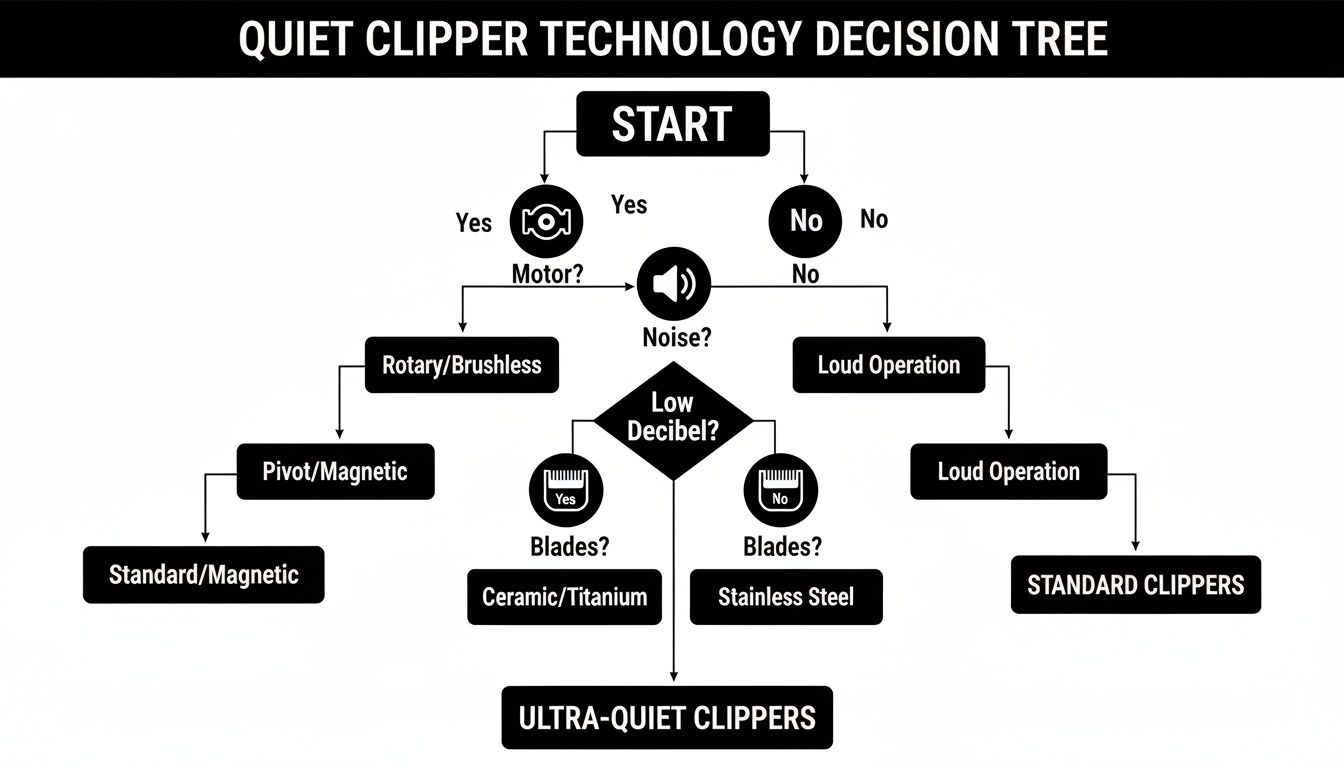
As you can see, the quietest journey almost always leads to a combination of a rotary motor, a sub-60 dB rating, and ceramic blades.
Corded Power Versus Cordless Freedom
One of the biggest forks in the road is choosing between a corded and a cordless model. There’s no single "best" answer here—it all comes down to your dog and your grooming space.
Cordless Clippers: The obvious win here is freedom. You can groom anywhere without wrestling with a cord or searching for an outlet. This is a huge plus for dogs that fidget or move around, as you can easily follow their lead. If you go cordless, look for a modern lithium-ion battery with at least 90 minutes of run time.
Corded Clippers: The main advantage is pure, uninterrupted power. You’ll never have the battery die halfway through grooming a thick-coated dog. This reliability is crucial for big jobs on big dogs. They also tend to pack a little more punch, making them a workhorse for the toughest coats.
To help you decide, here’s a quick head-to-head comparison.
Feature Comparison Corded vs Cordless Quiet Clippers
| Feature | Cordless Clippers | Corded Clippers | Best For |
|---|---|---|---|
| Mobility | Unrestricted movement, groom anywhere. | Limited by cord length. | Cordless: Anxious dogs, small spaces, outdoor grooming. |
| Power | Consistent until battery drains. | Uninterrupted, powerful performance. | Corded: Large dogs, thick/matted coats, long sessions. |
| Runtime | Limited by battery life (look for 90+ mins). | Unlimited. | Corded: Professional-style, back-to-back grooming. |
| Convenience | Grab-and-go, no outlet needed. | No need to charge, always ready to use. | Cordless: Quick touch-ups and travel. |
| Weight | Can be slightly heavier due to battery. | Generally lighter and more streamlined. | Corded: Groomers concerned with hand fatigue. |
Ultimately, the choice depends on whether you prioritize the maneuverability of cordless or the sheer staying power of a corded model.
Matching Attachments to Your Dog's Coat
Guide combs are your best friend for a safe, even haircut. These simple plastic attachments snap over the blade to set the cutting length, making it nearly impossible to trim too close to the skin.
Different coats need different tools:
- Silky Coats (e.g., Yorkie, Shih Tzu): This fine hair is prone to tangles. A longer guide comb (like a ½ inch) helps you achieve that polished, fluffy look without snagging.
- Thick Double Coats (e.g., Golden Retriever, Poodle Mixes): The dense undercoat is the challenge here. Always brush out mats with a steel comb before you clip. Then, work in layers with shorter guide combs to thin the bulk without cutting into the protective topcoat.
- Wiry Coats (e.g., Terriers): Coarse hair is tough on blades, so sharpness is key. Having a variety of comb lengths on hand lets you achieve that classic, tidy-but-textured look.
Why Ergonomics and Weight Matter
Don't forget about how the clippers feel in your hand. Grooming can take a while, and a clunky, heavy tool will wear you out fast. Hand fatigue leads to sloppy cuts and increases the chance of making a mistake.
Look for clippers that feel balanced, lightweight, and have a comfortable, non-slip grip. Good ergonomics give you better control, especially around tricky spots like paws, ears, and faces. Choosing a tool that feels right to you makes the whole process better for everyone involved.
Explore our full range of grooming and cleaning supplies to find the perfect clippers and accessories for your needs.
Mastering the Art of a Calm and Confident Grooming Session
Having a great set of quiet clippers is a fantastic start, but the tool itself is only half the battle. The other half? That’s all you. Your calm, confident energy sets the entire tone for the grooming session, and your dog will absolutely pick up on it.
Think of it less like a chore you have to get through and more like you’re teaching your dog a new, relaxing skill. When you approach it with patience, introducing the clippers slowly and pairing them with plenty of praise and treats, you build trust. Over time, your dog will see grooming as just another predictable, safe part of their routine.
Setting the Stage for Success
Before you even think about flipping that power switch, a little prep work goes a long way. A calm start almost always leads to a calm finish. Rushing an unprepared dog into a trim is a surefire way to create stress for both of you.
Pick a Familiar Spot: Groom your dog in a room where they already feel safe and relaxed, like the living room or even a quiet bedroom. Unfamiliar spots like a cold laundry room can put them on edge before you even begin.
Burn Off Extra Energy: A tired dog is a much calmer dog. Take them for a good, long walk or have a fun game of fetch about an hour beforehand. This helps them settle down and reduces the wiggles.
Get Your Tools Ready: Lay out everything you need—clippers, guide combs, treats, and a brush—before you bring your dog into the space. Fumbling around for an attachment mid-clip just creates unnecessary delays and breaks the calm vibe.
Getting this prep work done makes the whole process smoother. It shows your dog that this is a planned, predictable activity, not something chaotic. And don't forget to give them a thorough brushing first! Using a good tool like our double-sided pet grooming brush helps get rid of any mats or tangles that could cause the clippers to pull on their fur. Ouch.
A Step-by-Step Introduction to Clippers
You can't just dive right in. The key is to introduce the clippers gradually over several short, happy sessions. The goal is to build a positive association long before the blades ever touch their coat.
Look & Reward: Start by just placing the clippers (turned off!) on the floor. The second your dog looks at or sniffs them, praise them and offer a super tasty treat. Do this for a couple of minutes, then put the clippers away.
Touch & Reward: In your next session, hold the clippers in your hand, still off. Briefly touch the body of the clippers to your dog’s back or shoulder, then immediately reward them. Keep these interactions short and sweet.
Sound & Reward: Time to turn them on, but keep them a few feet away from your dog. Don't move toward them. Just let the clippers run for about 30 seconds while you shower your dog with praise and treats. Turn them off and end the session on that high note.
Sound, Vibration & Reward: Once your dog is okay with the sound from a distance, turn the clippers on and gently hold the non-cutting end (the handle) against their back. This introduces the new sensation of vibration. Keep the rewards coming for their calm behavior.
By breaking down the introduction into these tiny, manageable steps, you're desensitizing your dog to the sight, sound, and feel of the clippers. This method, called counter-conditioning, is hands-down the most effective way to prevent fear from ever taking hold.
This gentle, step-by-step approach is a huge part of a bigger trend in pet care—a shift toward low-stress grooming. The growing demand for quiet clippers shows how much owners want to reduce their pet’s anxiety, and it’s why these tools are becoming a must-have for grooming at home.
If you’re passionate about giving your dog the best experience and want to deepen your skills, taking an animal grooming course can provide invaluable professional insights. At the end of the day, it’s your patient guidance that truly makes the technology behind quiet clippers work.
Keep Your Clippers Quiet: A Simple Maintenance Guide
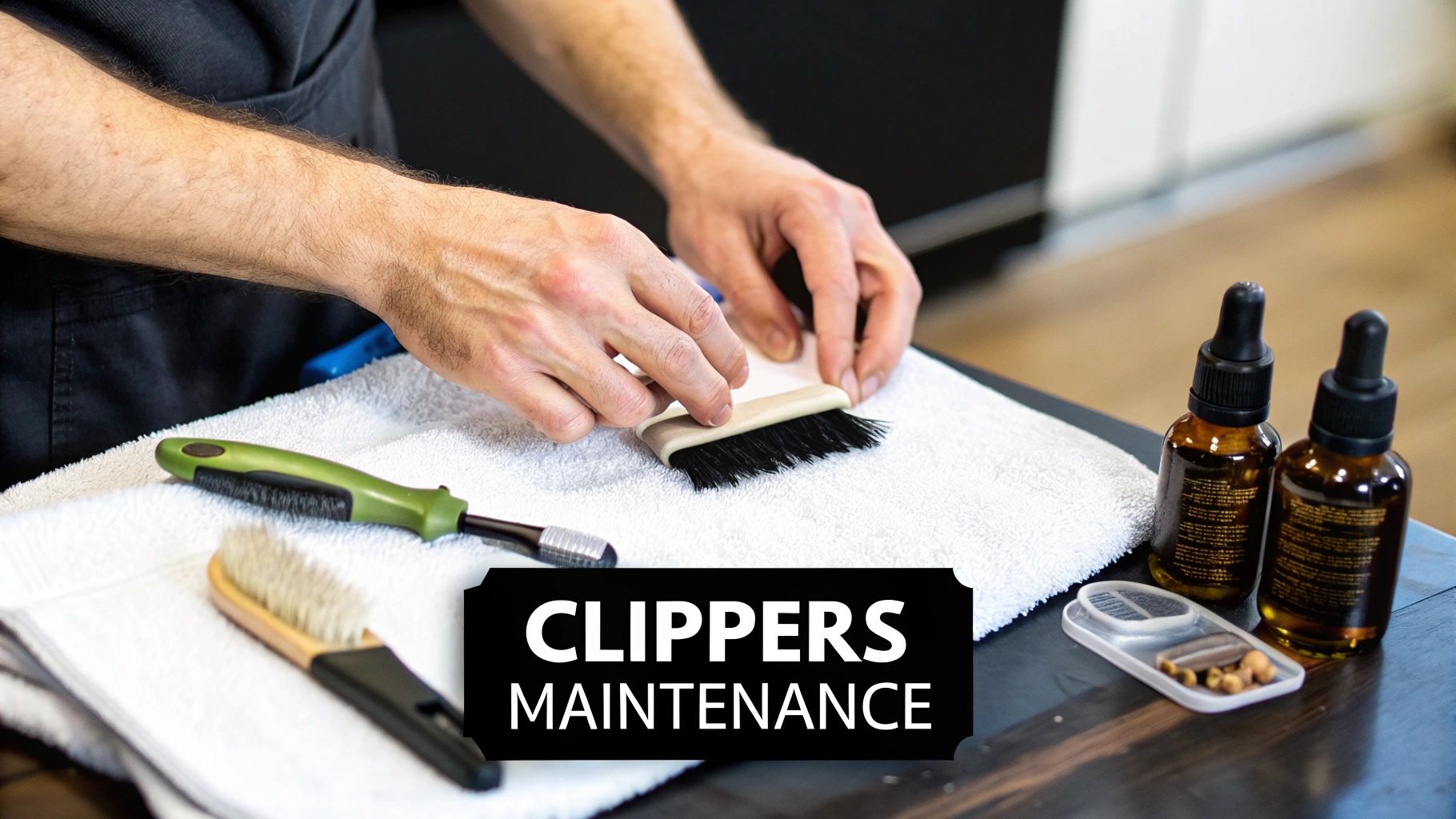
You’ve found the perfect pair of quiet clippers for dog grooming, and that first groom was a dream. But that peaceful hum isn't permanent—it's something you have to maintain. Over time, all clippers can get louder as hair, friction, and dulling blades take their toll.
Think of your clippers as a high-performance engine. It needs the right care to keep running smoothly. Ignoring basic maintenance is the fastest way to turn your silent grooming tool back into the buzzing monster you were trying to escape.
Thankfully, keeping them in top shape is surprisingly simple. A few minutes of care after each groom is all it takes to protect your investment and ensure a stress-free experience for your dog, every single time.
The Post-Grooming Checklist
So, what’s the secret to keeping that motor purring quietly? It boils down to fighting two things: hair and friction. When blades get clogged and dry, they force the motor to work overtime. That extra effort creates more heat, more vibration, and—you guessed it—more noise.
Make this three-step routine a habit after every trim.
Clean the Blades: This is priority one. Grab a small brush (an old toothbrush is perfect) and scrub away all the fur from between the blade's teeth and from inside the clipper head. For a really deep clean, a quick blast of compressed air works wonders.
Disinfect: Next, spritz the blades with a proper blade wash or disinfectant. This isn’t just for hygiene; it also cuts through any sticky residue from coat sprays or conditioners that can gum up the works and slow the blades down.
Oil, Oil, Oil: This is the most important step for quiet operation. Don't skip it! Put 2-3 drops of clipper oil along the teeth of the top blade and one drop at the back rail on each side. Flip the clippers on for a few seconds to work the oil in, then wipe off the excess with a soft cloth.
Pro Tip: Regular oiling is your number one weapon against noise. It creates a thin, protective barrier between the metal blades, letting them glide past each other instead of grinding. This simple act drastically reduces friction and can add years to the life of both your blades and the motor.
Troubleshooting A Noisy Clipper
Have your once-silent clippers started to sound a bit rattly or loud? Don't worry, it’s rarely a sign that the motor is dying. More often than not, it's a simple fix you can handle at home. Before you start shopping for a replacement, run through these common culprits.
Dull Blades: When blades lose their edge, they don't slice through fur—they snag and pull it. This puts a huge strain on the motor, making it work harder and sound louder. If a good cleaning and oiling don't help, it’s time to get the blades professionally sharpened or buy a replacement set.
Misaligned Blades: If you’ve taken the blades off for a deep clean, they might not be perfectly aligned when you put them back on. This can cause a loud, rattling sound. Make sure the top cutting blade is set just behind the bottom blade and that the screws are tight—but not so tight you strip them.
Clogged Housing: Sometimes, tiny hairs can find their way past the blade and into the motor housing. Check the vents for blockage. If you feel comfortable, follow the manufacturer's guide to open the clipper body and gently clean out any fur that has collected inside.
Making maintenance a regular habit doesn't just keep your clippers quiet. It proves the value of investing in a quality tool in the first place. A few minutes of care really does make all the difference.
Got Questions? We've Got Answers About Quiet Dog Clippers
Even after digging into the details, you probably have a few specific questions floating around. That’s perfectly normal! Here are some quick, straightforward answers to the most common queries we hear from pet parents just like you.
What Decibel Level Should I Look For?
A truly quiet dog clipper will hum along at under 60 decibels (dB). To give you a real-world comparison, that’s about the same volume as a normal conversation or a modern dishwasher running in the next room.
For most dogs, especially the ones who get jumpy with loud noises, a clipper in the 50-60 dB range is the sweet spot. If you can find one that dips below 50 dB, you've found a real gem. Always double-check the product specs for that dB rating—it's your best clue to how your dog will react.
Are Cordless Clippers Really as Strong as Corded Ones?
They absolutely can be! The gap between corded and cordless power has shrunk dramatically over the years. Many of today's best cordless clippers, particularly those with brushless or rotary motors, pack just as much punch as their corded cousins.
Sure, a heavy-duty corded model has long been the go-to for professional groomers tackling really thick, matted coats because the power never fades. But thanks to powerful lithium-ion batteries, premium cordless models can now handle almost any job you throw at them. The main difference you'll notice is the battery life, so if you're grooming a big dog (or a few of them), just make sure you get a model with a long run time.
Pro Tip: Think about your routine. For quick touch-ups on a small dog, the freedom of a cordless clipper is unbeatable. But if you’re planning a full-body clip on a large, double-coated breed, the endless power of a corded model can offer some extra peace of mind.
How Often Do I Need to Oil the Blades to Keep Them Quiet?
This is a simple but crucial step: oil your blades before every single grooming session and again right after you clean them. It only takes a few drops of clipper oil right along the teeth and on the sides.
Why is this so important? Oiling cuts down on friction. Friction is what creates noise and heat. Keeping those blades lubricated ensures they glide smoothly instead of snagging, which not only keeps things quiet but also extends the life of your motor and blades.
Can I Just Use My Own Hair Clippers on My Dog?
Please don't. While they look similar, human clippers and dog clippers are built for very different jobs. Dog clippers are engineered from the ground up to be quieter and vibrate less, specifically to avoid spooking a nervous pet.
More importantly, the blades are designed to handle coarse, dense dog fur. Human clippers will struggle, pulling and snagging on your dog's coat. This can lead to a choppy, uneven cut, skin irritation, and a very unhappy dog who will remember the bad experience next time.
Ready to make grooming a calm, positive experience for you and your best friend? Check out the full collection of premium grooming supplies at Ur Pet Store. We have everything you need to keep your pet looking and feeling their best.
Find the perfect tools for your furry friend at https://urpetstore.com