

Blog
Your Ultimate Guide to the Front Clip Dog Harness No Pull Solution

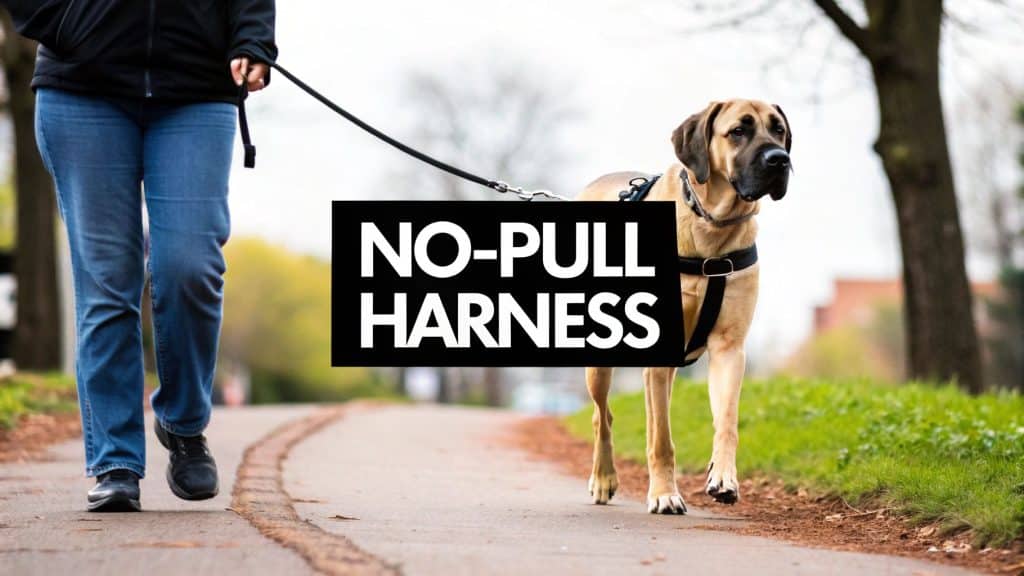
Let's be honest, we've all been there. That jarring, arm-yanking pull from an overeager dog can turn a pleasant walk into a frustrating battle of wills. The front clip dog harness no pull solution is a total game-changer, designed to gently redirect your dog's forward momentum. It makes pulling a completely ineffective way for them to get ahead, transforming your daily struggle into a relaxing stroll.
Tired of a Dog That Pulls You Down the Street?
If your daily walks feel more like a tug-of-war championship, you’re definitely not alone. It's not just a strain on your patience (and your shoulder!). That constant yanking puts a ton of pressure on your dog's throat, especially if you're using a traditional collar. This can easily lead to choking, gagging, or even long-term damage to their neck.
What many owners don't realize is that standard collars or back-clip harnesses can actually make the pulling worse. When a dog feels pressure on its back or neck, it instinctively pulls against it. This is called the opposition reflex—it’s the very same instinct that makes sled dogs lean in and pull a heavy load. Your gear might actually be teaching your dog to pull harder!
Shifting from Frustration to Control
This is exactly where the front clip dog harness no pull design comes in. Instead of fighting against your dog's natural instincts, it works with them to teach a better way to walk. The idea behind it is beautifully simple: if you control the chest, you control the direction of movement.
Think of it like this: when your dog tries to lunge forward, the leash attached to the front D-ring gently turns their body back toward you. There’s no pain or choking involved. It simply makes pulling a pointless and unrewarding strategy for moving forward.
This subtle redirection is a powerful communication tool. Your dog quickly learns that walking on a loose leash is the only way to explore ahead. It’s a humane and incredibly effective way to build a walking partnership instead of getting into a power struggle.
A Growing Movement Toward Better Walks
More and more dog owners are looking for smarter, kinder walking tools. This demand for safer and more effective gear is driving huge growth in the market. The global front-clip dog harness market was valued at an incredible $1.62 billion and is expected to nearly double to $3.21 billion by 2033. You can read the full research on these market trends to see just how popular this humane approach is becoming.
Here at Ur Pet Store, we've seen this shift firsthand. That's why we’ve put together a selection of top-quality, durable front-clip harnesses that are not just effective but also genuinely comfortable for your dog. And with our fast 4-5 day delivery, you can start enjoying better walks right away. Speaking of comfort, if you're looking to upgrade your pet's lounging situation at home, you might also find our guide on choosing a cat hammock for large cats helpful.
How a Front Clip Harness Works Its Magic
To get why a front clip dog harness is so effective, think about steering a runaway shopping cart. If you try to stop it by pushing from behind, you have almost no control. But what happens if you grab the front corner and pull? You can steer it anywhere you want with very little effort.
That’s the exact principle a front-clip harness uses. It moves the leash connection from your dog’s back to the center of their chest. This small shift in physics completely changes the walking game when your dog decides to pull.
Redirecting Your Dog’s Power, Gently
With a standard back-clip harness, a pulling dog can throw their entire body weight into it, just like a little sled dog. All their power is in their chest and shoulders, driving them forward. The pressure on their back actually triggers an instinct called the opposition reflex, which tells them to pull even harder. The harness basically becomes a handle that helps them drag you down the street.
A front-clip harness flips that dynamic on its head. When your dog pulls, the leash attached to the D-ring on their chest gently guides them into a turn. Instead of surging ahead, their own forward momentum pivots them back toward you.
It's not a harsh jerk or a painful correction. It’s just a subtle, automatic redirection. The message is simple and one they learn fast: pulling doesn't get me where I want to go. In fact, it turns me away from that interesting smell or that other dog I wanted to see.
The real genius here is that the harness makes pulling an ineffective strategy for the dog. By taking away the reward of moving forward, it encourages your dog to correct their own behavior without you having to do a thing.
This is a game-changer for building a positive training relationship. Your dog starts to learn that a loose, relaxed leash is the secret to getting where they want to go, which makes walks far less stressful for everyone.
It’s About Steering, Not Stopping
A common myth is that these harnesses work by physically restricting the dog's movement. That’s not it at all. A properly fitted no-pull front clip harness allows your dog to walk, run, and move their shoulders and legs completely naturally. The magic is all in the steering.
Here's a quick look at the mechanics:
- The Pivot Point: The D-ring on the chest acts like a pivot. When there's tension on the leash, it causes the dog's body to turn around that central point.
- Easy Leverage: You gain control without having to muscle your dog. A tiny bit of tension on the leash is all it takes to change their direction.
- Interrupting the Drive: By turning your dog's front end, you interrupt the powerful forward drive that comes from their back legs.
This humane approach is why so many professional trainers and veterinarians recommend them. As certified professional dog trainer Staci Lemke often explains to her clients, these harnesses simply take away the dog's leverage, making it much easier to teach good leash manners. The harness isn't just a piece of gear—it becomes an active part of the training process.
Ultimately, this design creates a calmer, more cooperative walking partner. It encourages your dog to check in with you and pay attention to the leash, building a stronger bond and making your daily walks something you can both look forward to.
Comparing Your Dog Walking Tools
Walking into a pet store and seeing the wall of collars, leads, and harnesses can be overwhelming. To cut through the noise, let's focus on how each tool actually works and what it's designed to do. We’ll break down the three most popular options: the front-clip no-pull harness, the classic back-clip harness, and the head collar.
Every dog is different. What works for a tiny, polite Chihuahua is definitely not the right choice for a freight-train-pulling Labrador. My goal here isn't to name one "best" tool, but to give you the real-world pros and cons of each one. That way, you can pick the right gear for your dog's personality and your walking goals.
Front-Clip Harness: The Balanced Trainer
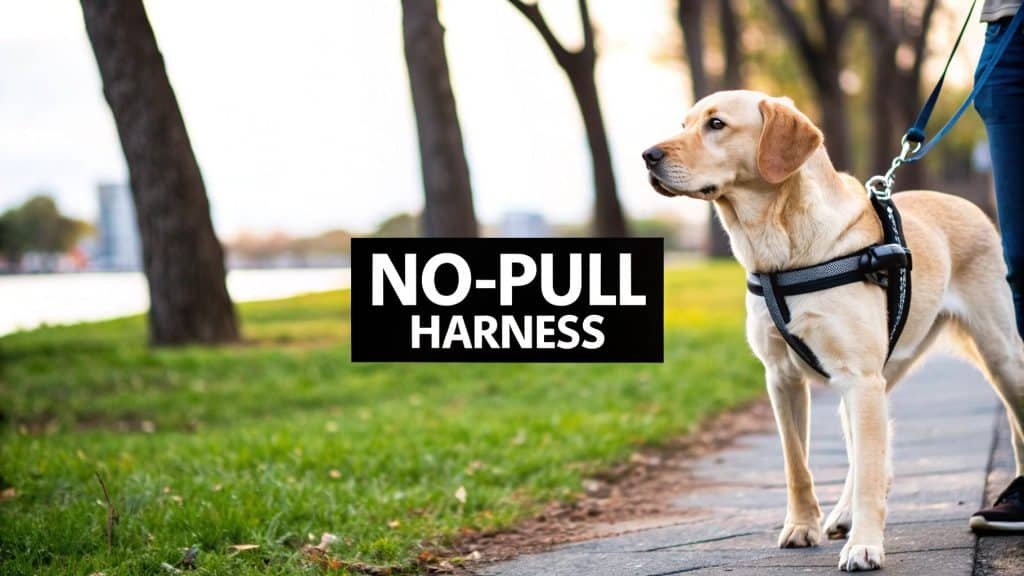
The front-clip harness was specifically invented to solve one problem: pulling. The magic is in the leash attachment point, which sits right in the center of your dog’s chest. When your dog tries to lunge forward, the leash gently pivots them back toward you.
Pulling gets them nowhere. It’s a simple, humane way to teach them that a loose leash is the only way to move forward.
- Best For: Dogs of all sizes that are moderate to heavy pullers. It's fantastic for teaching polite loose-leash walking from the ground up.
- Comfort Level: High. A well-fitted harness doesn't chafe, restrict movement, or put any pressure on their sensitive throat area.
- Control: Gives you excellent steering without pain or force, which is why it's a favorite tool for positive reinforcement trainers.
Back-Clip Harness: The Casual Stroller
This is probably the harness you see most often at the dog park. The leash clips to a D-ring on the dog’s back, right between the shoulder blades. While they are comfortable, these harnesses can actually make pulling worse for a dog that already has the habit.
Think about sled dogs. A back-clip harness can trigger a dog’s natural “opposition reflex.” When they feel that pressure on their back, their instinct is to lean in and pull against it.
This makes it a great choice for dogs who already walk nicely on a leash, but it's not the tool for the job if you're trying to stop a puller. On the plus side, the leash stays clear of their legs, making it great for a relaxed stroll.
- Best For: Small dogs or any dog that's already a pro at loose-leash walking.
- Comfort Level: Very high. There’s no risk of the leash getting tangled in their feet, and it keeps all pressure off the neck.
- Control: Low. For a dog that pulls, this design gives them all the leverage. You have very little steering power.
Head Collar: The Power Steering Option
A head collar (often called a "gentle leader") works a lot like a horse’s halter. One strap goes over the dog's muzzle, and another fastens behind the ears. The leash attaches to a ring under the chin. The principle is simple: where the head goes, the body has to follow.
While incredibly effective for strong pullers, head collars need a patient introduction. Most dogs find the sensation on their face a bit weird at first. It’s a powerful piece of equipment that requires a light touch—never a harsh yank.
- Best For: Very large, powerful dogs where an owner needs maximum control for safety.
- Comfort Level: Varies. Some dogs get used to it quickly, while others really dislike it. An improper fit can cause chafing or even injury.
- Control: Very high. It allows you to redirect your dog’s attention with very little physical effort.
To make it even clearer, let's put these tools side-by-side.
Comparison of Dog Walking Aids
Here's a quick look at how the front-clip harness, back-clip harness, and head collar stack up against each other. This should help you pinpoint exactly which tool is the best match for you and your dog.
| Feature | Front Clip Harness | Back Clip Harness | Head Collar |
|---|---|---|---|
| Pull Control | Excellent | Poor | Excellent |
| Dog Comfort | High | Very High | Moderate |
| Ease of Use | Moderate (some training needed) | Very Easy | Requires Acclimation |
| Best Use Case | Teaching loose-leash walking | Calm walkers, small dogs | Managing very strong pullers |
For most owners trying to get their dog's pulling under control, the front-clip no-pull harness simply hits the sweet spot. It provides fantastic, humane control and serves as a great training aid, all while keeping your dog comfortable.
When you're ready, you can explore a curated selection of high-quality harnesses and leashes to find the perfect one to start your journey toward more peaceful walks.
Getting the Perfect Fit for Your No Pull Harness
Imagine giving a painter the best brush in the world, but the handle is way too big for their hand. All that potential is lost. A front clip dog harness no pull is exactly the same—if the fit isn't right, it’s not just uncomfortable for your dog, it's unsafe and won't do a thing to stop the pulling. A sloppy fit can lead to chafing, restricted movement, or worse, a Houdini-like escape.
Nailing that perfect, secure fit is the real secret to making these harnesses work their magic. This isn't a "close enough is good enough" situation. It's about taking a few minutes to measure and adjust so the harness works with your dog's body, not against it. Let's walk through how to get it done.
Measuring Your Dog Accurately
Before you even think about clicking "add to cart," you'll need two simple measurements. Guessing is just a fast track to making a return. Grab a soft measuring tape (the kind used for sewing works great) and let's get started.
- Chest Girth: This is the single most important measurement. Wrap the tape around the widest part of your dog’s rib cage, which is usually an inch or two behind their front legs. You want it to be snug, but not tight.
- Neck Measurement: While there's usually a lot of room for adjustment here, getting a baseline number is always a good idea. Measure around the base of their neck, right where a collar would naturally sit.
Jot these numbers down. Every brand has its own sizing chart, so you'll use these specific measurements to find the right size harness for your pup.
The image below shows where front-clip harnesses fit in with other common walking tools. Each has a very different job.
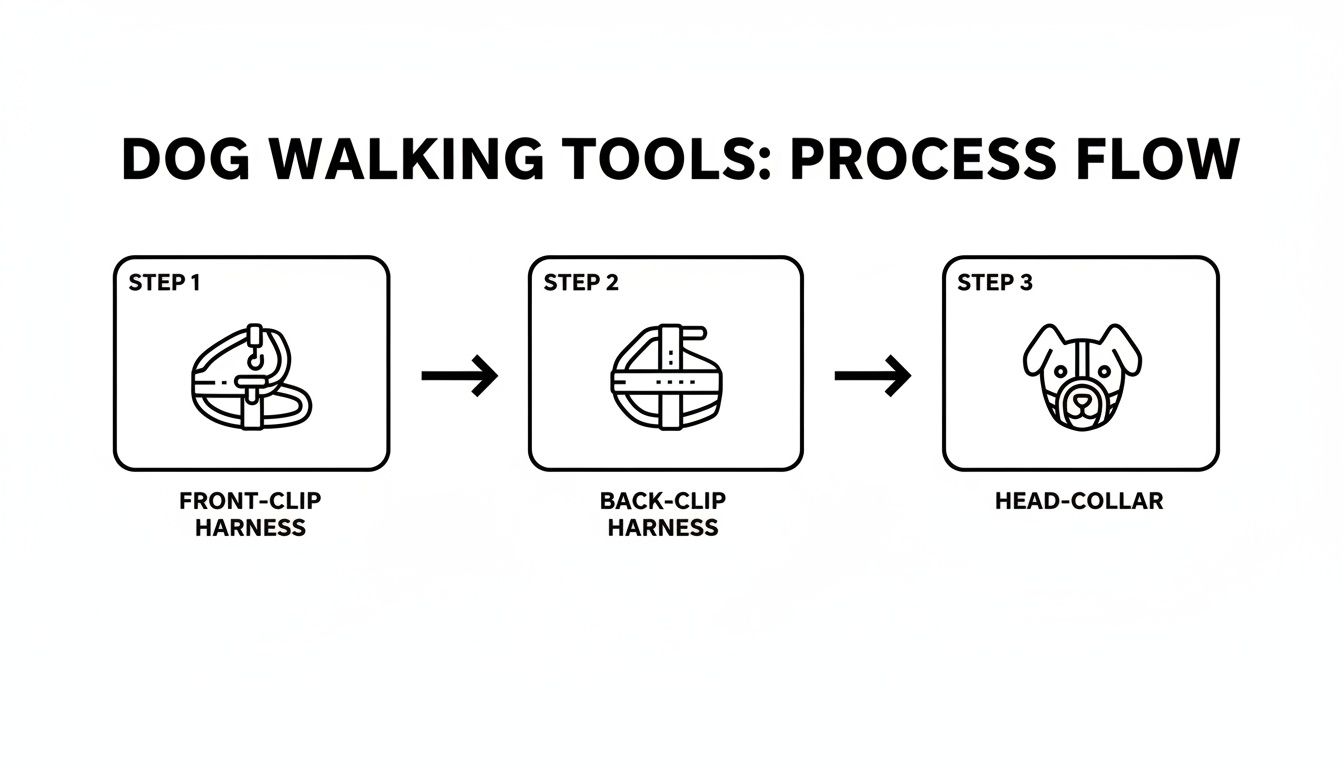
As you can see, while they all connect you to your dog, the front-clip design is specifically engineered to redirect and train, which is a completely different approach than a back-clip harness or a head collar.
Adjusting for a Snug and Safe Fit
When your new harness arrives, it’s time to dial in the fit. A harness straight out of the package will almost never be a perfect fit. You've got to customize it to your dog’s unique shape.
First, loosen all the straps to make it easy to slip on. Once your dog is wearing it, you can start tightening each strap—the neck, chest, and the one around their body—one at a time. This is where the classic "two-finger rule" is your best friend.
The Two-Finger Rule: You should be able to slide two fingers flat between any part of the harness and your dog's body. If you can fit a whole fist in there, it's way too loose. If you can't even get one finger in, it's dangerously tight.
This simple check makes sure the harness is snug enough to stay put but loose enough to avoid restricting their breathing or causing painful rubbing.
Common Fitting Mistakes to Avoid
Even with the best intentions, it's easy to make a few common mistakes that can make the harness totally ineffective. Keep an eye out for these classic slip-ups:
- The Chest Piece Sags Too Low: The front strap should sit high on your dog’s breastbone. If it’s hanging down low near their legs, it's going to mess with their shoulder movement. Getting this right is crucial for any front clip dog harness no pull.
- The Straps Rub Their "Armpits": The strap that goes around their belly should be a few inches behind their front legs, not right up in the sensitive armpit area. This is a major cause of chafing and skin irritation.
- The Whole Harness Twists or Shifts: If you find the harness is constantly sliding to one side as you walk, that's a dead giveaway that it's too loose somewhere. Go back and re-check all the straps with the two-finger rule.
Take your time with these adjustments. A few minutes spent getting the fit just right today will pay off with hundreds of safer, more enjoyable, and pull-free walks down the road.
Training Tips for Your First Walk
A perfectly fitted harness is a great start, but the real magic happens when you pair it with positive, consistent training. This tool isn't a quick fix; it's a way to communicate better with your dog, making it easier to teach good leash manners. Think of it as giving your dog a clearer way to understand what you're asking on a walk.
The first step is making your dog absolutely love their new gear. Before you even head out the door, you need to convince them the front clip dog harness no pull is the best thing ever.
- Step 1: Let your dog sniff the harness. The second they do, offer a high-value treat and some enthusiastic praise.
- Step 2: Gently touch the harness to their back or chest, then reward them again. Keep these sessions short, sweet, and fun.
- Step 3: Once they're comfortable, slip the harness on for just a few seconds, give them a treat, and take it right off. Gradually increase the time they wear it around the house, always connecting it with treats, playtime, or cuddles.
Setting Up for Success on the First Walk
Once your dog is happy to wear the harness indoors, you're ready for the real deal. The key to your first few walks is keeping them short and positive. Your job is to reward the behavior you want to see, not just correct the pulling.
Your goal is to teach your dog that a loose leash is a fantastic thing. The sweet spot is when the leash has a gentle "J" curve between you and your dog. When you see that slack, calmly praise them and offer a small treat right by your leg. This reinforces that sticking close to you is where the good stuff happens.
Gentle Redirection When Pulling Happens
The moment that leash goes tight, the training truly begins. This is when your dog will feel the gentle redirection from the front-clip design, and your job is to back up what the harness is doing.
As soon as you feel tension, just stop walking. Stand still and quiet, like a tree. Don’t yank or pull back on the leash; let the harness do the work of turning your dog slightly toward you. The instant the leash goes slack—even for a second—say "Yes!" and start walking again.
This simple action teaches a powerful lesson: "Pulling makes the fun walk stop, but a loose leash keeps it going."
Another great technique is to turn the other way. If your dog hits the end of the leash, stop, wait for them to look back at you, then cheerfully call their name as you turn and walk a few steps in the opposite direction. This move keeps them focused on you instead of just what's ahead.
With these skills, you can start dreaming of bigger adventures. Many beautiful destinations, like these Smoky Mountain pet-friendly cabin rentals, are perfect for enjoying the outdoors with a dog who walks politely by your side.
It's no surprise these tools are becoming so popular. Front-clip models now hold 25% of the global market share, right behind back-clip harnesses. That popularity makes sense when you consider that surveys show around 40% of dogs are strong pullers.
By pairing the smart design of a front clip dog harness no pull with these positive training methods, you're not just stopping a bad habit. You're building a walking partnership based on clear communication and respect.
Your Top No-Pull Harness Questions, Answered
Even after reading a guide, it's totally normal to have a few questions when you're trying out new gear for your dog. A front clip dog harness no pull is a game-changer for a lot of owners, but a few common wrinkles can pop up at the start. I've put together some straight answers to help you feel confident and sort out any little issues.
Let's get right into the questions I hear most often from dog owners. This is the practical advice you need to make every walk a good one.
Can My Dog Wear This Harness All Day?
I get this question a lot. While these harnesses are built to be comfy on walks, you shouldn't leave one on your dog 24/7. Think of it like your running shoes—you wear them for your workout, but you kick them off the second you're back home.
Leaving a harness on all the time can cause chafing and skin irritation, especially for dogs with sensitive skin or thin coats. The straps can also trap dirt and moisture, which isn't great for their skin. Plus, taking it off helps build a positive routine. When the harness comes out, your dog knows an adventure is about to happen!
Keeping your dog's skin and coat in top shape is always a good idea. For everything you need between walks, check out our great selection of grooming and cleaning supplies.
Key Takeaway: The harness is for walks and outdoor fun only. Taking it off indoors keeps your dog's skin healthy, the harness clean, and makes it a special signal for "it's time to go out!"
How Do I Stop the Leash from Tangling in Their Legs?
Ah, the classic leg tangle. This is hands-down the most common hiccup people run into with a front clip dog harness no pull. Since the leash clips to the chest, it's easy for it to droop and get caught in your dog’s front legs, especially when they stop for a good sniff.
The fix is surprisingly simple: keep the leash fairly short and light. A heavy clip or a long leash dragging on the ground is the main culprit. You're aiming for a loose "J" curve in the leash—enough slack so it isn't tight, but not so much that it's dangling by their feet.
If you see your dog is about to step over the leash, a quick, gentle lift is all it takes to get it out of the way. It feels a bit awkward at first, but I promise that managing the leash will become second nature in no time.
Are Front-Clip Harnesses Safe for All Dogs?
For the vast majority of dogs, front-clip harnesses are a fantastic and humane tool. That said, there are a few things to keep in mind for certain pups.
- Small Dogs: Absolutely! They're perfectly safe for the little guys. The trick is to find a harness that's lightweight and has thinner straps that won't feel bulky or overwhelming on their small frame.
- Flat-Faced (Brachycephalic) Breeds: For Pugs, French Bulldogs, Boxers, and other flat-faced breeds, a well-fitted harness is much safer than any collar. It keeps all pressure away from their sensitive airways. Just make sure the chest strap rests on their breastbone, not up near their throat.
- Dogs with Shoulder Issues: If you know your dog has a shoulder injury or mobility problem, it's always best to check with your vet first. Most harnesses are designed to allow a natural range of motion, but your vet can give you the green light and confirm it won't aggravate your dog's specific condition.
Why Ur Pet Store is the Right Choice for Your Harness
Finding the right no-pull harness is a big win, but where you buy it from matters just as much. When you’re ready to get a front clip dog harness no pull, you need to know you're getting a quality piece of gear that’s going to last. That’s where we come in.
We’ve done the hard work for you by hand-picking a collection of what we believe are the best harnesses out there. We’re serious about quality, focusing on tough materials that hold up to daily walks, strong buckles that won’t pop open when your dog lunges, and smart designs that keep your dog comfortable. You won't find any cheap, flimsy junk in our store.
More Than Just a Harness
Let's be honest, the market for pet products is huge. The dog harness market alone was worth a staggering $2.74 billion in 2023 and is expected to hit $7.05 billion by 2031. With nearly 1.2 billion pet dogs around the globe, it's no wonder owners are looking for better walking solutions. Front-clip harnesses make up about 25% of that market—they're a big deal. If you're curious, you can discover more insights about this expanding market and see for yourself why quality is so critical.
In such a crowded space, we set ourselves apart by thinking about your entire experience. We believe getting great gear shouldn't be a hassle. That’s why we offer:
- Free Shipping on Every Single Order: No gimmicks or hidden fees at checkout. What you see is what you pay.
- Fast 4-5 Day Delivery: You won’t be stuck waiting weeks to start training. We get your order out the door and to you quickly so you can get right to enjoying better walks.
Choosing Ur Pet Store means you're not just buying equipment. You're getting a partner dedicated to making life better and walks more enjoyable for you and your dog.
And because functional doesn’t have to mean ugly, our collection features modern, stylish designs. We think the tools you rely on every day should look as good as they work.
Ready to make your walks something you both look forward to? Take a look at our curated selection of top-notch no-pull harnesses at Ur Pet Store. Find the perfect one for your dog and start your journey to pull-free walks today at https://urpetstore.com. Remember, shipping is always free and fast